








Artificial intelligence has quietly moved from experiment to infrastructure inside the modern enterprise. It is writing production code, reviewing contracts, flagging fraud, summarizing board decks, and increasingly acting on our behalf. In many organizations, AI is already woven into critical workflows. Sometimes visibly. Often not.
As adoption accelerates, the question boards and regulators are asking has shifted. It is no longer theoretical: Is our AI secure, and can we prove it?
The most common response is to point to AI alignment, including responsible AI frameworks, guardrails, bias mitigation programs, and safety fine-tuning controls. All those matters.
But alignment is a model-level property. Enterprise AI security is a system-level responsibility. That distinction is where most organizations are quietly exposed.
Alignment Is Necessary, But It Is Not Security
AI alignment techniques are designed to shape how a model behaves. Reinforcement learning from human feedback, content filtering, and safety fine-tuning reduce the chances of a model producing harmful or inappropriate outputs. But alignment does not address the questions CISOs actually lose sleep over.
It does not determine who is entering sensitive data into models. It does not define what an AI agent is permitted to access or execute. It does not create an auditable trail suitable for regulatory review. It does not constrain blast radius when automation fails. And it does not provide transparency into the AI supply chain.
Alignment reduces misuse probability. Security reduces enterprise risk exposure. In 2026, those are not the same thing.
From Chatbots to Agents: When AI Gets Authority
The biggest shift over the past year is not simply how intelligent models have become. It is how much authority we have begun delegating to them.
We are no longer just deploying conversational interfaces. Enterprises are implementing AI agents that take real action, such as updating databases, modifying configurations, triggering workflows, generating and pushing code, and moving files across environments.
This represents a structural change, and the associated risk profile is fundamentally different. An aligned model may avoid generating offensive language. That same aligned model could still execute a technically valid command that inadvertently deletes a production dataset, alters a firewall rule, or escalates privileges through misconfigured tooling.
That is not an alignment failure. It is a delegated authority problem.
There is a reason the 2025 and 2026 OWASP Top 10 for LLMs identifies Excessive Agency as an emerging risk category. When AI systems inherit broad, persistent permissions, they effectively function as privileged service accounts, except their reasoning is probabilistic rather than deterministic.
This is where blast radius becomes central. If an AI agent is manipulated, misdirected, or simply wrong, how far can it reach? What systems are exposed? What controls contain the damage? Can actions be rolled back? Can intent and sequence of decisions be reconstructed?
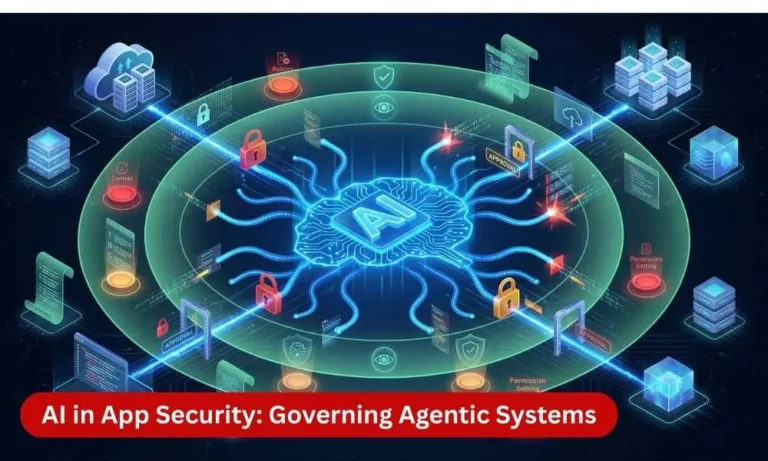
These questions are not abstract. They require architectural answers. Immutable audit logs of agent activity, separation between recommendation and execution layers, sandboxing for high-impact operations, human approval gates for destructive actions, and strict least-privilege scoping of agent permissions are no longer optional safeguards. They are containment mechanisms.
If AI can act, it must be governed like any other control operator inside the enterprise control plane.
The Visibility Problem No One Is Talking About
There is another gap that receives far less attention, and that is what happens after deployment.
Most organizations conduct appropriate diligence before go-live. Models are evaluated, red-teamed, and approved. Risk assessments are completed. But once AI becomes embedded in daily workflows, visibility often declines sharply.
The AI begins interacting with sensitive datasets. It influences operational decisions. It generates outputs that enter production systems. Yet in many environments, prompts and responses are not centrally logged. Behavioral baselines are not established. Prompt injection attempts are not consistently detected. Output validation is inconsistent or absent.
In effect, AI becomes an unmonitored endpoint inside business-critical processes.
From an architectural standpoint, AI telemetry must integrate into existing logging pipelines such as SIEM, identity governance, DLP, and incident response workflows rather than forming a separate monitoring ecosystem.
At the same time, it is important to acknowledge the friction. Most SIEM platforms were not designed to ingest large-scale prompt and response telemetry. Most DLP systems were not built to understand model boundaries, vector stores, or probabilistic outputs. Existing security infrastructure was architected for deterministic systems. AI introduces a different class of interaction.
Integration will require adaptation and, in some cases, new control layers built specifically for AI observability.
This posture is increasingly difficult to defend, not just from a risk perspective but from a regulatory one. Under the EU AI Act, high-risk AI systems operating in the European market must support logging, traceability, and meaningful human oversight by August 2, 2026. For AI systems influencing employment, financial decisions, critical infrastructure, healthcare, or other materially impactful outcomes, these requirements are concrete and enforceable.
Runtime monitoring is no longer an aspirational best practice. It is becoming a legal obligation.
The question is no longer whether to monitor AI. It is whether your monitoring posture would withstand audit scrutiny.
Identity: The Layer That Cannot Be Ignored
There is another layer that sits underneath many of these risks, and that is identity.
AI agents authenticate. They call APIs. They access repositories. They inherit roles. They execute under service accounts. In practical terms, they are machine identities operating at scale.
Who authenticates to the AI system? How are API keys managed? Are model endpoints protected with strong authentication controls? Are agent service accounts governed within identity governance platforms? Can every AI action be traced back to a responsible principal?
Attackers increasingly target token abuse, API key leakage, and weakly governed service accounts. AI endpoints introduce a new high-value attack surface. Without strong identity binding, secrets management, and governance controls, AI systems can become attractive entry points.
AI agents must be onboarded into IAM programs like any other privileged entity. Least privilege, multi-factor authentication where applicable, secrets rotation, and auditability are foundational controls.
Shadow AI and the IP Problem Executives Actually Worry About
While public discourse often centers on bias and fairness, executive leadership tends to focus on intellectual property and litigation exposure.
Across industries, employees paste proprietary source code into public LLMs, upload confidential roadmaps for summarization, and query internal data through generative tools that were never formally vetted. Meanwhile, SaaS vendors increasingly embed AI capabilities into platforms that were not originally assessed for model-level data exposure.
This is a new form of shadow IT known as shadow AI, and it is expanding rapidly.
When sensitive information enters external AI systems, retention policies may lack clarity. Terms governing model training reuse may be ambiguous. Jurisdictional control may be compromised. eDiscovery exposure may increase. Insider threat vectors may quietly expand.
Without a comprehensive inventory of AI systems and usage patterns across the enterprise, organizations cannot reliably detect sensitive data exposure, enforce classification policies, or demonstrate due diligence to regulators. Shadow AI is not a governance nuisance, it is a data exfiltration vector.
Embedded Data and the Governance Dilemma
AI introduces data lifecycle complexities that traditional systems were not designed to address.
Where organizations consume third-party APIs without training or fine-tuning, exposure profiles differ significantly from environments that fine-tune models on proprietary datasets or conduct internal model training. The risk landscape must be evaluated accordingly.
If personally identifiable information or regulated datasets are used in training or fine-tuning, that information may become embedded within model parameters. Unlike structured database records, embedded data cannot simply be deleted. Remediation may require retraining if removal is technically feasible at all.
For CISOs in financial services, healthcare, energy, and the public sector, this raises difficult but unavoidable questions.
What data was used in training or fine-tuning?
Where is it geographically stored?
Can we produce verifiable lineage documentation?
Does our deployment conflict with GDPR, HIPAA, or data residency mandates?
These questions require clear escalation pathways. Model cards, AI-specific vendor risk questionnaires, contractual restrictions on training data reuse, documented data processing agreements, and formal lineage attestations should become part of third-party AI due diligence. Legal and compliance teams need artifacts, not assurances.
Alignment does not address these concerns. Governance must extend beyond inference behavior to the full data lifecycle.
AI Supply Chain: The Emerging Attack Surface
Supply chain transparency is not theoretical. It is an active attack surface.
Model provenance matters. Foundation model updates can introduce behavioral changes. Third-party plugins and tool integrations expand execution boundaries. Fine-tuning datasets can be poisoned. Model context protocol servers can be compromised. Hidden behaviors can be introduced during model weight updates.
For leaders who have lived through SolarWinds, Log4j, or XZ Utils, the parallel is clear. The AI equivalent of a backdoored dependency may not be a library. It may be a compromised model artifact or poisoned training dataset.
AI-BOM concepts are emerging for this reason. Organizations need visibility into which model versions are deployed, what dependencies they rely on, how updates are validated, and what independent testing exists.
Trust without verification is not a strategy.
To Conclude:
AI risk is no longer theoretical. It is embedded in infrastructure, workflows, identities, and decision-making systems. Alignment remains necessary.
But defensible AI requires architectural containment, constrained authority, runtime visibility, governed identities, supply chain transparency, and audit-ready documentation.
In security, assurance is never assumed. It is monitored, measured, and enforced. AI must now meet that same standard.
Enjoyed reading this blog? Stay updated with our latest exclusive content by following us on Twitter and LinkedIn.