







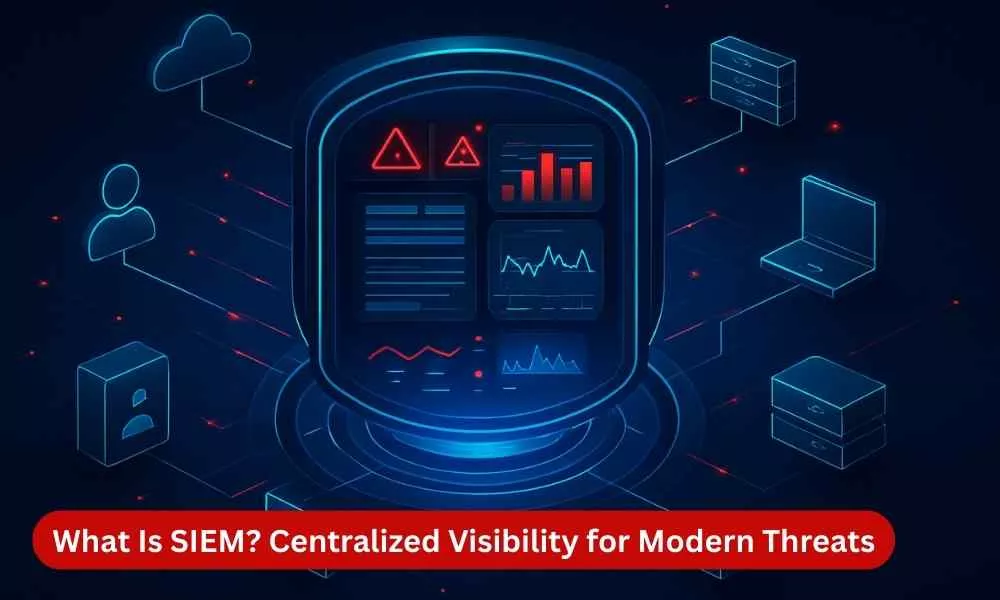
As organizations expand their digital environments across cloud platforms, remote workforces, and interconnected systems, the volume of security data continues to grow rapidly. Every login attempt, file access, firewall event, and endpoint activity generates logs. Without centralized visibility, identifying suspicious activity within this vast stream of data becomes extremely difficult.
Security Information and Event Management (SIEM) systems help organizations collect, analyze, and correlate security data from across their infrastructure and systems, providing a unified view of potential threats. Understanding SIEM is essential for organizations seeking improved detection, monitoring, and compliance capabilities.
What Is SIEM?
SIEM stands for Security Information and Event Management. It is a solution that aggregates and analyzes log data from multiple sources in real time. A SIEM platform enables organizations to:
- Collect logs from across systems and applications
- Normalize and correlate events
- Detect suspicious patterns
- Generate alerts for potential security incidents
- Maintain centralized visibility for investigations
By consolidating security data into a single platform, SIEM systems help teams identify threats that might otherwise go unnoticed.
How SIEM Works
SIEM platforms operate through several key processes:
1. Log Collection
SIEM systems collect data from various sources, including:
- Firewalls
- Intrusion Detection Systems (IDS)
- Endpoint security tools
- Servers and databases
- Cloud platforms
- Identity and access management systems
This raw data is transmitted to the SIEM platform for processing.
2. Data Normalization
Because logs come from different systems and formats, SIEM tools normalize the data into a standardized structure. This ensures consistent analysis across sources.
3. Event Correlation
Correlation rules analyze relationships between events.
For example:
- Multiple failed login attempts followed by a successful login
- A user logging in from two geographically distant locations within minutes
- Data transfers occurring outside normal business hours
By linking related events, SIEM platforms can detect patterns indicative of malicious activity.
4. Alerting and Reporting
When suspicious activity matches predefined rules or thresholds, the SIEM generates alerts.
Security teams can then:
- Investigate the alert
- Escalate the issue
- Initiate incident response procedures
SIEM systems also generate reports to support compliance requirements and audit readiness.
5. Automated Response and Extended Detection (Modern SIEM & XDR)
Modern SIEM platforms increasingly integrate automation and response capabilities, often overlapping with technologies such as Extended Detection and Response (XDR).
Unlike traditional SIEM systems that primarily detect and alert, modern solutions can:
- Automatically isolate compromised endpoints
- Disable suspicious user accounts
- Block malicious IP addresses or domains
- Trigger predefined containment workflows
- Orchestrate response actions across security tools
By combining detection, correlation, and automated response, modern SIEM and XDR platforms reduce response time and help security teams contain threats more efficiently.
Why Organizations Use SIEM
Organizations implement SIEM to address several core security challenges.
- Fragmented Visibility: Security data is often scattered across tools and environments. SIEM centralizes this information.
- Delayed Threat Detection: Manual log review is inefficient. SIEM enables real-time monitoring and faster detection.
- Compliance Requirements: Regulatory frameworks often require log retention, monitoring, and reporting. SIEM helps meet these obligations.
- Complex Threat Landscape: Modern attacks involve multiple stages. Correlating events across systems improves detection accuracy.
Key Benefits of SIEM
Organizations using SIEM platforms may gain:
- Centralized Monitoring: A unified dashboard provides visibility across the entire IT environment.
- Faster Threat Identification: Correlation rules detect suspicious activity more efficiently than manual processes.
- Improved Incident Investigation: Historical log storage supports forensic analysis and root-cause investigations.
- Regulatory Support: SIEM assists with audit trails, reporting, and compliance documentation.
Common SIEM Use Cases
SIEM platforms support a range of operational scenarios, including:
- Detecting brute-force login attempts
- Identifying insider threats
- Monitoring privileged account activity
- Tracking data exfiltration attempts
- Supporting incident investigations
- Maintaining compliance audit logs
These use cases demonstrate how centralized visibility strengthens overall security posture.
Challenges in SIEM Implementation
Although SIEM provides significant value, organizations may encounter challenges.
- High Data Volumes: Large environments generate extensive log data, requiring storage and processing capacity.
- Alert Fatigue: Improperly tuned correlation rules can generate excessive alerts.
- Configuration Complexity: Effective SIEM deployment requires careful rule creation and ongoing tuning.
- Resource Requirements: Skilled analysts are needed to interpret alerts and investigate incidents.
- False Positives: Detection rules may trigger alerts for legitimate activity. Without proper tuning and contextual analysis, false positives can overwhelm security teams and divert attention from genuine threats.
To maximize effectiveness, organizations must continuously refine detection rules and optimize monitoring strategies.
SIEM vs SOAR: Understanding the Difference
SIEM and SOAR are complementary technologies.
| SIEM | SOAR |
| Collects and analyzes log data | Automates incident response workflows |
| Detects suspicious activity | Executes predefined response actions |
| Generates alerts | Reduces manual response effort |
SIEM focuses on detection and visibility, while SOAR focuses on response automation.
When Should Organizations Consider SIEM?
SIEM is particularly beneficial for organizations that:
- Operate complex IT environments
- Require centralized security monitoring
- Must meet regulatory compliance requirements
- Need detailed log retention and reporting
- Operate a Security Operations Center (SOC)
It supports organizations seeking improved threat detection and operational visibility.
The Role of SIEM in Modern Cybersecurity
As digital infrastructure expands, security teams require continuous monitoring and correlation across diverse systems.
SIEM provides:
- Centralized log aggregation
- Real-time analysis
- Structured alerting
- Historical data for investigation
By consolidating security data into a unified platform, SIEM enhances visibility and strengthens detection capabilities against evolving threats.
Conclusion
Security Information and Event Management (SIEM) systems provide centralized visibility into security events across an organization’s infrastructure. By collecting, correlating, and analyzing log data, SIEM platforms help detect suspicious activity, support incident investigations, and meet compliance requirements.
Understanding how SIEM works enables organizations to evaluate whether centralized monitoring can improve their overall cybersecurity strategy.
| Learn more about our SIEM services. Contact our experts today! |
Enjoyed reading this blog? Stay updated with our latest exclusive content by following us on Twitter and LinkedIn.