







Imagine an employee preparing a presentation for a major client. They copy a few lines of confidential pricing data into an AI chatbot to summarize it. There is no malicious intent, no suspicious login, and no file being uploaded. Yet sensitive information has just left the organization’s control.
Now consider the same thing happening through a misdirected email, a USB drive, a personal cloud account, or a departing employee downloading customer records.
These are the moments Data Loss Prevention (DLP) is designed to catch.
What is Data Loss Prevenetion?
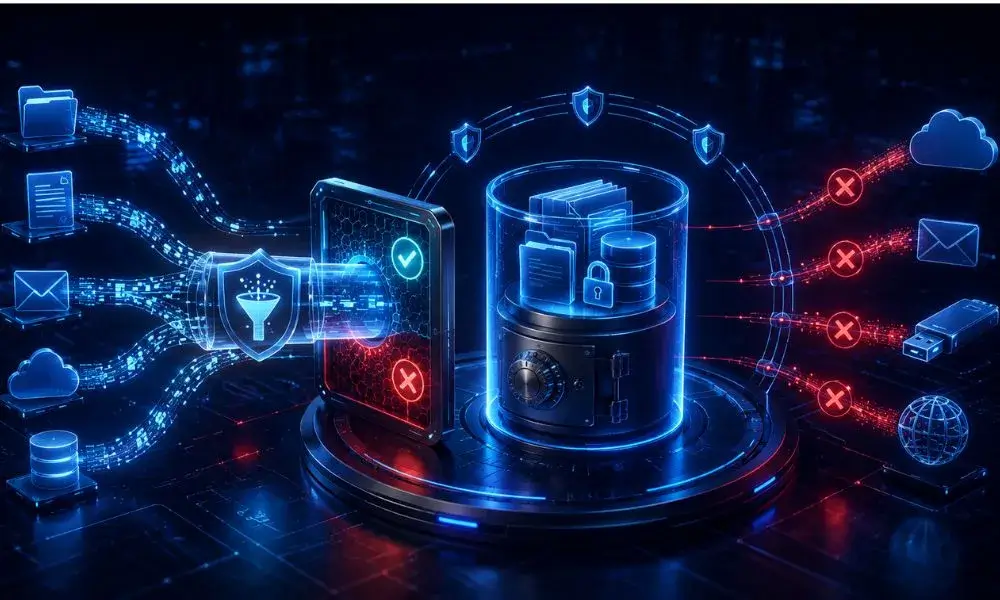
Data loss prevention (DLP) is a set of tools and policies that identify sensitive data, monitor how it moves across endpoints, networks, and cloud services, and block or flag transfers that violate policy before that data leaves the organization’s control.
DLP works by first classifying what counts as sensitive: customer records, source code, financial data, health information, trade secrets, and then watching for that data wherever it travels. That includes data at rest in file shares and databases, data in motion across email and network traffic, and data in use on an employee’s screen as they copy, paste, upload, or print it. When a DLP system detects a policy violation, typically a match against a data pattern, fingerprint, or classification label, it can log the event, warn the user, encrypt the file, or block the transfer outright depending on how the policy is configured.
The discipline exists because most data loss is not the result of a sophisticated attack. It is an employee emailing a spreadsheet to the wrong recipient, a departing staff member downloading a client list, a misconfigured cloud bucket, or, increasingly, someone pasting proprietary code into a public AI chatbot. DLP is the control layer built specifically to catch these moments before data leaves.
Why Does DLP Matter Now?
DLP has moved from a compliance checkbox to a board-level priority because the cost of data loss keeps climbing and the ways data can leave an organization have multiplied faster than most security stacks were designed to track.
The scale of the problem is well documented. Verizon’s 2026 Data Breach Investigations Report, based on more than 22,000 confirmed breaches, found that unapproved employee use of AI tools, commonly called shadow AI, tripled year over year to 45% of employees, creating a data exposure pathway most existing security stacks were not built to see. The same report found third-party and supply chain involvement in breaches jumped 60%, now present in 48% of all breaches, meaning sensitive data is leaving through vendor connections as often as through an organization’s own systems.
Insider-driven data loss carries its own weight. Ponemon Institute research on insider risk has consistently found that a majority of incidents, roughly 55%, come from negligent employees rather than malicious ones, which matters directly for DLP strategy: a program built only to catch deliberate theft will miss most of the actual loss events an organization experience.
What Are the Main Types of DLP?
DLP is deployed across four layers, network, endpoint, cloud, and email, each covering a different path data can take out of the organization, and most mature programs run more than one layer simultaneously.
For large language models specifically, these techniques often appear as jailbreaking, where carefully crafted prompts bypass safety training, or RAG poisoning, where the external documents a model retrieves and summarizes are manipulated to influence its output.
| DLP layer | What it monitors | Best at catching | Common blind spot |
| Network DLP | Traffic crossing the corporate network perimeter | Bulk exfiltration over unencrypted channels | Encrypted traffic, remote and off-network devices |
| Endpoint DLP | Activity directly on laptops and workstations | Copy-paste, USB transfers, screenshots, printing | Requires an agent on every device; gaps on unmanaged or BYOD devices |
| Cloud DLP (CASB-integrated) | File sharing and data movement within SaaS and cloud storage | Oversharing, public links, misconfigured permissions | Shadow SaaS and unsanctioned apps outside the monitored tenant |
| Email DLP | Outbound and inbound email content and attachments | Misdirected email, unencrypted sensitive attachments | Data pasted into web-based tools instead of sent as a file |
No single layer covers every path data can take, which is why most effective programs treat DLP as a coordinated policy applied consistently across layers rather than a single product deployed once.
How Does DLP Detect Sensitive Data?
DLP tools identify sensitive data through a combination of pattern matching, document fingerprinting, and increasingly, machine learning classification, each suited to a different type of data.
Pattern matching uses regular expressions and known formats to catch structured data such as credit card numbers, national ID numbers, or API keys, and it is fast but prone to false positives on data that merely resembles the pattern. Exact data matching and document fingerprinting compare content against a hashed index of actual sensitive files or database records, giving high accuracy for known documents but requiring the source data to be indexed in advance. Machine learning classification looks at context and content structure to identify sensitive material it has not seen before, such as an unstructured contract or a draft strategy document, at the cost of requiring tuning to avoid flagging legitimate business content. Mature DLP deployments layer all three, using fast pattern matching for high-volume structured data and reserving ML-based classification for the unstructured content that older DLP generations routinely missed.
Why Is Generative AI Creating New DLP Blind Spots?
Employees pasting proprietary or regulated data directly into AI chat interfaces bypasses traditional file-based DLP entirely, since no file is created, uploaded, or emailed, only text typed into a browser window.
This is the fastest-growing gap in DLP coverage. Traditional DLP was built to inspect files: attachments, uploads, and transfers with a defined beginning and end. A prompt typed into a public AI model is neither a file nor a network transfer in the conventional sense, and by the time the text is submitted, the data has already left the organization’s control. Closing this gap requires DLP policies and browser-level controls specifically extended to recognize AI interaction points, inspecting content before submission rather than after the fact, and applying the same data classification rules to a chat prompt that would apply to an email attachment or a shared file.
What Regulations Make DLP a Compliance Requirement?
GDPR, HIPAA, PCI DSS, and India’s DPDP Act do not name DLP explicitly in most cases, but each requires the kind of data protection and breach prevention that is difficult to demonstrate without it.
GDPR requires organizations to implement appropriate technical measures to protect personal data and to report breaches within 72 hours, both of which depend on knowing where sensitive data lives and being able to detect when it leaves. HIPAA’s Security Rule requires safeguards against unauthorized disclosure of protected health information and PCI DSS explicitly requires monitoring and restricting the movement of cardholder data.
In India, the DPDP Act places direct accountability on organizations for how personal data is processed and shared, including by third parties, making data movement visibility a practical necessity rather than an optional control. None of these frameworks mandate a specific DLP product, but auditors and regulators increasingly expect organizations to show, not just claim, that sensitive data is monitored and controlled in transit.
How Should Organizations Implement DLP Without Disrupting the Business?
Successful DLP rollouts start with data classification and a monitor-only phase before any blocking rule goes live, since a program that blocks legitimate business activity on day one quickly gets disabled by frustrated business units.
Start by classifying what needs protection rather than attempting to monitor everything at once; a small set of well-defined categories, customer PII, source code, financial records, is far more effective than an unfocused policy that generates constant noise. Run new policies in monitor-only or alert mode first, using that period to tune out false positives before enabling automatic blocking, since a DLP program that repeatedly interrupts legitimate work trains employees to route around it. Feed DLP alerts into your SIEM platform so data-loss events are correlated with other security telemetry rather than reviewed in isolation and used SOAR playbooks to automate the response steps for high-confidence violations.
Extend DLP coverage into third-party and vendor risk reviews through your TPRM program, since a growing share of data loss now happens through vendor connections rather than internal systems. Finally, make sure DLP events with potential regulatory impact route directly into your incident response process, and if personal data under India’s DPDP Act is involved.
To Conclude
Data loss prevention has outgrown its old reputation as a compliance formality. With shadow AI use tripling in a single year and third-party breaches climbing sharply, the paths sensitive data can take out of an organization have multiplied faster than most legacy DLP deployments were built to track. The programs that hold up are the ones built around clear data classification, layered coverage across network, endpoint, cloud, and email, and policies that have been extended to cover how people work today, including the AI tools most DLP products were never designed to see.
| Connect with Ampcus Cyber’s security experts to assess your current data loss exposure and build a DLP program that covers where your sensitive data moves. |
Enjoyed reading this blog? Stay updated with our latest exclusive content by following us on Twitter and LinkedIn.