










As AI rapidly transforms third-party risk management (TPRM), organizations are struggling to separate genuine innovation from marketing hype. This article explores what agentic AI in TPRM is actually capable of in 2026, highlighting the production-ready capabilities that are delivering measurable value today from automated evidence parsing and continuous vendor monitoring to intelligent risk prioritization and regulatory mapping. It also examines the critical gaps the industry still faces, including nth-party visibility, model risk, shadow AI, and agent identity governance, while outlining how Ampcus Cyber and its Wizard platform approach AI-driven TPRM with a governance-first mindset.
Every TPRM vendor now claims to be “AI-powered.” Walk any RSA or Gartner Security & Risk floor in 2026 and you’ll see the same three words: agentic, autonomous, intelligent, pasted onto products that, until eighteen months ago, were static questionnaire engines. For organizations building real programs, the signal-to-noise ratio is brutal. This piece separates what is shipping in a modern AI risk management platform today from what is still demo-ware promise.
The Hype: Autonomous Everything
The loudest marketing claim in the third-party risk management platform category is that AI agents will replace your entire vendor review team. In the pitch, a swarm of specialized agents ingests a vendor’s SOC 2, scrapes their breach history, parses the DPA, tiers the vendor, triggers remediation, and notifies the board, all without a human in the loop. While some of this is real, most of it is not.
Autonomous ingestion of structured evidence (SOC 2 Type II reports, ISO 27001 certificates, pen test attestations) genuinely works now. Large language models can extract control attestations with high accuracy on well-formed inputs, especially when paired with confidence scoring and analyst review workflows. Internal testing across structured assurance documents typically demonstrates materially stronger results on machine-readable files than poor-quality scans, exactly why serious platforms retain analyst validation steps.
Autonomous decision-making about whether to onboard a high-risk vendor, however, still sits with humans, and regulators like the Reserve Bank of India and EU DORA authorities expect it to stay that way.
The Reality: Four Capabilities That Actually Work
Across the vendor risk management software market today, four AI-driven capabilities have matured enough for production deployment:
1. Evidence Parsing at Scale
An automated vendor risk assessment tool that reads a 120-page SOC 2 and pre-fills large portions of a CAIQ questionnaire is no longer speculative. Mature platforms now combine extraction models with analyst review, confidence scoring, and exception handling rather than relying on blind automation.
2. Continuous Posture Monitoring
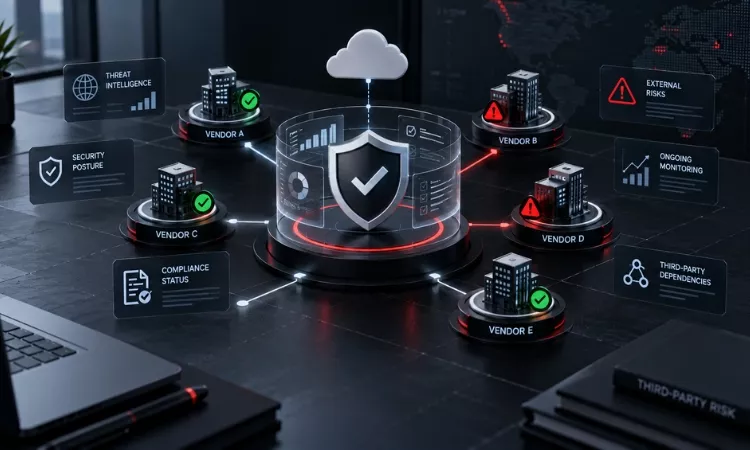
A mature continuous vendor risk monitoring tool correlates breach notifications, certificate expirations, financial signals, exposed asset changes, and other external telemetry into a single delta score. Point-in-time assessments are officially the old world. External signals, however, should complement, not replace, direct control assurance.
3. Risk Tiering and Prioritization
Models trained on historical incident data can now help predict which vendors are most likely to cause a material event, turning intelligent vendor risk monitoring from a slogan into a routable workflow for lean security teams.
4. Regulatory Mapping
An AI compliance risk platform that maps a single vendor control to DORA, NIS2, HIPAA, PCI DSS, RBI expectations, CERT-In reporting obligations, SEBI governance requirements, and sector-specific obligations can save weeks of manual cross-walking per assessment cycle.
What still does not work well: fully autonomous remediation, closed-loop vendor negotiation, and nth-party discovery beyond the fourth tier. Anyone selling those capabilities should be asked to demo them on your own data, not a curated environment.
The Unsolved Problem: nth-Party Exposure
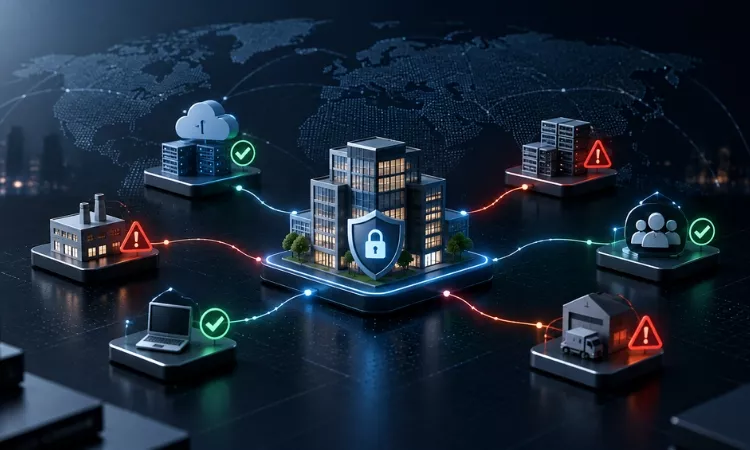
Fourth-party exposure deserves more than a footnote. It is where material incidents originate, the processor your vendor uses, the cloud sub-processor that processor relies on, the open-source library embedded three layers down. The SolarWinds and MOVEit events were not first-party failures. They were cascade failures originating deep in supply chains that most TPRM programs could not see.
No platform in production today solves nth-party discovery reliably at scale. Coverage typically degrades sharply beyond the second or third tier, and false-negative rates on undisclosed sub-processors remain high across the market. CISOs should ask vendors specifically what their nth-party discovery covers, at what tier it stops, and what the false-negative rate looks like on their own client data. Honest vendors will tell you it remains largely manual beyond tier three. That is not a disqualifier, it is a scoping reality every program needs to plan around.
The Hidden Risks: Three Gaps the Market Is Not Talking About
1. Model Risk: Your AI Is Also a Third Party
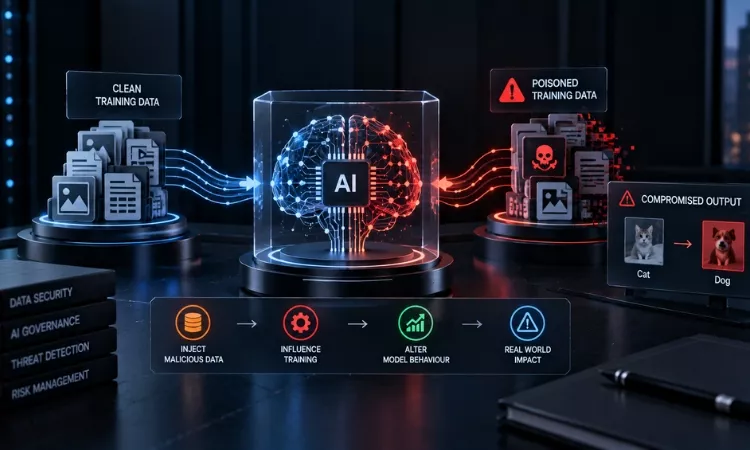
One risk category conspicuously absent from most TPRM AI marketing is model risk itself. When AI generates a control attestation summary, hallucinates a finding, or drifts in accuracy as vendor document formats evolve, your risk program inherits that error, and your auditors will ask who was responsible for catching it.
Before deploying any AI-assisted TPRM platform, ask the vendor how accuracy is measured post-deployment, what the escalation path looks like when the model is wrong, and whether your data is used to train or fine-tune shared models. The AI inside your risk function is itself a third-party worth assessing. Apply the same scrutiny you would to any critical supplier.
2. Shadow AI and the Prompt Privacy Problem
The training data question is necessary but not sufficient. The more immediate data leakage risk in 2026 is not what your TPRM vendor does with your data, it is what your own analysts are doing with it before it ever reaches the platform.
Shadow AI is already endemic in risk teams. Analysts under time pressure paste non-public vendor vulnerability assessments, draft pen test findings, and confidential remediation plans into public consumer LLMs to get faster summaries. The vendor data never touches your approved platform. It goes straight into a shared model with no data residency controls, no audit trail, and no way to walk it back.
This is not a technology problem the TPRM vendor can solve for you. It requires an internal acceptable use policy that explicitly covers third-party data, tooling controls that restrict which AI services analysts can access from corporate devices, and training that connects the behaviour to the actual regulatory exposure, not just a generic “don’t use AI carelessly” memo. The CISO who has not audited their own team’s AI usage habits before deploying a TPRM AI platform is measuring the wrong risk surface.
3. Agent Identity: Who Owns the Bot’s Credentials?
Agentic TPRM platforms are not passive readers. They have read and write access to GRC systems, procurement platforms, ticketing tools, and sometimes contract repositories. That access profile makes the agent itself a privileged identity and, in most deployments, today, that identity is poorly governed.
Typical gaps include service accounts with excessive permissions that were never scoped down after initial integration, API tokens that rotate annually at best and are stored in configuration files rather than a secrets manager, no behavioural monitoring on what the agent is actually doing versus what it is supposed to do, and no clear ownership of who de-provisions the agent’s access when the platform relationship ends.
An agent that can write to your GRC system and read your procurement data is, by any reasonable definition, a privileged access risk. Before deployment, the agent’s identity should go through the same PAM review you would apply to a human with equivalent access. Ask the vendor: what permissions does the agent require a minimum, how are its credentials stored and rotated, and where does the agent’s activity log and who reviews it? If the vendor cannot answer those three questions precisely, the integration is not ready for production.
What’s Actually Shipping: Wizard
Rather than chasing the autonomous-everything narrative, Wizard the AI vendor risk management platform built by Ampcus Cyber, focuses on the four production-ready capabilities above and wraps them in a workflow CISOs can govern.
Wizard is designed to close the evidence-to-insight gap that slows most third-party risk programs. Instead of producing generic summaries, the platform connects findings back to supporting evidence, analyst review steps, and auditable workflows, the design principle that keeps AI output defensible in front of an auditor.
Its monitoring model combines vendor cybersecurity signals, financial indicators, compliance evidence, and configurable risk triggers to surface changes that warrant reassessment. That is a more practical model than promising fully autonomous risk management, and it aligns with what regulators expect: human accountability over material decisions, with AI reducing the volume of repetitive work that reaches human desks.
For regulated enterprises, the platform includes workflows aligned to PCI DSS, PCI SAQ, and ESG reporting requirements. For India-focused organizations, the more relevant question is whether a platform can support oversight models tied to RBI governance expectations, CERT-In incident readiness, SEBI BRSR obligations, and sector-specific third-party controls, an area where regional specificity matters more than global feature breadth.
Wizard also provides a consolidated vendor dashboard intended to replace spreadsheet sprawl with a governed operating model. Whether it delivers on that in practice is a question any serious evaluation should test against a live vendor inventory, not a pre-loaded demo environment.
Implementation Reality:
An organization does not just buy a platform. They deploy it into an existing environment with existing inventory, existing integrations, and existing audit obligations. Practical questions matter more than feature lists:
- How quickly can existing vendor inventories be onboarded?
- Does it integrate with ticketing, procurement, GRC, and IAM ecosystems?
- What are the data residency options?
- Can it support multi-entity or multi-region operating models?
- How configurable are workflows, scoring logic, and approval gates?
Any serious vendor should be ready to answer these before procurement, with reference customers in comparable regulatory environments available to validate the answers.
The 2026 Takeaway
Agentic AI in TPRM is real, but the value is not in replacing your team, it is in collapsing the 50-hour-per-vendor review into something your analysts can finish in an afternoon, while keeping humans accountable for the decisions that matter.
The AI vendor risk assessment tools that will define the next three years are the ones that pair genuine automation with defensible governance, not the ones with the boldest marketing claims at RSA. Use AI to remove spreadsheet friction, accelerate evidence review, surface the right vendors for analyst attention, and keep regulatory mappings current.
Keep humans for material onboarding decisions, exception handling, and accountability. The nth-party problem remains unsolved. Model risk in your risk function is real and largely unaddressed by the market. Shadow AI is already happening inside your team whether you have a policy for it or not. And the agent your platform deploys into your GRC stack is a privileged identity that needs the same governance as any other. All four deserve a place in your evaluation criteria.
As the world accelerates digital trust, financial resilience, and AI adoption, the global enterprises will need risk platforms that move at the speed of innovation without compromising governance. The platforms that earn trust over the next cycle will be the ones that are honest about what they cannot yet do and rigorous about what they can.
| Ready to close the gap between AI promise and audit reality? Connect with our experts to get the checklist! |
Enjoyed reading this blog? Stay updated with our latest exclusive content by following us on Twitter and LinkedIn.