









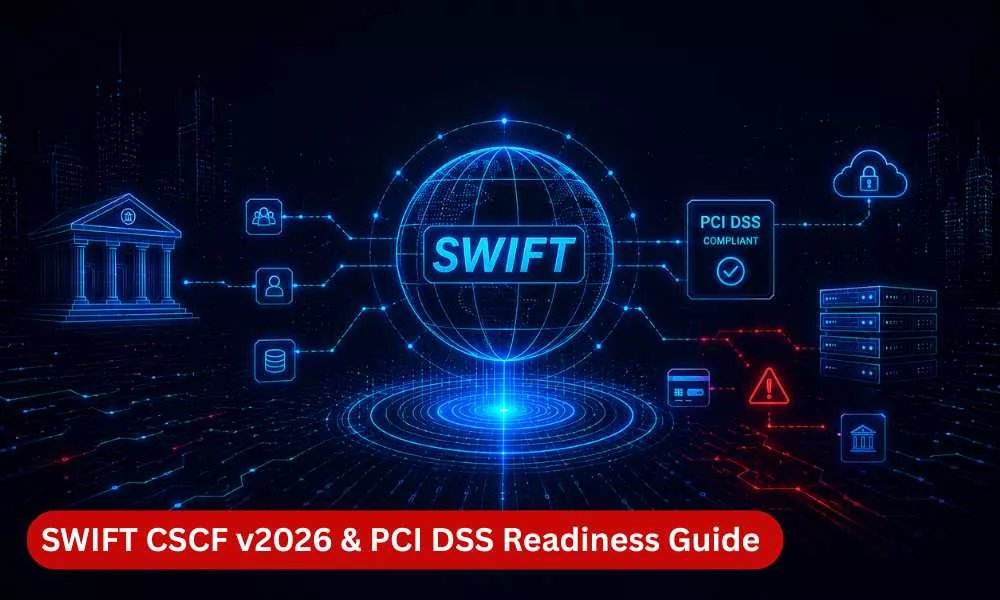
SWIFT CSCF v2026 signals a shift toward tighter controls, stronger evidence, and deeper third-party accountability, making early preparation critical for financial institutions. This blog explores how aligning SWIFT and PCI DSS controls, reducing scope complexity, and adopting continuous compliance can turn audit readiness into a strategic advantage.
For many financial institutions, compliance deadlines do not fail because they were unknown. They fail because remediation always takes longer than expected. That is why SWIFT CSCF v2026 deserves attention now.
The latest update from SWIFT is more than a routine framework refresh. It reflects a wider shift across the financial sector toward stronger evidence, tighter scope control, higher accountability for vendors, and less tolerance for legacy security gaps.
Institutions reviewing the official framework should also reference the latest SWIFT Customer Security Controls Framework guidance directly on the SWIFT website. For organizations that also process payment card data, the overlap with PCI Security Standards Council obligations is becoming harder to ignore.
The strongest programs are no longer treating these as separate workstreams. They are aligning controls once, then using them across multiple regulatory obligations.
Why SWIFT CSCF v2026 Requires Immediate Action
Several updates matter, but three deserve immediate executive focus.
Control 2.4A: Back Office Data Flow Security
Control 2.4A remains advisory in 2025 and becomes mandatory in 2026. It focuses on protecting data flows between the SWIFT Secure Zone and internal back-office systems. Many institutions still rely on older first-hop connections built for operational continuity rather than modern encrypted trust.
Now is the right time to identify applications exchanging data with the secure zone, middleware using weak encryption, unmanaged service accounts, and transfer paths with limited monitoring. Waiting until the next attestation cycle usually turns this into a rushed and expensive remediation program.
Control 2.2: Security Updates
Unsupported operating systems remain one of the simplest ways to create avoidable findings. As Windows 10 reaches end-of-life, any workstation, jump host, or administrative endpoint supporting SWIFT operations can quickly become a compliance concern if left in scope. This is one of the clearest quick wins available to security leaders.
Control 2.8: Outsourced Critical Activities
Third-party dependence continues to grow, but so does scrutiny. Institutions are increasingly expected to validate that critical providers are maintaining patch discipline, restricting privileged access, logging activity, and managing incidents effectively.
Strong oversight now goes beyond questionnaires. It often includes contractual right-to-audit clauses, defined breach notification windows, evidence review rights, and visibility into subcontractors or fourth parties supporting the service.
Independent assurance reports such as SOC 2 Type II, ISAE 3402, or equivalent control attestations are becoming increasingly important in vendor assurance programs.
Where PCI DSS and SWIFT Controls Overlap
Many organizations still run separate programs for SWIFT and PCI obligations. That often creates duplicate controls, repeated evidence requests, and unnecessary spend.
The following control mapping highlights where key PCI DSS requirements and SWIFT CSCF controls already align.
| Security Area | PCI DSS | SWIFT CSCF |
| Multi-Factor Authentication | Requirement 8.3 | Control 2.1 |
| Network Security & Segmentation | Requirement 1 | Secure Zone Protection |
| Logging & Monitoring | Requirement 10 | Monitoring Controls |
| Third-Party Governance | Requirement 12.8 | Control 2.8 |
| Security Updates | Requirement 6 | Control 2.2 |
The practical lesson is simple: build strong controls once, then map them intelligently across frameworks.
How to Reduce Scope Risk Across Payment Environments
Many difficult audits begin with one problem, that is unclear boundaries. Where does the Cardholder Data Environment end? Where does the SWIFT Secure Zone begin? Which systems interact with both?
A shared middleware host, translation engine, or authentication service can unintentionally expand scope across multiple frameworks. A practical model many institutions adopt is a three-zone design that supports cleaner segmentation and long-term scope reduction.
- SWIFT Secure Zone: Dedicated systems supporting SWIFT messaging and operator activity.
- Cardholder Data Environment: Systems that store, process, or transmit payment card data.
- Shared Services Zone: Approved central services such as logging, authentication, monitoring, and tightly governed integrations.
The principle is controlled traffic between zones, no unnecessary trust relationships, and administrative access only through hardened pathways. Clear segmentation often saves more money than late-stage remediation.
Continuous Compliance and Audit Readiness
The traditional audit model is familiar to every security team: weeks of screenshot collection, spreadsheet chasing, and manually proving controls that should already be visible.
That model is fading. Leading institutions are moving toward automated continuous compliance & assurance through live feeds from firewalls, IAM platforms, vulnerability tools, cloud environments, and monitoring systems.
The real advantage is not the tools themselves. It is orchestration. Mature programs connect these evidence sources into a centralized control register where each control has a defined owner, testing cadence, live evidence source, open exceptions, remediation status, and management reporting visibility.
That gives leadership a real-time picture of control health instead of a once-a-year compliance snapshot or rushed attestation of compliance exercise.
Legacy Systems and Compensating Controls
Many financial institutions still depend on platforms that cannot be replaced quickly. Some cannot support modern agents. Others break when security tooling is introduced. That is operational reality.
Strong programs compensate intelligently. Where direct modernization is not possible, institutions often use dedicated network isolation, hardened jump hosts, virtual patching, hardware-backed key protection, packet-level monitoring, and increased review frequency.
In some environments, formal documentation such as a compensating control worksheet may be required to justify alternate safeguards during assessments. Regular penetration testing should also validate that these compensating measures remain effective. The objective is not perfection. It is risk reduction that can withstand scrutiny.
ISO 20022 and Hidden Compliance Scope Expansion
As MX messaging under ISO 20022 becomes mandatory across payment ecosystems, many institutions are discovering that message translators, validation layers, and integration platforms now sit closer to regulated environments than expected.
If those same systems interact with payment card processes, access control, data quality, logging, and change governance obligations may overlap. This often appears late in architecture reviews, when it is far more expensive to fix.
What Security Leaders Should Prioritize in 2025
The institutions most prepared for 2026 are already doing five things now:
- Mapping systems affected by Control 2.4A.
- Replacing unsupported endpoints in regulated scope.
- Reassessing critical vendors and fourth-party exposure.
- Validating segmentation between SWIFT and payment environments.
- Building live evidence into a unified control register.
These actions reduce future cost, shorten remediation timelines, and improve confidence before attestation cycles begin.
Many institutions also engage a qualified security assessor (QSA) early to validate assumptions before formal review cycles begin.
Final Thoughts
SWIFT CSCF v2026 is not simply another framework update. It is a signal that financial institutions need cleaner architecture boundaries, stronger operational evidence, and more disciplined third-party governance. PCI DSS expectations are moving in the same direction.
Organizations that act early can turn compliance into a strategic advantage. Those that wait will likely spend the next cycle negotiating deadlines instead of reducing risk.
Preparing for SWIFT CSCF v2026 and PCI DSS obligations at the same time can be complex. Our advisory team helps financial institutions simplify scope, close control gaps, and improve readiness with practical remediation strategies.
| Connect with us to start your readiness assessment. |
Enjoyed reading this blog? Stay updated with our latest exclusive content by following us on Twitter and LinkedIn.