









Keeping up with PCI DSS vulnerability management isn’t just complex; it’s where most compliance programs quietly fail. This blog breaks down why testing fatigue happens and how organizations can move from reactive checklists to continuous, validated security.
PCI DSS compliance has become a universal language of security for any organization that deals with the storage, processing, and transmission of account data (cardholder data & sensitive authentication data). As cyber threats continue to escalate across finance and retail sectors, costing millions in losses, PCI DSS compliance has shifted from ‘best to have’ practice to a non-negotiable global mandate. Regardless of the size and geographical location, organizations are required to adhere to version 4.0.1 of the PCI DSS that mandates 12 core requirements across six domains. One of these domains is related to ‘maintaining a vulnerability management program’ and is often seen as a major hurdle in achieving and maintaining PCI DSS compliance.
So, what is a vulnerability management program under PCI DSS, and what are the mandated testing activities in it? Let’s have a look at them first.
Security Testing Activities Mandated Under Vulnerability Management Program
A PCI DSS vulnerability management program is a mandatory requirement that focuses on identifying, evaluating, and addressing security weaknesses in systems that handle cardholder data. As per the program, organizations handling cardholder data are mandated to conduct the following testing activities within strict timelines.
- Internal Vulnerability Assessment: As per the 11.3.1 requirement outlined for PCI DSS, this assessment is done on internal-facing systems and needs to be carried out every quarter and whenever there is a major change in the environment.
- ASV Scan: This activity is done on external-facing IPs, and just like the internal vulnerability assessment, it must be performed once every three months (as per 11.3.2) or whenever there is a significant change in the environment.
- Web and Mobile Penetration Testing: The test and frequency also apply to public-facing web applications (as per requirements 6.4), mobile applications, as well as the associated APIs that are part of the Cardholder Data Environment (CDE).
- External and Internal Penetration Testing: As per 11.4 requirement in PCI DSS guidelines, this test is to be performed on both internal and external facing systems, annually and as and when there are major changes in the environment.
- Segmentation Penetration Testing: This activity is necessary for isolating segments holding sensitive card data from other networks in the environment, and this segmenting testing must be conducted biannually (as per 1.2 and 11.4.1 requirements), whenever there is any major change in the environment.
- Network Security Control Configuration Review: The assessment is performed on the network devices, including switches, routers, firewalls, and IDS/IPS, to prevent unauthorized traffic from entering the CDE. As per requirements 1.2, PCI SSC mandates that the assessment needs to be performed once every six months; however, organizations with a high volume of changes to their network configurations should do it more frequently.
- Wireless Scan Review: If a wireless technology, such as wireless point-of-sale or wireless local area network (WLAN), is part of or connected to the CDE, the testing, identification, and detection needs to be done once every three months (as per requirements 11.2 in PCI DSS). In case there is no wireless in the environment, wireless scans need to be performed to identify rogue access points and maintain an inventory.
While these testing activities are mandatory to stay compliant with PCI DSS, the exact requirements depend on the organization’s scope. Yet, tailoring these activities becomes both an operational and technical burden for organizations. Here’s the reality where organizations struggle to keep up with.
Reality Check: Why Maintaining a Vulnerability Management Program is a Challenge?
While the PCI SSC imposes strict mandates for PCI DSS compliance, auditors at Ampcus Cyber observe that organizations treat the standard as a mere checklist exercise, often neglecting the requirements associated with the vulnerability management program.
In many cases, organizations prioritize certification without understanding the importance of a vulnerability management program. Some take remediation into their own hands, only to find that previously detected vulnerabilities remain open.
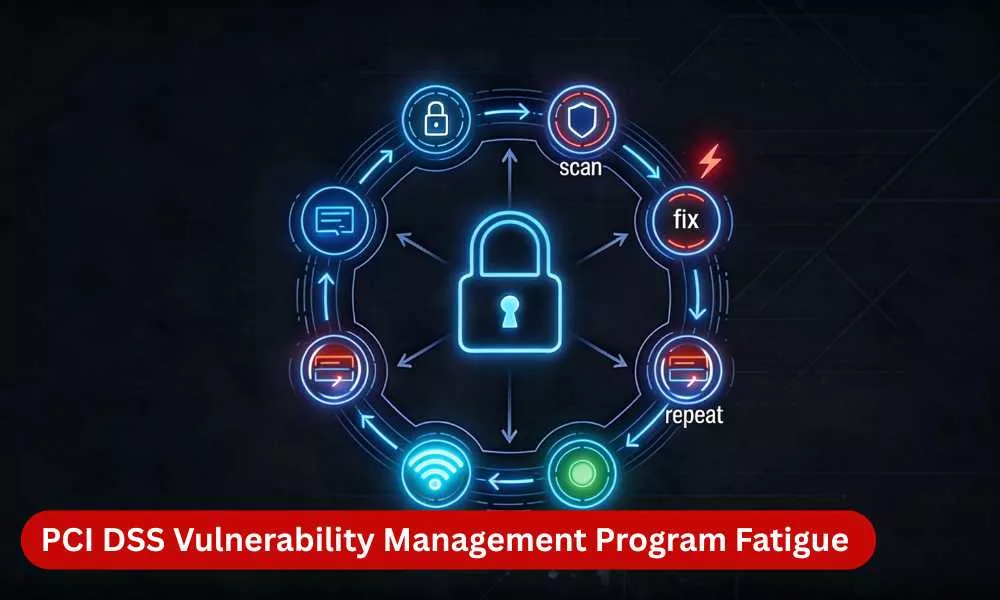
Challenges also arise when organizations struggle to track the strict timelines for testing; a failure often identified only during audits. This is most evident in the quarterly “scan and rescan” process: teams successfully perform initial scanning, but when remediation lags, the critical validation of rescan is missed within the same window. This results in a missed scan in the same period and an entire compliance break.
Furthermore, organizations rely on traditional approaches that sometimes introduce new vulnerabilities during new deployments. By the time existing gaps are remediated, new ones have already emerged to trap organizations in a growing backlog. This leads to testing fatigue, longer remediation times, and ultimately, significant compliance risk.
Lack of Understanding of Testing Methodologies Adds to the Problem
Beyond the general challenges of tracking timelines and managing remediation, a deeper technical barrier exists that adds to the problem. Managing a vulnerability management program under PCI DSS involves navigating complex requirements, and some of these include:
- Scoping Ambiguity: With multiple mandatory testing activities in the PCI DSS framework, organizations often struggle with defining ‘what to consider’ and ‘what not to’ in their Cardholder Data Environment (CDE). In this chaos, overlooking even one critical component such as segmenting a VLAN or a server, can create a significant blind spot. This oversight leads to audit failure and leaves the environment exposed, even if official scans appear clean.
- Expert Testing Team: A well-informed testing team is the backbone of all testing activities. Testing personnel should not only know ‘what’ and ‘when’ to perform these activities but must also know how to execute standard methodologies including scanning, identification, prioritization, and remediation, without oversight. Unfortunately, many organizations burden general IT personnel with these specialized tasks, which leaves them in a confusing state, with missed timelines and overlooked critical vulnerabilities.
- Experience in Software/Technology: While testing activities, such as ASV (Approved Scanning Vendor) scans or Vulnerability Assessment & Penetration Testing (VAPT), require the use of automated tools, these tests are effective only if the tools are configured appropriately to get the required results. There are many automated scanning tools available in the market; however, the challenge is to use these tools to their full capacity. Without hands-on experience to fine-tune these systems, scans often produce distracting false positives or, worse, miss high-risk vulnerability entirely.
- Testing Methodologies: To navigate through any security problem, one needs a well-defined approach. A well-defined approach starts with planning and scoping, followed by tests aligned with the specific PCI DSS requirements, and ends with a robust remediation process and thorough documentation. In the absence of standard methodologies, organizations often find themselves in a soup, unsure of what to look for, how to map vulnerabilities to business impacts, or how to prioritize gaps and remediate them effectively.
The Path to Sustainable Compliance: Start Managing with a Trusted Partner
Vulnerability management is not a “do-it-yourself” project. To move beyond the cycle of audit fatigue and mounting vulnerability testing and remediation backlogs, organizations need a trusted partner who can transform compliance from a hurdle into a strategic advantage that strengthens their overall security posture. Choosing a trusted and reliable cybersecurity vendor can help organizations overcome these technical and operational challenges through:
- Scoping & Methodology Accuracy: Eliminating scoping ambiguity is the first step toward a successful audit. A rigorous approach to defining CDE boundaries ensures that every VLAN, jump server, firewall, or any other asset is accounted for. This precision prevents the blind spots that often lead to audit failures and leave critical segments exposed to threats.
- AI-Powered Validation & Advanced Testing: To solve the challenge of theoretical risks and manual testing fatigue, modern programs leverage autonomous penetration testing platforms. Unlike traditional scanners that generate thousands of unverified alerts, AI-driven tools can simulate real-world attacker behavior including discovering, exploiting, and validating vulnerabilities across web apps, APIs, and infrastructure. This delivers proof-of-exploit evidence, providing teams with enough time to verify and confirm existing threats and focus on other major security testing activities.
- Specialized Expertise: Rather than burdening general IT staff with highly specialized security tasks, a successful PCI DSS vulnerability management program utilizes a well-informed testing team that possesses the hands-on experience required to fine-tune automated tools and interpret complex results. This ensures that scanning and testing are executed to their full capacity across the suspected attack surface.
- Proactive Timeline Management: Maintaining compliance requires strict adherence to mandatory intervals, such as quarterly ASV scans and biannual segmentation tests. A turnkey management approach ensures that all testing activities are scheduled, performed, and documented well in advance of audit deadlines, turning a reactive scramble into a predictable, streamlined process.
Ampcus Cyber delivers this exact balance by pairing elite security consultants with our proprietary AI pentesting platform Mirror, to provide autonomous, exploit-validated testing.
Mirror is our AI pentesting platform that matches human creativity with machine speed, and accelerates the detection, exploitation, and validation of vulnerabilities across the entire attack surface on demand. As a vendor-agnostic platform, Mirror provides the unique capability to automate Proof-of-Exploit for every finding, execute complex multi-step attack paths, identify business logic flaws, and perform zero-day exploitation to preemptively secure your most critical assets.
Mirror transforms vulnerability management from a manual hurdle into a streamlined strategic advantage. By replacing theoretical risk with validated exploits, it breaks the cycle of audit fatigue and clears remediation backlogs. This autonomous approach ensures security scales alongside your operations, allowing teams to prioritize high-impact fixes that safeguard your infrastructure.
In short, the platform takes the guesswork out of PCI DSS 4.0.1 by managing your entire vulnerability lifecycle through precision scoping and automated penetration testing.
With Ampcus Cyber, you don’t just meet a mandate; you gain a resilient, audit-ready security posture backed by hands-on expertise and intelligence-driven technology.
| Not sure where your vulnerability program stands? Get a tailored assessment and uncover hidden gaps in your PCI DSS scope and testing strategy. |
Enjoyed reading this blog? Stay updated with our latest exclusive content by following us on Twitter and LinkedIn.