









In modern environments, attacks don’t always look like attacks. Sometimes, they look exactly like normal system behavior and that’s precisely what makes them dangerous.
During a recent security assessment, a misconfigured Java management interface enabled full system compromise without triggering a single alert from Endpoint Detection and Response (EDR) tools. There was no malware, no file drops, and no suspicious processes. Just legitimate functionality, used in the wrong way.
This incident is a reminder that detection alone is not a security strategy. Without strong governance, configuration management, and application-layer visibility, even the most advanced tools will have blind spots.
The Scenario: A Normal Server with an Invisible Risk
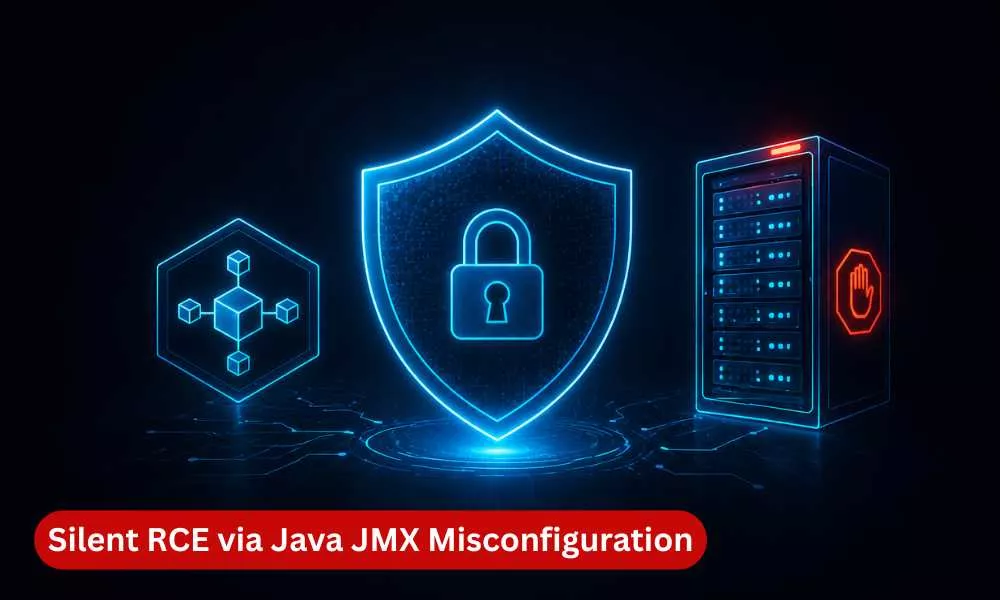
The target environment was unremarkable. A Windows server running a Java-based application on Apache Tomcat, operating as expected in a production setting. Everything appeared standard until a closer examination revealed that a Java Management Extensions (JMX) interface was exposed externally.
JMX is designed to help administrators monitor and manage Java applications. It provides deep visibility into system internals and allows remote interaction with application components known as MBeans. In this case, however, the interface was accessible over the network, unprotected by authentication, and unrestricted to trusted sources.
What was intended as a management feature had effectively become an open control panel, one that any attacker could walk through.
What Happened: No Exploit, Just Access
Rather than exploiting vulnerability in the traditional sense, the attacker leveraged the exposed JMX interface exactly as it was designed to be used. By connecting to the service, they were able to interact with internal application components, dynamically load a malicious component into the running application, and execute system-level commands remotely.
All of this occurred within the existing Java application runtime. No binaries were dropped. No external payloads were executed in the traditional sense. No alarms were raised.
This is the hallmark of modern attack techniques: the weaponization of trust in legitimate tools and configurations.
Why EDR Didn’t Detect It?
Despite the presence of EDR, the activity went completely undetected. Understanding why requires a closer look at how modern detection tools operate and where their visibility ends.
- Execution Stayed Inside a Trusted Process
All actions occurred within the Java Virtual Machine (JVM) hosting the application. No new processes were created, and no suspicious child processes were spawned. From the EDR’s perspective, the parent process was legitimate, the binary was trusted, and the behavior was consistent with normal execution. There was nothing obviously malicious to flag.
- No Files, No Footprints
The attack operated entirely in memory. There were no file writes, no dropped payloads, and no artifacts left on disk. Traditional detection mechanisms rely heavily on file-based indicators of compromise. Without them, visibility drops significantly.
- Legitimate Features Were Used as Designed
The attacker did not introduce foreign tools or exploits. Instead, they used native Java capabilities: remote management interfaces, dynamic component loading, and built-in command execution mechanisms. To monitoring systems, this activity was indistinguishable from legitimate administrative operations.
- Protocol Blind Spots
The communication occurred over Java RMI (Remote Method Invocation), a protocol that uses serialized object streams. Most EDR and network monitoring tools do not deeply inspect these streams and cannot easily differentiate normal operations from malicious ones. The activity blended seamlessly into expected traffic patterns.
- Not a Failure of Detection Alone
This incident highlights a critical shift in how modern attacks operate. The attacker did not bypass security controls; they operated entirely within them. The compromise was made possible by misconfigured management interfaces, a lack of access controls, and limited visibility into application-layer behavior.
A governance gap
Organizations that treat security as a technology problem alone will continue to face incidents like this. Detection tools are reactive by design. Without a governance layer that ensures systems are properly configured, monitored, and hardened from the outset, these tools are left defending a perimeter that is already compromised from within.
What Organizations Are Missing
Many organizations invest heavily in detection technologies but overlook foundational risks. Exposed internal management interfaces, weak configuration controls, over-reliance on endpoint-level visibility, and a lack of monitoring within application runtimes are all common gaps that attackers know how to exploit.
Security tools are only as effective as the environment they operate in. If critical services are exposed without proper controls, detection becomes secondary to the real issue: governance and configuration hygiene.
What Needs to Change?
To address risks like this, organizations must extend their focus beyond traditional detection and invest in a layered approach that starts with governance.
Management interfaces such as JMX must never be exposed externally without strict controls. Authentication and access restrictions should be enforced on every management service, and access should be limited to trusted networks and identities. Organizations must adopt application-layer visibility, monitoring behavior inside runtimes, not just at the OS level. Most importantly, configurations must be continuously validated, because misconfigurations remain one of the most consistent root causes of breaches across industries and compliance frameworks.
Where Does Governance Becomes the Differentiator?
This is where governance, risk, and compliance (GRC) play a central role. Security is not just about detecting threats, it is about ensuring that systems are configured, monitored, and controlled correctly from the start.
A unified approach to governance helps organizations identify misconfigurations before attackers do, maintain visibility across systems and applications, align security controls with operational realities, and continuously validate their risk posture against evolving threats and compliance requirements.
Frameworks like NIST CSF, ISO 27001, and PCI DSS all emphasize configuration management, access controls, and continuous monitoring as core tenets. Yet in practice, these controls are often treated as checkbox exercises rather than active defenses. Incidents like this one demonstrate why that approach falls short.
Without a governance-first mindset, even the most advanced detection tools can miss what appears to be “normal.”
Final Thought
The most dangerous attacks today are not the loudest ones. They don’t rely on obvious exploits or noisy malware. They rely on trust, misplaced, unverified, or unmonitored.
Organizations that want to stay ahead of these threats need governance frameworks that ensure every system, every interface, and every configuration is accounted for and continuously validated.
Because when everything looks normal, that’s often when something is not.
If your organization is struggling to identify and control hidden exposures across applications and infrastructure, it may be time to rethink how security is operationalized.
Ampcus Cyber helps organizations uncover misconfigurations, enforce control validation, and continuously monitor risk across complex environments.
| Let’s schedule a one-on-one discussion with our experts to identify your hidden risks! |
Enjoyed reading this blog? Stay updated with our latest exclusive content by following us on Twitter and LinkedIn.