










This article provides a structured comparison of HIPAA and GDPR across critical operational dimensions, a dual-compliance checklist, and practical guidance for organizations operating under both frameworks simultaneously.
A US hospital network acquires a telehealth platform serving patients in Germany. A health-tech startup incorporates in California but sells to NHS-linked clinics across the UK. A medical device manufacturer ships to 40 countries and processes patient diagnostics in a US-based cloud.
Each of these organizations operates under two of the world’s most consequential health data regulations simultaneously: the Health Insurance Portability and Accountability Act (HIPAA) in the United States and the General Data Protection Regulation (GDPR) in the European Union. While both protect patient and health data, they do so through fundamentally different legal philosophies, scope definitions, enforcement mechanisms, and data subject rights frameworks.
For compliance leaders, privacy counsel, and CISOs navigating dual jurisdiction, the differences are not academic. A control that satisfies HIPAA may not satisfy GDPR, and vice versa. Building a compliance program that addresses both requires understanding precisely where they diverge and where they create complementary obligations.
HIPAA vs GDPR: At a Glance
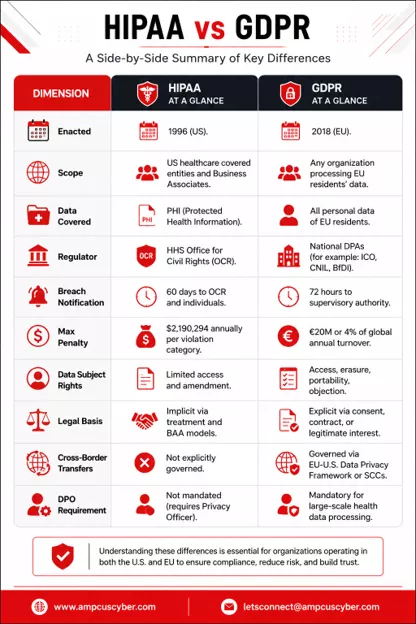
Before diving into the differences, here is a side-by-side summary of each framework:
Does HIPAA or GDPR Apply to Your Organization?
Who Does HIPAA Apply To?
HIPAA applies to covered entities, which includes healthcare providers, health plans, and healthcare clearinghouses that transmit health information electronically. It also covers their Business Associates (BAs), meaning any third party that creates, receives, maintains, or transmits Protected Health Information (PHI) on behalf of a covered entity.
HIPAA is sector-specific and geographically anchored to the United States. It governs only health-related data within the defined covered entity ecosystem. If a US company processes health data outside this ecosystem (such as fitness data from a consumer app), HIPAA does not apply. Similarly, if a European hospital processes data about US citizens, HIPAA does not apply to that hospital.
Who Does GDPR Apply To?
The territorial reach of the GDPR is expansive. It applies to any organization anywhere in the world that processes the personal data of EU or EEA residents, regardless of where the organization is headquartered or where the data processing takes place. This extraterritorial scope has significant operational consequences for US healthcare organizations serving European patients.
Furthermore, GDPR covers all personal data such as names, email addresses, IP addresses, and device identifiers. Health data is explicitly classified as a “special category” under Article 9, carrying additional processing restrictions and protections far beyond ordinary personal information.
What Data Does HIPAA Protect vs. GDPR?
This is one of the most practically significant divergences for global organizations:
- HIPAA defines Protected Health Information (PHI) as individually identifiable health information in any form (electronic, paper, or oral) that relates to a person’s physical or mental health condition, healthcare provision, or payment. HIPAA identifies 18 specific identifiers that must be present for information to constitute PHI. Data properly de-identified under HIPAA’s Safe Harbor or Expert Determination methods falls completely outside HIPAA’s scope.
- GDPR defines health data broadly as data concerning a person’s physical or mental health that reveals information about their health status. GDPR applies to all personal data, not just health data. Location data, IP addresses, and behavioral data are all in scope when linked to an identifiable EU resident. Crucially, de-identification under GDPR requires a significantly higher bar of anonymization than HIPAA’s Safe Harbor; pseudonymized data remains personal data under GDPR rules.
What Is the Breach Notification Deadline Under HIPAA vs. GDPR?
Breach notification timelines are among the most operationally challenging differences for organizations operating under both frameworks.
HIPAA Breach Notification (HITECH Act)
- Notification to affected individuals must happen within 60 days of discovering a breach.
Notification to the HHS Office for Civil Rights (OCR) must happen within 60 days for all major breaches. Smaller breaches affecting fewer than 500 individuals can be logged and reported annually. - Notification to prominent media outlets is required if a breach affects 500 or more residents in a single state or jurisdiction.
GDPR Breach Notification (Articles 33 and 34)
- Notification to the competent supervisory authority (the national DPA) must happen within 72 hours of becoming aware of a breach, if the breach is likely to result in a risk to individuals’ rights and freedoms.
- Notification to affected individuals must happen without undue delay when the breach is likely to result in a high risk to their rights and freedoms.
- If notification within 72 hours is not possible, the reasons for the delay must be provided to the supervisory authority in phases.
Operational Warning: A single breach event may trigger parallel notification obligations with completely different timelines. Relying on HIPAA’s 60-day window while ignoring the 72-hour GDPR obligation is one of the most common dual-compliance failures in global healthcare.
What Rights Do Patients Have Under HIPAA vs. GDPR?
The rights regimes under HIPAA and GDPR diverge significantly, particularly for patients who are EU residents.
Patient Rights Under HIPAA
- Right of access: Patients may request access to their PHI within 30 days, and organizations may charge a reasonable, cost-based fee.
- Right to amend: Patients may request the amendment of inaccurate or incomplete PHI.
- Right to an accounting: Patients may request a list of disclosures of their PHI made in the prior six years.
- Right to restrict: A limited right to request restrictions on certain uses and disclosures, though the covered entity may decline if it impacts care.
Data Subject Rights Under GDPR
- Right of access (Article 15): Right to receive a full copy of personal data, free of charge in most cases, within one month.
- Right to rectification (Article 16): Right to have inaccurate data corrected without undue delay.
- Right to erasure (Article 17): The right to be forgotten, which allows individuals to request the deletion of data under specific conditions, including the withdrawal of consent.
- Right to data portability (Article 20): Right to receive data in a structured, machine-readable format and transfer it directly to another controller.
- Right to restrict processing (Article 18): Right to limit how data is used while its accuracy or legitimacy is contested.
- Right to object (Article 21): Right to object to processing for direct marketing, profiling, or legitimate interest purposes.
Who Is Accountable When a Vendor Causes a Breach?
For HIPAA, the covered entities must execute Business Associate Agreements (BAAs) with all Business Associates before sharing PHI. Under HITECH, BAs carry direct statutory liability; they are not merely contractually liable to the covered entity but are directly accountable to federal regulators. Sub-contractors of BAs must also execute downstream BAAs.
For GDPR, on the other side, controllers must execute Data Processing Agreements (DPAs) with all data processors under Article 28. Unlike HIPAA’s BA model, GDPR DPAs must explicitly specify the nature, purpose, duration, type of data, and categories of data subjects. Controllers remain ultimately accountable for processor compliance. Sub-processors must be formally disclosed, and further processing requires prior authorization. GDPR also mandates Data Protection Impact Assessments (DPIAs) before processing health data at scale.
How Do You Build a Compliance Program That Satisfies Both?
The most effective approach is to design a unified compliance architecture that satisfies the more stringent requirement in each dimension, rather than maintaining two separate programs that diverge and conflict.
1.Map Combined Data Flows and Cross-Border Transfers: Phase 1.
Map every data pipeline where PHI and EU personal data intersect. Identify which data paths utilize the EU-U.S. Data Privacy Framework or require Standard Contractual Clauses (SCCs).
2.Re-Architect Incident Response Plans: Phase 2.
Update triage criteria so security teams can instantly identify GDPR notification triggers. This ensures you can meet the strict 72-hour European window while managing the 60-day federal track concurrently.
3.Consolidate Patient Rights Workflows: Phase 3.
Build a centralized intake system that handles basic HIPAA access requests alongside complex GDPR rights, including data portability and the right to erasure.
4.Harmonize Controls via HITRUST CSF: Phase 4.
Deploy a unified control framework like the HITRUST CSF to map organizational security settings directly to HIPAA, GDPR, ISO 27001, and NIST standards simultaneously.
Executive Summary: The Dual-Jurisdiction Takeaway
Migrating away from siloed privacy management is a strategic necessity for global healthcare firms. Organizations must eliminate compliance isolation and enforce unified validation to protect their data, maintain compliance, and reduce overall breach risks across multiple international borders.
Operating Across HIPAA and GDPR Jurisdictions?
| Build a Unified Compliance Program with Ampcus Cyber – Call our experts or Request a Dual-Compliance Assessment now! |
Enjoyed reading this blog? Stay updated with our latest exclusive content by following us on Twitter and LinkedIn.