









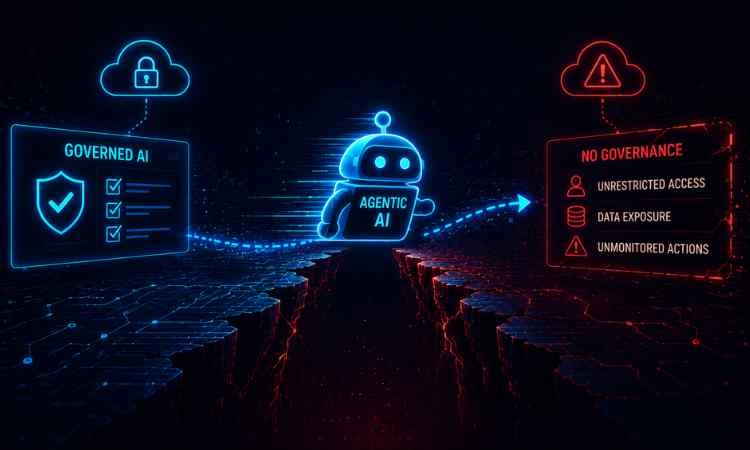
Autonomous AI agents are no longer a pilot project sitting in an innovation lab. They query databases, approve transactions, file compliance reports, and modify cloud configurations, often with the same permissions as the employees who deployed them. Boards are approving budgets for this technology faster than security teams can build the controls to govern it. That mismatch is the hidden governance gap most organizations are living with right now, whether they have named it or not.
The problem is rarely a lack of interest in governance. Most enterprises already run mature programs for identity, data protection, and regulatory compliance. The issue is that those programs were built for software that waits for a human to click a button. Agentic AI does not wait. It plans, decides, and acts across multiple systems in a single task, and it can do so faster than any human reviewer can follow along. Understanding why that changes the governance equation is the first step toward closing the gap.
Why Agentic AI Governance Differs From Traditional AI Oversight
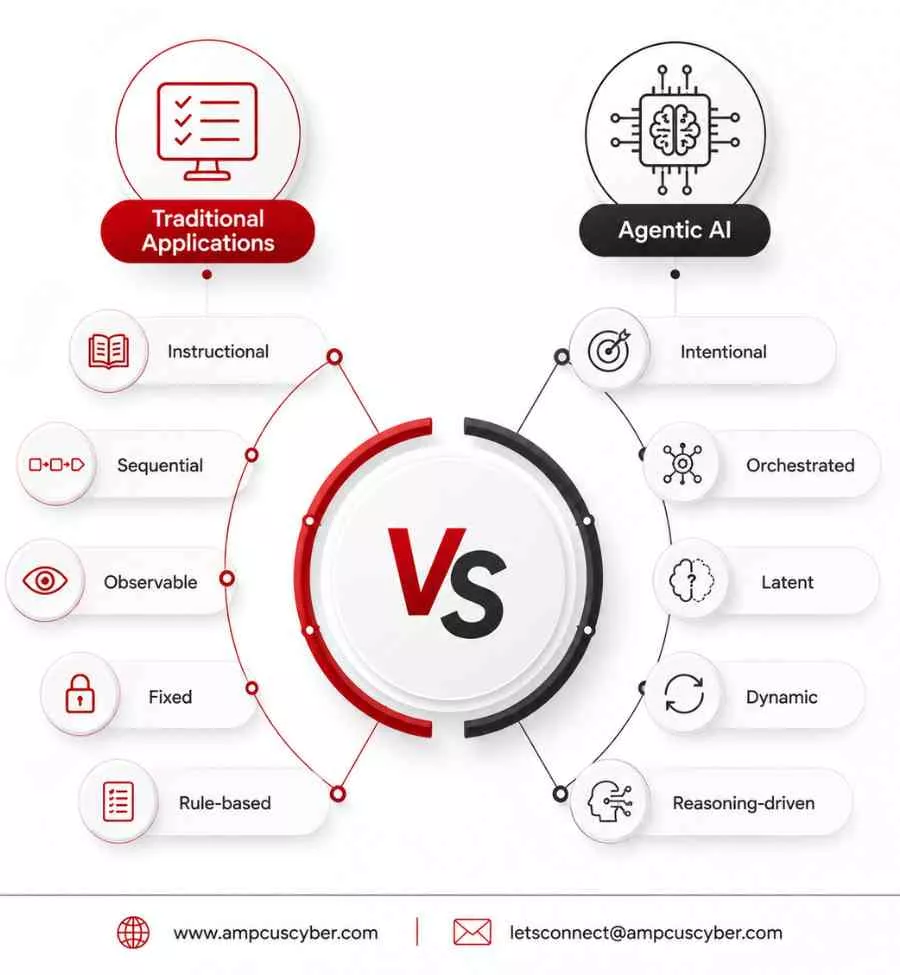
Traditional application governance assumes a predictable chain of events: a user requests something, a system processes it, and a log captures what happened. Agentic AI security breaks that assumption in three important ways.
- Agents pursue goals rather than execute fixed instructions. An agent given a broad objective will independently determine the steps needed to reach it, which means its behavior cannot always be predicted in advance.
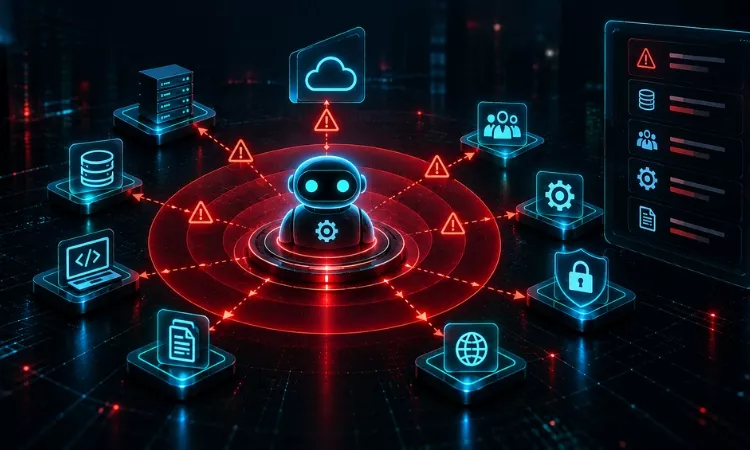
- Agents chain tool calls, meaning a single task might involve a dozen API requests, a database query, and a handoff to another agent, all before a human sees any output.
- The reasoning that drives those actions often stays inside the model itself, invisible to the SIEM and DLP tools that security teams already trust.
None of this makes agentic AI unmanageable. It does mean that governance built for static software, or even for earlier generations of generative AI, will not transfer cleanly. Boards and CISOs who assume their existing controls already cover agentic systems are the ones most likely to discover the gap during an incident rather than before one.
The Governance Gap Hiding in Plain Sight
The scale of the mismatch is becoming clear in recent industry research. Gartner has cautioned that enterprises applying the same governance rules to every AI agent, regardless of how much autonomy that agent holds, are setting themselves up for failure. The firm projects that by 2027, 40% of enterprises will demote or decommission autonomous AI agents, and the reason is consistent: governance gaps only surface after something has already gone wrong in production. Gartner’s recommended fix is a proportional governance model, where agents are classified by autonomy level and governed according to the trust boundary each level represents, rather than treated as a single uniform category.
This is not a distant risk scenario. Agent deployments in enterprise applications have grown from a small fraction of software just a year ago to a substantial share of new deployments today, and most security programs have not scaled their oversight capacity at the same pace. Visibility gaps compound the problem. Many organizations still cannot see the full chain of decisions an agent made before it took an action, only the final API call it executed. That blind spot is precisely where accountability breaks down during an audit, a regulatory inquiry, or a post-incident review.
Where the Gap Breaks Down in Practice?
Three areas tend to expose the governance gap most consistently, and each deserves direct attention.
Identity and Access:
Agents are frequently granted broad, standing permissions because it is simpler to provision them that way. Traditional identity and access management was designed for human users who authenticate once and act within predictable boundaries. Agentic IAM addresses this by treating each agent as a distinct, verifiable identity with permissions evaluated at the moment of action, not just at login. Without that layer, a compromised or manipulated agent can escalate privileges and move across systems with little friction.
Runtime Oversight:
Prompt-level instructions are not a control; they are a request to a system that does not always comply predictably. Enterprises are increasingly turning to dedicated oversight architectures, sometimes referred to as a Governor Agent, a separate system built specifically to monitor, evaluate, and constrain the actions of operational agents in real time. This kind of runtime layer is what allows a security team to intervene before an agent completes a harmful action, rather than reconstructing what happened afterward.
Accountability and Liability:
When an agent files an incorrect regulatory report or approves a fraudulent transaction, the question of who is responsible does not stay theoretical for long. Under frameworks such as the EU AI Act, organizations that cannot demonstrate documented authorization boundaries and a clear audit trail are in a materially weaker position when liability questions arise. Building that evidence trail before an incident, not after, is what separates organizations that can defend their governance program from those that cannot.
What the Security Community Is Already Telling Us
The broader security community has moved quickly to formalize these risks. In December 2025, OWASP released its Top 10 for Agentic Applications, built with input from more than one hundred security researchers and practitioners. The list covers risks that simply did not exist in earlier LLM threat models, including agent goal hijacking through hidden instructions, tool misuse driven by over-permissioned access, and memory poisoning that quietly reshapes an agent’s behavior over time. Its existence is itself a signal: the industry now recognizes agentic systems as a distinct risk category requiring dedicated governance, not an extension of generic AI policy.
For governance leaders, this framework is a useful starting point for structuring internal risk assessments. It maps naturally onto existing GRC processes, provided those processes are updated to account for autonomous decision-making rather than static application behavior.
Building a Strong Strategic Governance Framework
Closing the gap does not require replacing every existing control. It requires extending governance so it can keep pace with systems that act at machine speed. A workable framework generally includes four elements: a live inventory of every agent operating across the environment, including those deployed by business units without formal security review; identity and access controls scoped to individual agents rather than shared credentials; continuous, runtime monitoring rather than periodic audits; and a documented chain of authorization that ties every consequential agent action back to a named accountable owner.
Agentic GRC platforms are emerging specifically to operationalize this model, connecting governance frameworks, evidence collection, and risk registers into a system that can keep up with agents operating continuously rather than on an audit calendar. Ampcus Cyber’s own GRACE platform was built around exactly this shift, centralizing control management and evidence collection so governance leaders get continuous visibility into agent behavior instead of a once-a-year snapshot. Embedding this capability into an organization’s broader governance, risk, and compliance program ensures agentic oversight does not exist as an isolated initiative, disconnected from the rest of the enterprise risk picture.
None of this needs to start from scratch. The fastest, lowest-risk entry point is a structured agentic AI governance readiness assessment, one that inventories every agent already operating in the environment, maps each one to an autonomy tier, and identifies exactly where identity, monitoring, and accountability controls fall short before an auditor or regulator finds the gap first.
The Cost of Waiting?
The organizations most exposed to agentic AI risk are not necessarily the ones deploying the most agents. They are the ones assuming their current governance program already covers autonomous systems it was never designed to handle. Every week that assumption goes untested, the distance between what an organization believes it controls and what it controls in practice grows wider. Closing that distance now, while agent deployments are still expanding rather than fully entrenched, is considerably less costly than retrofitting governance after an incident force the question.
Ready to find out where your agentic AI governance stands?
| Book an agentic AI governance readiness assessment with Ampcus Cyber and get a proportional, audit-ready framework built for autonomous systems. |
Enjoyed reading this blog? Stay updated with our latest exclusive content by following us on Twitter and LinkedIn.