









Artificial intelligence is autonomously planning, browsing the web, executing code, and completing enterprise workflows with minimal human intervention. These autonomous AI agents are transforming business operations. They are also quietly expanding your attack surface in ways most security teams are not yet equipped to handle.
From LLM-powered agents handling customer service to multi-agent systems managing financial workflows, the era of agentic AI is already here. Securing it demands a fundamentally different approach from traditional cybersecurity.
What is Agentic AI?
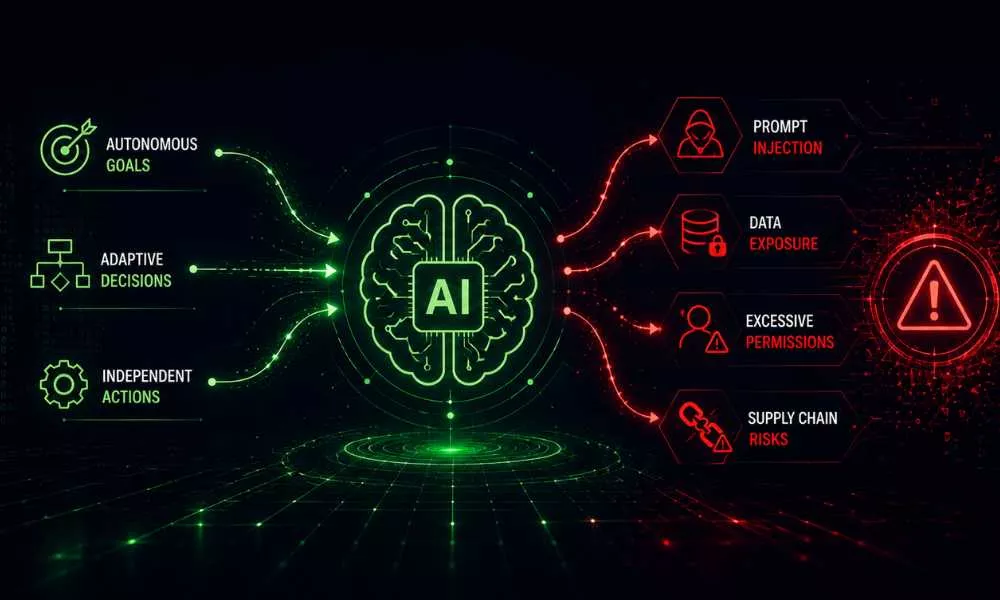
Agentic AI refers to artificial intelligence systems designed to operate autonomously, pursuing goals across extended sequences of actions with minimal human intervention. Unlike conventional models that respond to a single prompt, an autonomous AI agent can do the following:
- Set and pursue sub-goals independently over time.
- Interact with external tools, APIs, databases, and web services.
- Make real-time decisions without constant human oversight.
- Orchestrate other AI agents within multi-agent systems.
- Retain memory and context across sessions to improve task execution.
Common deployments include AI coding agents, research automation tools, LLM-based robotic process automation (RPA), and customer service bots with tool-use capabilities. As these self-directed AI systems become embedded in critical infrastructure, their security posture becomes a board-level concern.
What is Agentic AI Security?
Agentic AI security is the practice of identifying, assessing, and mitigating the unique cybersecurity risks associated with autonomous AI agents operating inside digital environments. It encompasses:
- Governing the access permissions granted to AI agents and agentic workflows.
- Monitoring agent behavior in real time for anomalies and unauthorized actions.
- Enforcing least-privilege principles across all agent-based AI interactions.
- Detecting and blocking attacks that specifically target LLM agent pipelines.
- Ensuring data integrity flowing through multi-agent orchestration layers.
Unlike traditional application security, agentic AI security must account for non-deterministic behavior, for example an intelligent agent may act in unexpected, difficult-to-audit ways, rendering conventional security controls insufficient when applied in isolation. For a deeper view of how Ampcus Cyber approaches these challenges, visit our AI and Cybersecurity Services.
What Are the Key Risks of Agentic AI?
Autonomous AI agents introduce a distinct risk profile that security teams must urgently address. Unlike static software, agent-based AI systems can act, adapt, and escalate, making their failure modes uniquely dangerous:
Excessive Privilege and Scope Creep
AI agents granted broad permissions become high-value targets. A compromised autonomous agent can exfiltrate data, modify files, or trigger unauthorized transactions at machine speed, far faster than any human can intervene.
Lack of Human Oversight
Speed is the value proposition of agentic workflows, but removing humans from the decision loop means malicious or erroneous actions can propagate rapidly before anyone detects them.
Unpredictable Decision-Making
LLM agents trained on vast datasets can behave erratically when faced with adversarial crafted inputs. Attackers exploit this to steer intelligent agents toward harmful outcomes without triggering obvious security controls.
Supply Chain Vulnerabilities
Most multi-agent systems rely on third-party plugins and APIs. A single compromised tool in the agent’s ecosystem can become the entry point for a far broader attack against your environment.
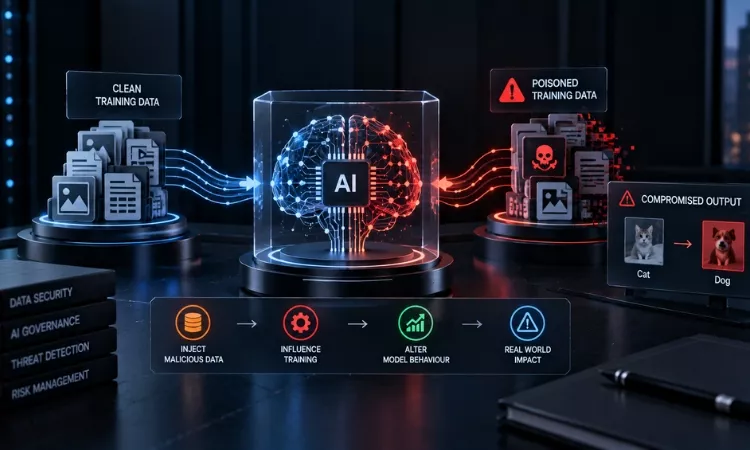
Data Poisoning and Model Manipulation
If adversaries influence the data an autonomous AI agent retrieves or learns from, they can manipulate its behavior at scale, a critical concern for agents handling compliance, financial, or healthcare data.
Shadow AI Sprawl
Business units deploying agentic AI tools without IT visibility create ungoverned agents that bypass security policies, audit trails, and data governance frameworks entirely.
What Threats Do Agentic AI Systems Face?
The threat landscape targeting autonomous AI agents and LLM-powered systems is evolving rapidly. Security teams must understand these specific attack vectors:
Prompt Injection
Malicious instructions embedded in content that the AI agent reads, a webpage, email, or document, cause it to deviate from its intended task. This is the number one risk in the OWASP Top 10 for LLM Applications, the authoritative reference for LLM agent security.
Agent Hijacking
Attackers intercept communication between an autonomous AI agent and its orchestration layer, redirecting the self-directed AI system to perform unauthorized or destructive actions on their behalf.
Memory Poisoning
Many agentic AI systems maintain persistent memory across sessions. Injecting malicious data into an intelligent agent’s memory corrupts its future decisions and outputs, a slow-burn attack that is notoriously difficult to detect.
Tool Abuse
Agents authorized to use code interpreters, file systems, or browsers can be manipulated into weaponizing those tools, downloading malware, exfiltrating sensitive data, or escalating privileges within your environment.
Adversarial Context Manipulation
By carefully crafting the inputs and context an LLM agent receives, adversaries can alter its reasoning chain without triggering obvious security controls, one of the stealthiest threats to multi-agent systems. The MITRE ATLAS Framework provides a comprehensive taxonomy of these attack techniques.
Who is Most at Risk from Agentic AI Security Threats?
The short answer: every organization deploying or interacting with autonomous AI agents. However, certain sectors carry significantly higher exposure:
Financial Services
LLM agents handling transactions, fraud detection, or customer onboarding are high-value targets. A compromised autonomous financial agent can execute unauthorized transfers faster than any human can intervene.
Healthcare and Life Sciences
AI agents accessing patient records or clinical decision-support systems face HIPAA obligations and direct patient safety risks. A manipulated intelligent agent in this context is not just a data breach; it can be a life-safety event.
Government and Critical Infrastructure
Self-directed AI systems with access to sensitive infrastructure or operational technology represent national security concerns, even when accessed indirectly through multi-agent orchestration.
Enterprise SaaS and E-Commerce
Agentic AI tools managing supply chains, inventory, or customer data operate as wide attack surfaces with significant downstream impact across partner and customer ecosystems.
Even organizations that do not directly deploy autonomous AI agents face risk if their vendors or SaaS platforms do, making third-party AI risk management essential. See how Ampcus Cyber’s Third-Party Risk Management helps you assess and monitor the AI security posture across your entire vendor ecosystem.
Why Does Agentic AI Security Matter Right Now?
Adoption of agentic AI and autonomous AI agents is accelerating faster than enterprise security frameworks can adapt. Several converging pressures make this the critical inflection point:
- Regulatory momentum: The EU AI Act, US Executive Orders on AI, and emerging global standards are creating new compliance obligations for organizations operating autonomous AI systems.
- Adversary sophistication: Nation-state actors and organized cybercriminal groups are actively developing LLM-specific attack toolkits targeting multi-agent systems.
- Deployment velocity: Enterprises are launching agentic workflows faster than security reviews can be completed, creating exploitable windows of vulnerability.
- Expanding attack surface: Every new API, plugin, or data source an intelligent agent connects to adds a new potential attack vector to your environment.
The NIST AI Risk Management Framework (AI RMF) makes clear that organizations must address the trustworthiness, reliability, and security of AI agent systems before deployment, not as an afterthought. Waiting is not a security strategy.
How Can Organizations Defend Against Agentic AI Threats?
Defending against threats targeting autonomous AI agents requires a layered approach that extends traditional cybersecurity principles into the unique threat model of agentic AI systems:
- Apply Least Privilege to Every Agent: Grant autonomous AI agents only the minimum permissions required. Treat each AI agent like a human user account, subject to role-based access control, regular access reviews, and session logging.
- Deploy Continuous Behavioral Monitoring: Integrate AI agent activity logs into your SIEM or SOC. Flag deviations from expected behavioral baselines in real time, a sudden spike in API calls or file access is a red flag in any agentic workflow.
- Enforce Human-in-the-Loop for High-Stakes Actions: Require human approval before any autonomous AI agent executes financial transactions, data deletions, or external communications. Speed matters, but not more than safety and accountability.
- Secure the Entire AI Agent Pipeline: Apply security testing to every component the LLM agent touches: APIs, plugins, memory systems, retrieval databases, and data sources. In multi-agent systems, the weakest link is the entry point.
- Red Team Your Autonomous Agents: Proactively test agentic AI systems for prompt injection, hijacking, and tool abuse using MITRE ATLAS TTPs to guide adversarial simulation of attacks on your intelligent agent infrastructure.
- Adopt AI-Specific Governance Frameworks: Align your agentic AI security program with NIST AI RMF and OWASP LLM Top 10. Establish an AI governance policy covering all agent-based AI deployments, including shadow AI and third-party tools.
Building this capability in-house is resource intensive. Ampcus Cyber’s Managed Security Services provide continuous monitoring, threat intelligence, and incident response capabilities purpose-built for organizations operating autonomous AI agents at scale.
What’s the Bottom Line on Agentic AI Security?
Agentic AI is a present and rapidly expanding threat landscape. Autonomous AI agents, LLM-powered workflows, and multi-agent orchestration systems are already embedded in enterprise infrastructure, and the adversaries targeting them are not waiting for the security community to catch up.
Organizations that invest in agentic AI security are now building governance, monitoring, and defense-in-depth around their autonomous AI deployments, will be positioned to scale AI adoption safely, compliantly, and with confidence.
Ready to Secure Your Autonomous AI Infrastructure?
Talk to Ampcus Cyber’s AI security experts and get a tailored defense strategy built for your organization.
Enjoyed reading this blog? Stay updated with our latest exclusive content by following us on Twitter and LinkedIn.