









Learn what happens in the first 72 hours after a ransomware attack, from containment to recovery, and how simulations help organizations prepare.
It’s 2 am and a monitoring alert fire. Within minutes, file servers across three regional offices stop responding, and a ransom note appears on a domain controller. For the security team on call, the next 72 hours will decide how much the organization loses, in data, in downtime, and in trust.
This is not a hypothetical scenario. IBM’s 2025 Cost of a Data Breach Report puts the average total cost of a ransomware incident, including downtime, remediation, and business interruption, at $5.08 million.
This article, moreover, walks through what happens hour by hour after detection, who needs to be in the room, and why simulating this timeline in advance, something Ampcus Cyber builds entire engagements around, is one of the highest value exercises a security program can run.
What Is the “First 72 Hours” and Why Does It Matter?
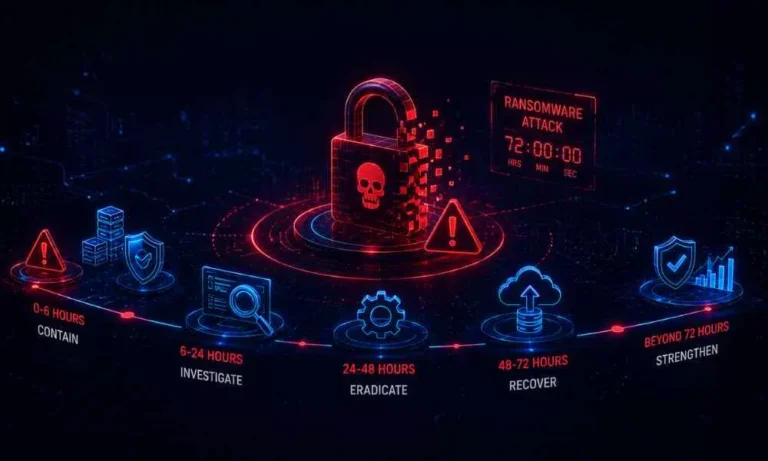
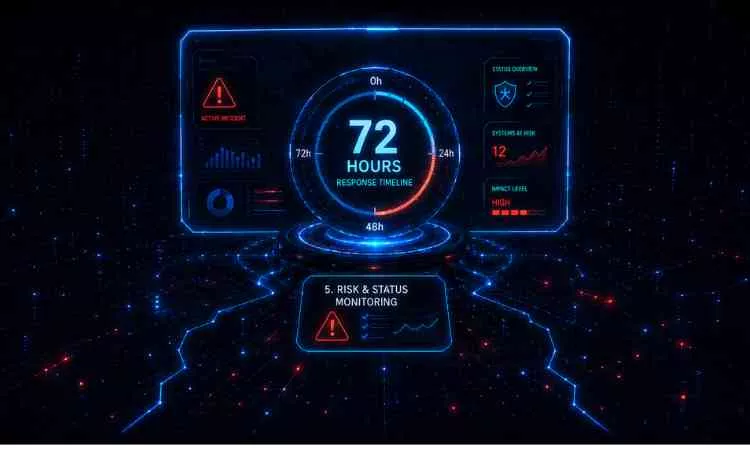
The first 72 hours of ransomware response is defined as the window from initial detection to the point where an organization has contained the threat, understood its scope, and stabilized operations enough to plan recovery. It is not the same as full recovery, which for most organizations takes weeks rather than days. But how a team performs in this window largely determines whether the incident becomes a contained event or a prolonged crisis involving regulators, customers, and the media. Ampcus Cyber’s incident response teams treat this window as the single highest-leverage phase of any ransomware engagement.
Who Needs to Be Involved?
A ransomware incident is never just an IT problem. A functioning response typically pulls in:
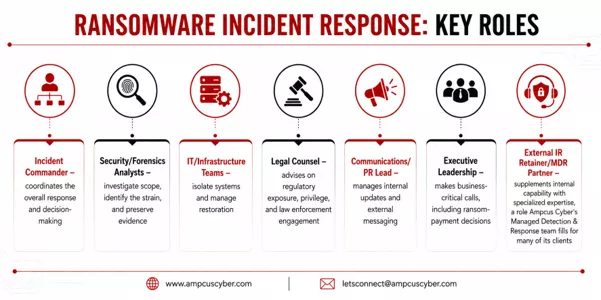
Organizations that have already mapped these roles into a documented incident response plan move faster once the pressure is on.
Hour 0-4: Detection and Initial Triage
The clock starts the moment an alert, employee report, or unusual system behavior signals something is wrong. In this window, the priority is confirmation and containment, not full investigation.
Typical actions include:
- Validating whether the alert reflects an actual ransomware event.
- Isolating affected endpoints and segments from the network to stop lateral spread.
- Activating the incident response plan and assembling the core response team.
- Preserving volatile evidence (memory, logs) before systems are powered down or rebuilt.
Speed matters here more than precision. A slightly imperfect containment action taken in minutes is often better than a perfect one taken in hours.
Hour 4-24: Scoping, Notification, and Strain Identification
Once the bleeding is stopped, the team shifts to understanding exactly what happened. This phase typically includes:
- Identifying the ransomware family or threat actor group involved, since tactics, negotiation behavior, and known decryption weaknesses vary widely by strain.
- Determining whether data was exfiltrated (double extortion) in addition to encryption.
- Standing up a secondary, out-of-band communication channel, since email and chat systems may be compromised or untrusted.
- Looping in legal counsel to assess regulatory notification obligations.
- Making an initial decision on whether and when to contact law enforcement.
Public agencies increasingly urge early reporting. The CISA #StopRansomware Guide is one of the most widely referenced resources for organizations working through this stage, offering a structured checklist for both response and recovery.
Hour 24-48: Containment Verification and Recovery Planning
By day two, most organizations have moved from reacting to planning. Key activities include:
- Confirming the threat actor no longer has active access (verifying containment is complete, not partial).
- Assessing backup integrity: are backups clean, current, and isolated from the compromised environment?
- Building a prioritized system restoration order based on business impact.
- Briefing executive leadership on scope, likely business impact, and ransom-payment considerations.
- Drafting initial internal and external communications, even if they are not yet released.
This is also when the ransom-payment question becomes concrete. Federal guidance consistently discourages payment, noting it does not guarantee data recovery and can encourage further targeting, a point echoed in Ampcus Cyber’s own overview of how organizations should respond when ransomware strikes.
Hour 48-72: Stabilization and Early Recovery
By the end of day three, the goal is operational stabilization, not full recovery, but enough restored function that the business can operate while deeper remediation continues.
Typical milestones:
- Restoring priority systems from verified-clean backups.
- Rotating credentials and rebuilding compromised identity infrastructure.
- Continuing forensic investigation to close remaining gaps.
- Delivering a consolidated update to leadership, employees, and, where required, regulators or affected customers.
- Beginning the after-action documentation that will feed the post-incident review.
Why Simulate This Timeline Before an Attack Happens?
Reading a timeline is different from living it. Tabletop exercises and full-scale ransomware simulations expose the gaps that only surface under pressure: a communications plan that assumes email still works, a backup that was never actually tested for restoration, an executive who isn’t sure who has authority to approve a ransom decision.
Frameworks such as the NIST SP 800-61 incident response guidance emphasize that preparation and continuous improvement are as central to incident response as detection and recovery themselves, not an afterthought bolted on at the end. Running a realistic simulation is how organizations turn a documented plan into muscle memory, which is the core premise behind Ampcus Cyber’s Ransomware Simulation & Assessment engagements.
Where Do Organizations Typically Fail?
The most common breakdowns in the first 72 hours aren’t technical, they’re procedural:
- No pre-established communication channel outside the compromised network.
- Backup strategies that were never tested against a real restoration scenario.
- Unclear decision rights on ransom payment, leaving executives to debate this for the first time mid-crisis.
- Incomplete evidence preservation, which weakens both forensic findings and any law enforcement engagement
- No rehearsed message for customers, regulators, or the public, leading to inconsistent or delayed communication.
Each of these is preventable with planning that happens long before an attacker gets in, which is precisely why understanding frameworks like NIST’s security standards alongside practical response planning gives security teams a repeatable, auditable structure to work from. Ampcus Cyber’s assessments are built specifically to surface these gaps before an attacker does.
How Should Organizations Prepare for Their Own First 72 Hours?
- Document and regularly update an incident response plan with clearly assigned roles.
- Test backups through actual restoration drills, not just verification checks.
- Establish pre-negotiated relationships with IR retainers, legal counsel, and law enforcement contacts before an incident occurs.
- Run tabletop and live-fire ransomware simulations at least annually.
- Pre-draft communication templates for employees, customers, and regulators.
Final Thoughts
Ransomware response is won or lost in the first three days. Organizations that have rehearsed the decisions, tested their backups, and clarified who owns what, before an attacker forces the question, consistently recover faster and with less damage than those improvising in real time.
Ampcus Cyber’s Ransomware Simulation & Assessment service is built around exactly this scenario: testing an organization’s response protocols, communication channels, and recovery procedures against a realistic ransomware event, so the first 72 hours of a real incident feel like the tenth rehearsal instead of the first.
| Prepare before the clock starts. Connect with our experts before a real attack puts your plans to test! |
Enjoyed reading this blog? Stay updated with our latest exclusive content by following us on Twitter and LinkedIn.
Related Posts