









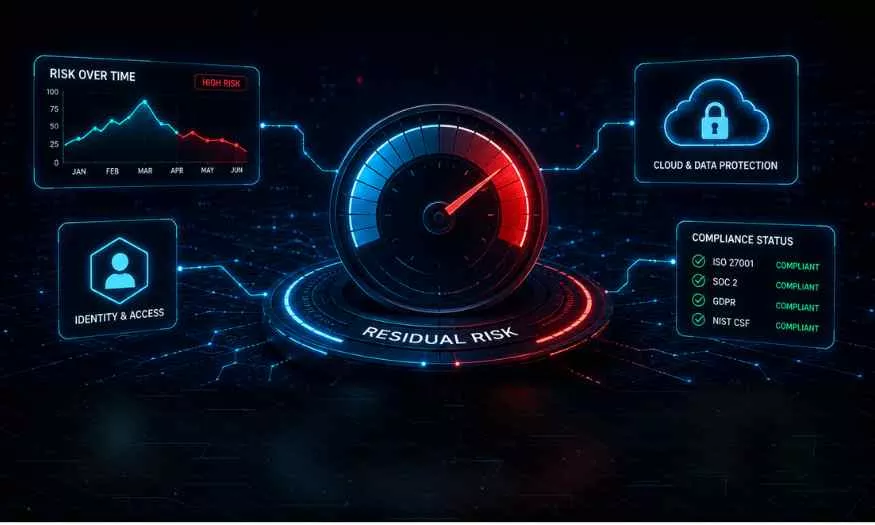
Every organization runs on risk. The question isn’t whether risk exists, it’s how much remains after you’ve done everything reasonably possible to reduce it. That remaining exposure, known as residual risk, is one of the most important, and most misunderstood, concepts in cybersecurity, compliance, and enterprise risk management.
This guide breaks down what residual risk means, how it differs from related terms like inherent risk and risk appetite, and how security and compliance teams can track it effectively using modern, structured approaches.
What Is Residual Risk?
Residual risk is the level of risk that persists after an organization has implemented controls to reduce a threat’s likelihood or impact. In simple terms: you identify a risk, apply a safeguard, and whatever danger is left over is your residual risk.
For example, a company may encrypt sensitive customer data (a control) to reduce the risk of exposure during a breach. Even with encryption in place, some risk remains, a misconfigured key, an insider threat, or a zero-day vulnerability. That leftover exposure is the residual risk.
Residual risk is unavoidable. The goal of risk management isn’t to reach zero risk, which is practically impossible, but to reduce residual risk to a level the organization can knowingly accept.
What is the Difference Between Residual Risk and Inherent Risk?
These two terms are often confused, but the distinction matters for accurate risk reporting:
- Inherent risk is the raw, uncontrolled level of risk that exists before any safeguards are applied. It reflects the natural severity of a threat in the absence of mitigation.
- Residual risk is what remains after controls, policies, and safeguards have been layered on top of that inherent risk.
The gap between inherent and residual risk essentially measures how effective your controls are. A large gap suggests strong mitigation; a small gap suggests controls aren’t doing much work, or the threat is severe enough that even strong controls can’t fully contain it.
What Is the difference between Residual Risk and Risk Appetite?
Risk appetite is the amount of risk an organization is willing to accept in pursuit of its objectives. Residual risk becomes a decision point once it’s calculated: leadership compares the remaining exposure against the organization’s defined risk appetite and risk tolerance thresholds.
If residual risk falls within appetite, the organization typically accepts it and moves on. If it exceeds appetite, the organization must apply additional controls, transfer the risk (through insurance or contracts), or in rare cases, avoid the activity altogether.
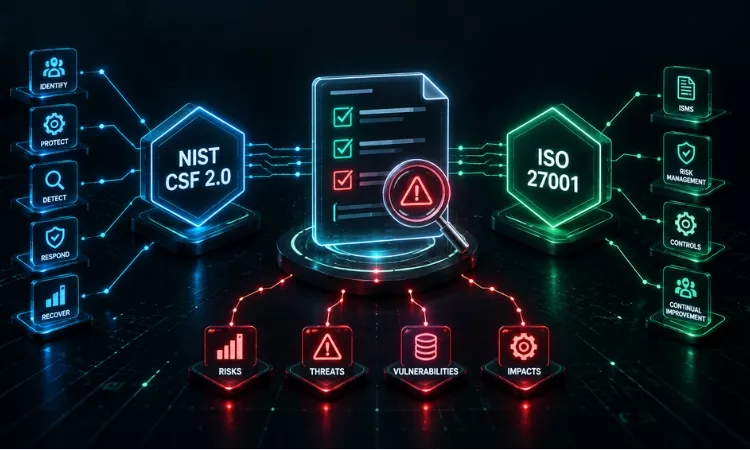
This is where risk management connects directly to governance. Structured programs, like those built around frameworks such as ISO 27001, PCI DSS, SOC 2, NIST CSF 2.0, HIPAA, HITRUST, and DPDPA, expect organizations to demonstrate that residual risk decisions are documented, justified, and reviewed, not just left as an afterthought. Understanding what NIST security standards require can help ground this process in a recognized methodology.
How to Calculate Residual Risk
While formulas vary by framework, the most common simplified model is:
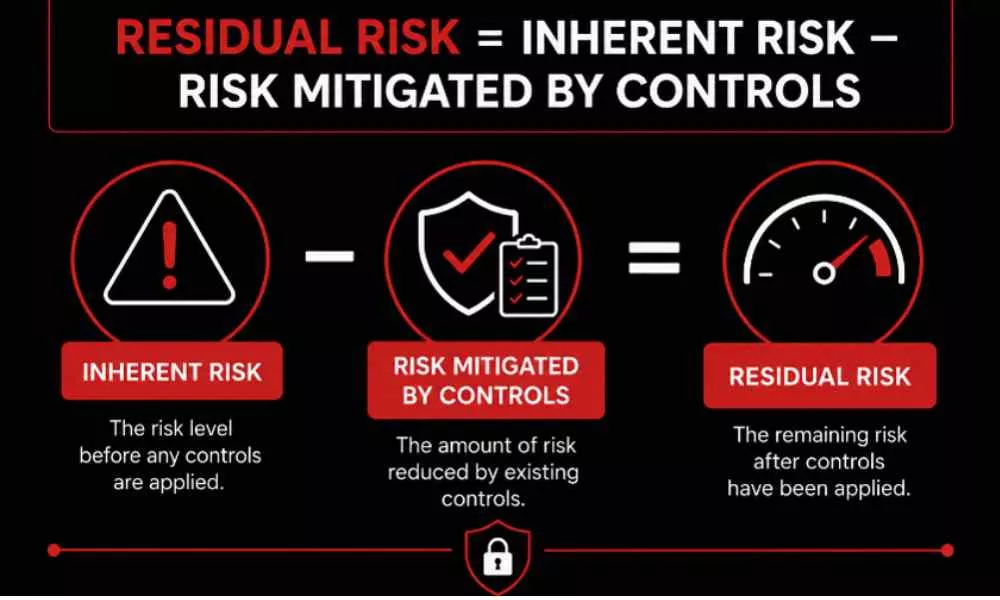
This model reflects the same core logic outlined in the NIST Guide for Conducting Risk Assessments (SP 800-30), which formalizes how organizations should evaluate threats, vulnerabilities, and control effectiveness.
A more detailed version used in many risk registers is:
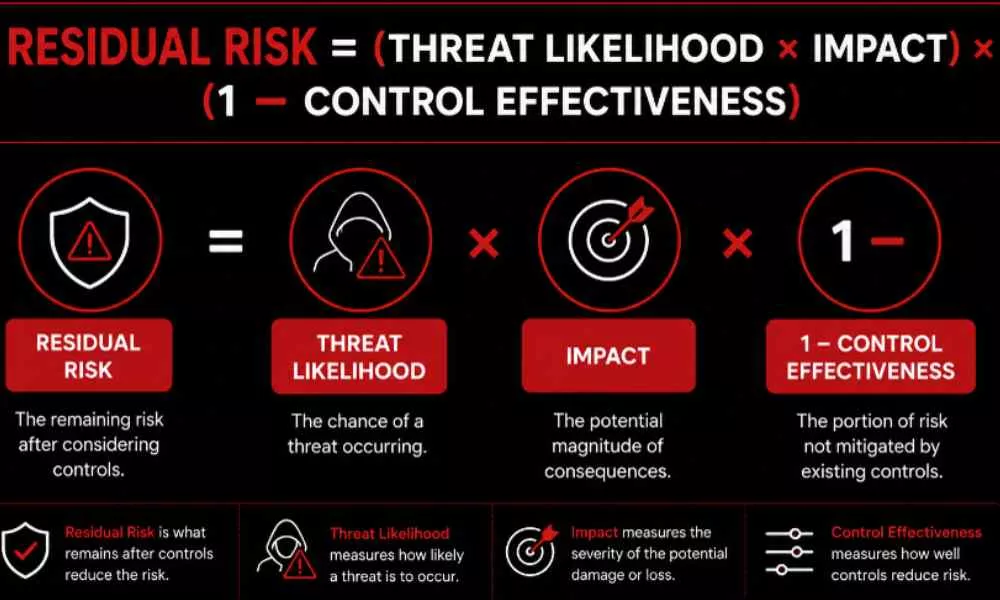
In practice, most teams don’t calculate this with mathematical precision. Instead, they use qualitative or semi-quantitative scoring, rating likelihood and impact on a scale (e.g., 1–5), then adjusting the score downward based on how effective existing controls are judged to be. The result is typically expressed as Low, Medium, High, or Critical residual risk, often visualized on a heat map.
What is the Importance of Tracking Residual Risk?
Ignoring residual risk creates a false sense of security. Organizations that implement controls and stop measuring what’s left behind often assume they’re protected when significant exposure still exists. Tracking residual risk matters because it:
- Informs accurate decision-making: Leadership can only make sound risk-acceptance decisions if residual exposure is clearly quantified and documented.
- Supports regulatory and audit requirements: Auditors increasingly expect evidence that residual risk was assessed and formally accepted, not just that a control exists. This is a recurring theme in cybersecurity audit readiness programs.
- Prioritizes remediation efforts: Security teams have limited time and budget. Tracking residual risk helps prioritize which gaps need attention first.
- Prevents control decay: Controls that were effective a year ago may weaken over time due to configuration drift, new threats, or personnel changes. Ongoing tracking catches this before it becomes a breach.
- Extends to third parties: Vendors and partners introduce inherited risk. Programs built around modern third-party risk management apply the same residual risk logic to external relationships, not just internal systems.
How to Track Residual Risk: A Practical Framework?
- Maintain a centralized risk register: Every identified risk, its inherent score, applied controls, and resulting residual score should live in one authoritative system, not scattered spreadsheets across departments.
- Score consistently: Use a standardized scoring methodology (likelihood × impact, or a recognized framework like ISO 31000) across every business unit so residual risk scores are comparable.
- Reassess on a defined cadence: Residual risk isn’t static. Reassess after major system changes, new threat intelligence, control failures, or at minimum on a quarterly basis for high-priority risks.
- Map residual risk to risk appetite thresholds: Build a heat map or dashboard that flags any risk exceeding your organization’s tolerance, so it surfaces automatically rather than getting buried in a report.
- Document risk acceptance formally: When residual risk is knowingly accepted, capture who approved it, why, and for how long. This is critical evidence during audits and regulatory reviews.
- Automate where possible: Manual tracking doesn’t scale. Continuous monitoring platforms and GRC tools can recalculate residual risk in near real time as new data comes in, like how agentic GRC systems now automate evidence collection and gap analysis.
Turn Residual Risk Into a Managed, Measurable Program
Understanding residual risk is only half the work, tracking it consistently, documenting acceptance decisions, and keeping pace with a constantly shifting threat landscape is where most organizations struggle. Ampcus Cyber’s Risk Assessment & Management services help you identify inherent risk, evaluate control effectiveness, and build a defensible, audit-ready residual risk program tailored to your business.
| Talk to our risk management experts and turn uncertainty into a structured, measurable strategy. |
Enjoyed reading this blog? Stay updated with our latest exclusive content by following us on Twitter and LinkedIn.