











Cyber insurance premiums are no longer based solely on industry or company size. Modern underwriters evaluate your security governance posture, control maturity, and continuous evidence before determining pricing and coverage. Learn how governance directly influences insurability, what insurers assess, and the steps to secure better terms while strengthening cyber resilience.
Your security governance posture affects your cyber insurance premium because underwriters now price policies based on verifiable evidence of control maturity, not stated intent. Organizations that can prove framework-aligned governance (MFA enforcement, tested incident response, immutable backups, documented vendor oversight) qualify for lower premiums, broader coverage, and fewer exclusions.
Organizations that cannot prove it face higher premiums, denied claims, or outright non-renewal.
For CISOs and governance leaders, this makes cyber insurance far more than a finance-team line item, it is a direct output of how well the organization governs risk. The sections below break down exactly how underwriters score governance posture, what evidence moves the needle, and how to convert governance maturity into better pricing at renewal.
Why Has Underwriting Shifted From Trust to Verification?
Underwriting has shifted from trust to verification because rising claims frequency forced carriers to move from broad actuarial averages to technical, evidence-based risk scoring of each applicant.
The U.S. cyber insurance market has grown to nearly $10 billion in direct written premium, with policies in force rising year over year even as pricing has started to stabilize. But that growth has come with sharply tighter underwriting rigor. Carriers increasingly rely on AI-driven platforms that scan an applicant’s external attack surface, dark web exposure, and internal control telemetry before a quote is even generated, replacing the old model of self-reported questionnaires with continuous, outside-in verification.
The financial stakes of getting this wrong are severe. Coalition’s claims data points to a scenario worse than a denied application: an organization pays premiums for months or years, believes it is covered, suffers an incident, and only then discovers the insurer is denying the claim because the controls attested to at policy inception were never actually maintained. Strong governance isn’t just about winning better pricing, it’s about ensuring the policy you’re paying for will pay out.
What Governance Controls Do Underwriters Actually Score?
Underwriters score six governance dimensions including identity and access control, detection and response maturity, incident response readiness, backup and recovery discipline, vendor risk oversight, and patch management cadence.
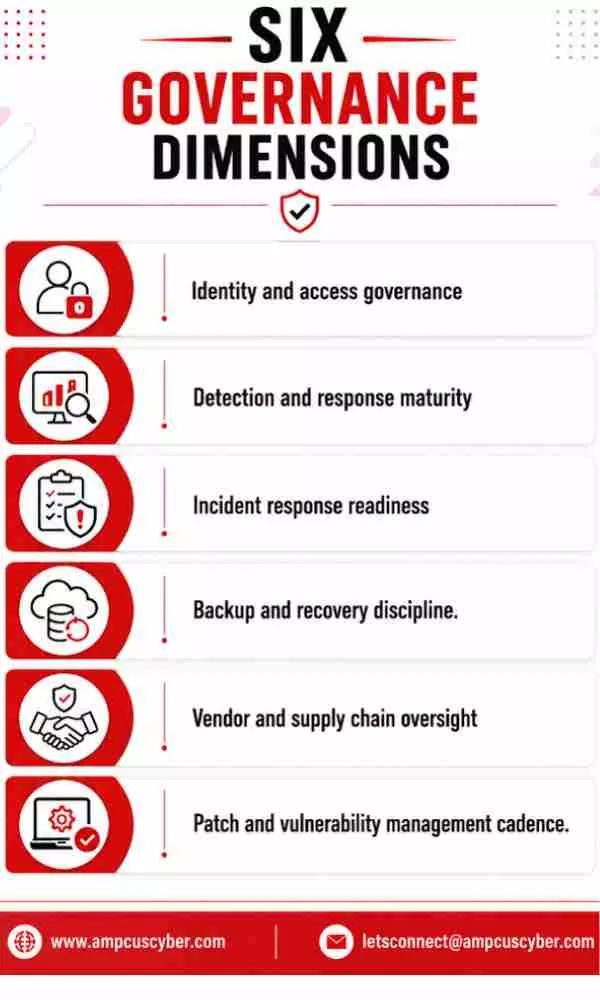
- Identity and access governance: Multi-factor authentication, particularly phishing-resistant methods for privileged, remote, and SaaS access, has moved from a recommended control to a baseline requirement. Applicants without enforced MFA are frequently classified as high risk before any other factor is considered.
- Detection and response maturity: Endpoint detection and response (EDR) with 24/7 monitoring, integrated SOC or MDR workflows, and demonstrable alert-to-remediation timelines signal that a governance program can contain an incident before it becomes a catastrophic loss.
- Incident response readiness: Underwriters want proof, not policy documents alone: evidence of recent tabletop exercises, a contactable on-call roster, and a retained forensics partner. A tested IR plan has been linked to meaningfully lower average breach costs, precisely the kind of quantifiable risk reduction underwriters reward in pricing.
- Backup and recovery discipline: Immutable or air-gapped backups, tested recovery procedures, and off-site storage are scrutinized closely, since ransomware resilience hinges on an organization’s ability to recover without paying an extortion demand.
- Vendor and supply chain oversight: Third-party involvement in breaches has been rising sharply, and supply chain incidents now carry some of the longest resolution timelines and highest costs of any breach category. Underwriters expect a current, evidenced vendor risk register, not a static list from an old audit.
- Patch and vulnerability management cadence: A large share of incidents still trace back to unpatched, known vulnerabilities. Documented patch cycles and vulnerability scan results demonstrate operational discipline, not just intent.
Does Aligning to a Framework Like NIST CSF or ISO 27001 Actually Lower Premiums?
It Does! Framework alignment lowers perceived risk because it gives underwriters a standardized way to score control maturity, which consistently rates better than an unstructured list of security tools.
Organizations that present their governance program through a recognized framework are treated as lower risk than those who simply list purchased tools. A framework gives underwriters a common language to assess control maturity and benchmark an applicant against thousands of comparable risk profiles. It signals that governance decisions are structured, repeatable, and owned at a leadership level, rather than reactive purchases made after the last incident.
This is where governance, risk, and compliance (GRC) programs earn their keep well beyond regulatory compliance. A mature GRC program that continuously aligns policies, controls, and evidence to a recognized framework does double duty: it satisfies regulators, and it becomes the exact documentation package underwriters are asking for at renewal.
How Can Governance Leaders Turn Posture Into Better Pricing?
Governance leaders improve pricing outcomes by documenting continuously, quantifying risk reduction with trend data, running a pre-underwriting risk assessment, and validating controls year-round instead of once a year.
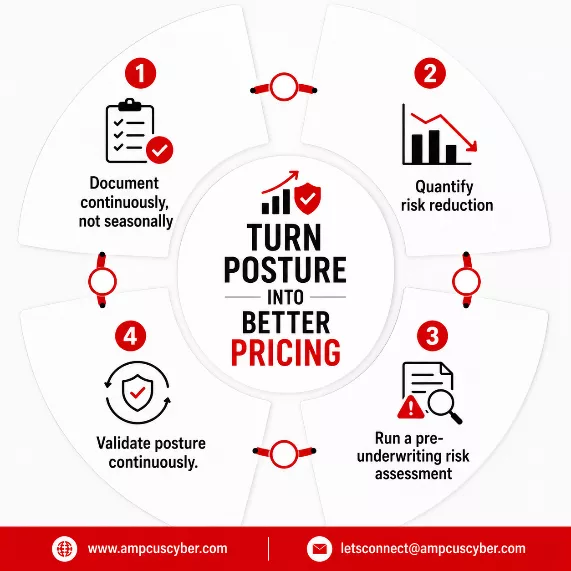
- Document continuously, not seasonally: Maintain live evidence, training completion records, patch management logs, vulnerability scan results, backup recovery test results, and IR exercise reports, so nothing needs to be reconstructed under deadline pressure.
- Quantify risk reduction: Show trend lines: declining mean-time-to-remediate for critical vulnerabilities, improving phishing simulation results, and shrinking detection-to-response windows. Underwriters price trends, not snapshots.
- Run a pre-underwriting risk assessment: A structured risk assessment and management engagement before you apply or renew identifies control gaps while there’s still time to remediate them, before an underwriter’s automated scan finds them first.
- Validate posture continuously: Ongoing assurance and continuous monitoring, rather than a once-a-year audit, keeps your organization inside the risk band insurers reward with better terms, and helps ensure the coverage you’re paying for will hold up at claim time. Ampcus Cyber’s Assurance-as-a-Service model was built for exactly this kind of continuous validation.
Even in a market where average premiums have softened somewhat due to insurer competition, claims frequency continues to climb, a warning that relaxed underwriting today can mean costlier incidents tomorrow. Governance leaders who treat their control environment as a living, evidenced program are the ones consistently securing better terms, broader coverage, and, most importantly, claims that pay out.
The Bottom Line
Your cyber insurance premium is priced on how well you can prove your governance program, works not on industry averages alone. For CISOs and governance leaders, that makes strong, evidenced, framework-aligned governance one of the highest-leverage investments available: it reduces the likelihood of an incident, and it directly lowers the cost of transferring the risk that remains.
| Ready to strengthen your security governance posture and improve your insurability? Talk to Ampcus Cyber experts about a governance and risk assessment built to hold up under underwriter scrutiny. |
Enjoyed reading this blog? Stay updated with our latest exclusive content by following us on Twitter and LinkedIn.