





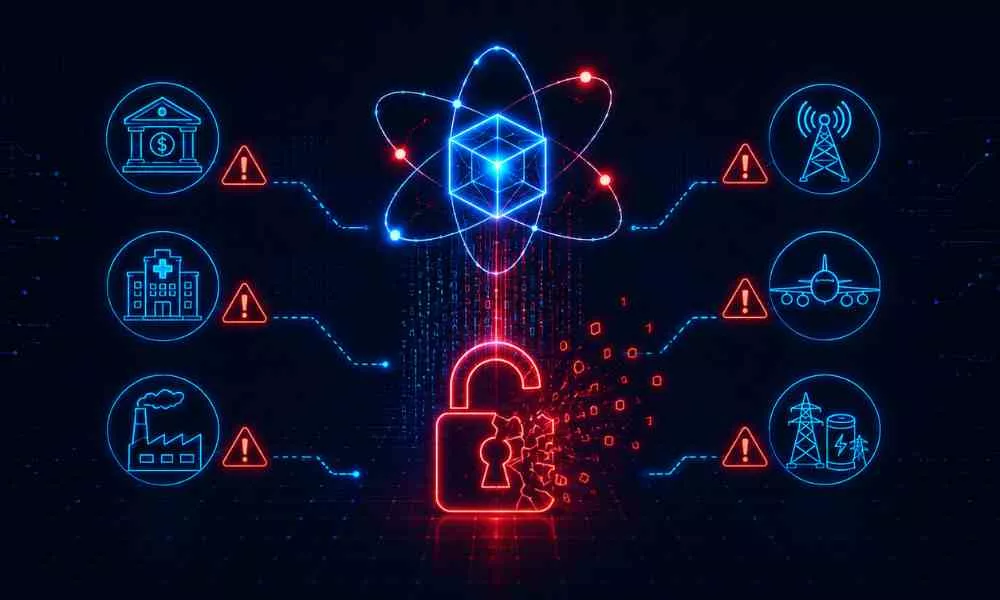
Quantum decryption isn’t distant threat now. From banking and defense to healthcare and critical infrastructure, discover which industries face the highest exposure to “Harvest Now, Decrypt Later” attacks and why crypto-agility is becoming essential for long-term resilience.
The race toward a cryptographically relevant quantum computer (CRQC) is accelerating. While symmetric encryption (like AES-256) can resist quantum attacks by utilizing longer key lengths, public-key cryptography including RSA, Elliptic Curve Cryptography (ECC), and Diffie-Hellman, underpins nearly all modern digital trust and is completely vulnerable.
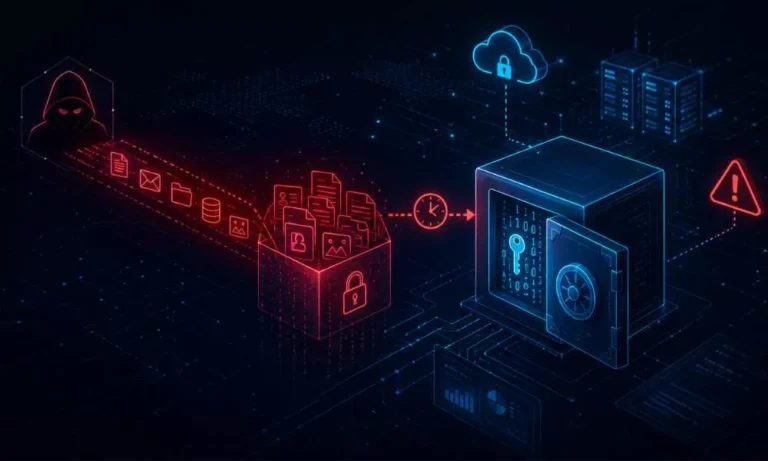
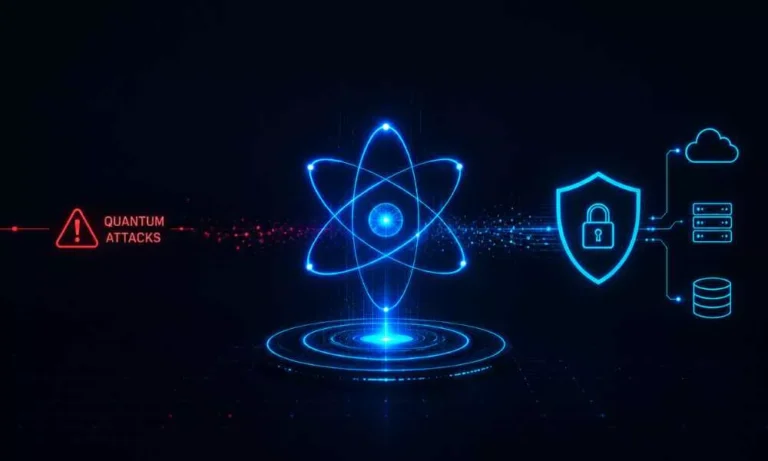
Threat actors are already executing “Harvest Now, Decrypt Later” (HNDL) attacks, actively siphoning and storing encrypted data today to decrypt it the moment quantum computing matures. Consequently, quantum vulnerability is not a future IT problem; it is an active data exposure issue happening right now.
Quantum Vulnerability Matrix: A Glance
| Industry | Primary Risk Driver | Critical Vulnerability | Impact Severity |
| Financial Services | Real-time transactional reliance; systemic dependency. | Interception of payment routing; forged transaction authorizations. | Critical |
| Defense & Government | Extreme data longevity requirements (decades-long classification). | Retroactive decryption of state secrets and military communications. | Critical |
| Critical Infrastructure | Legacy operational technology (OT); long hardware lifecycles. | Forged firmware updates to PLCs/SCADA; physical grid disruption. | High |
| Healthcare & Pharma | Lifetime data retention mandates; high-value proprietary IP. | Decryption of patient health records; theft of drug formulas. | High |
| Telecommunications | Core routing layer of global internet traffic. | Massive-scale passive harvesting of global network data packets. | High |
The Quantum Readiness Gap
The greatest quantum risk facing enterprises today is not the eventual arrival of a CRQC. It is the widespread, dangerous assumption that organizations have time to wait.
Most enterprises cannot identify where public-key encryption algorithms are embedded across their environments. Cryptographic dependencies often exist silently inside legacy applications, embedded devices, third-party software, VPN infrastructure, and vendor ecosystems.
For many organizations, the true hurdle is not deploying new mathematical algorithms. It is cryptographic discovery, finding where vulnerable algorithms exist before they can be replaced.
Proprietary Framework: The Quantum Exposure Model
To help organizations objectively measure their risk, Ampcus Cyber evaluates industry vulnerability across four distinct vectors:
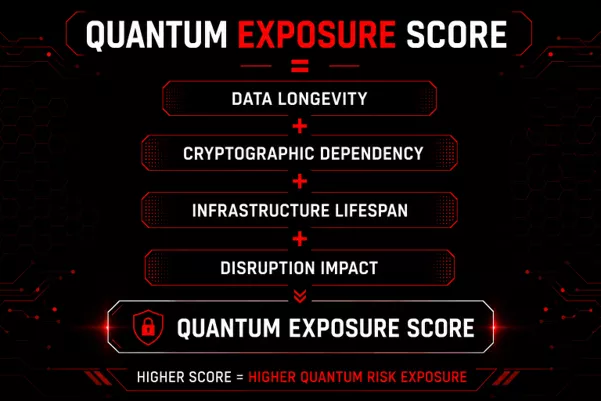
- Data Longevity: How long must stole data remain confidential before its exposure no longer causes damage? (e.g., 20+ years for defense secrets vs. 20 minutes for high-frequency trading data).
- Cryptographic Dependency: How deeply intertwined is the sector with public-key infrastructure (PKI) for basic operations, data transit, and access management?
- Infrastructure Lifespan: How difficult and time-consuming is it to replace or patch the underlying hardware and software?
- Disruption Impact: What are the physical, financial, or societal consequences if the industry’s digital trust layer completely fails?
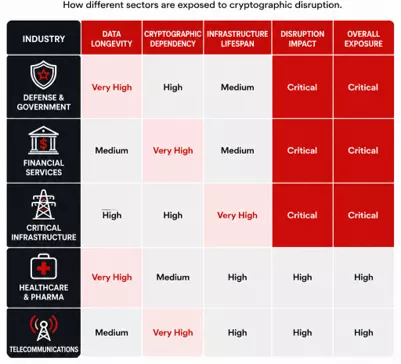
Sector Exposure Scorecard
Evaluating the core vulnerable industries against these dimensions reveals which sectors face the most compressed timelines for post-quantum migration:
Why Quantum Risk Prioritization Matters?
Not every organization needs to migrate to post-quantum cryptography at the same pace. Industries with long-lived data, legacy infrastructure, and high trust requirements face a significantly shorter timeline than sectors handling short-lived information. Using this exposure model allows executive leadership to move past the panic of “Q-Day” and establish a risk-prioritized, budget-conscious modernization roadmap.
Deep Dive: The Vulnerable Industries
1. Financial Services & Banking
The financial sector is a primary target for quantum-capable nation-states and sophisticated cybercriminals due to its total reliance on digital trust.
The Board Perspective: For financial institutions, quantum risk is ultimately a trust problem. If digital signatures can no longer be trusted, the integrity of transactions, settlements, and customer authentication becomes fundamentally uncertain.
Protocols like SWIFT and domestic clearinghouses depend heavily on public-key mechanisms. A quantum attack using Shor’s algorithm would allow malicious actors to forge digital signatures, manipulate ledger balances, and intercept or alter interbank wire transfers, destabilizing systemic trust overnight.
2. Defense, Government, and National Security
For state actors, the timeline for quantum vulnerability is dictated by the lifecycles of state secrets, making it an immediate national security crisis.
Because intelligence agencies and diplomatic channels handle classified information that must remain secure for 20 to 50+ years, they are the primary targets of HNDL attacks. Foreign adversaries are actively siphoning encrypted government communications today. When quantum decryptors go online, decades of historical geopolitical strategies, weapon designs, and identity records of undercover assets will instantly become transparent.
3. Critical Infrastructure & Utilities (Energy, Water, Transportation)
Industrial environments are structurally vulnerable because they bridge digital networks with physical operations through Operational Technology (OT).
Unlike traditional IT environments, operational technology cannot always be patched or replaced quickly. Some critical infrastructure assets remain operational for decades, making quantum migration significantly more complex than a standard software upgrade. Power grids, water treatment plants, and transportation networks run on SCADA systems and programmable logic controllers (PLCs) that lack the processing power or memory required to handle complex Post-Quantum Cryptography (PQC) algorithms. Attackers could compromise the secure boot process or forge vendor digital signatures to push malicious firmware updates, causing catastrophic physical damage.
4. Healthcare and Pharmaceuticals
Healthcare organizations handle an immense volume of highly regulated data, while pharmaceutical companies hold trillions of dollars in intellectual property.
Medical records (Protected Health Information or PHI) have a legal and functional lifespan tied to the patient’s lifetime. Concurrently, pharmaceutical companies rely on decades of proprietary data for drug discovery and clinical trials. These long-term data stores are uniquely susceptible to retrospective decryption. Compromising a health network’s archival backups could lead to catastrophic identity theft and extortion on a massive scale, while the theft of proprietary molecular formulations could wipe out a biotech firm’s competitive advantage overnight.
5. Telecommunications & Cloud Infrastructure
Telecommunications networks and cloud service providers form the physical and virtual routing layer of the global internet.
Telecom providers manage the transmission tunnels (such as VPNs, TLS/SSL channels, and fiber-optic backbones) that move global enterprise and civilian data. Because they act as conduits, telecom pipelines are the primary extraction points for passive harvesting. If an adversary compromises the underlying key exchange protocols (like Diffie-Hellman), they can undermine the confidentiality of historical communications at an unprecedented scale, rendering all historical internet traffic passing through those nodes entirely visible.
Summary: Moving Toward Crypto-Agility
To survive the quantum shift, vulnerable industries must move beyond static security models and embrace crypto-agility, the structural capability of an information system to rapidly switch cryptographic primitives and algorithms without disrupting the underlying architecture.
The most dangerous misconception surrounding quantum computing is that the threat begins when a cryptographically relevant quantum computer arrives. In reality, the threat begins the moment sensitive information is collected and stored by an adversary today.
Organizations that achieve crypto-agility before the quantum transition will view PQC as a planned, orderly modernization effort. Those that wait may find themselves attempting to rebuild digital trust under crisis conditions. The organizations most vulnerable to quantum decryption are not necessarily those with the largest attack surfaces. They are the organizations whose data remains valuable long after it is stolen. For them, quantum readiness is no longer a technology initiative. It is a long-term business resilience strategy.
Is Your Industry Ready for the Quantum Era?
| Talk to Ampcus Cyber experts to assess your quantum exposure, discover hidden cryptographic dependencies, and build a risk-prioritized roadmap toward post-quantum resilience. |
Enjoyed reading this blog? Stay updated with our latest exclusive content by following us on Twitter and LinkedIn.