









When a cyberattack occurs, an organization’s ultimate trajectory is rarely determined by the sophistication of the attacker. Instead, it is determined by the speed and coordination of the defense.
What is Incident Response Plan?
An incident response plan (IRP) is a documented, structured blueprint outlining exactly how an enterprise detects, responds to, and recovers from cybersecurity disruptions. When executed properly, an IRP protects assets, preserves operational continuity, and minimizes both financial and reputational damage.
However, modern security research reveals a concerning paradox: while a vast majority of enterprises maintain a documented IRP on paper, most plans harbor systematic structural flaws that cause them to fail under real-world pressure.
What is the Importance of Incident Response Planning?
As cyber threats continue to grow in frequency, complexity, and impact, having a well-defined incident response plan is essential to strengthening an organization’s security posture. Being prepared before an incident occurs enables organizations to contain threats faster, minimize business disruption, and reduce the overall impact of an attack.
Cyber incidents can damage brand reputation, erode customer trust, and result in significant financial and regulatory consequences. An effective incident response plan, combined with lessons learned from previous events, helps organizations improve resilience, strengthen defenses, and reduce the likelihood of future breaches and penalties.
What is The Core Framework: The 6 Phases of Incident Response
An effective incident response capability is built on structured, reproducible phases. Industry standards, such as the frameworks established by the SANS Institute and the National Institute of Standards and Technology (NIST), divide the incident response lifecycle into six essential stages:
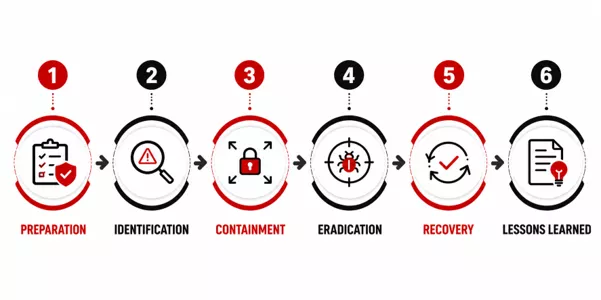
1. Preparation: Developing playbooks, establishing a cross-functional Computer Security Incident Response Team (CSIRT), setting up incident response testing, and securing forensic infrastructure before an anomaly occurs.
2. Identification: Aggregating data logs from SIEM systems, firewalls, and endpoints to distinguish true malicious threats from false positives, thereby establishing a clear scope of the compromise.
3. Containment: Executing coordinated technical plays (such as isolating network segments or revoking compromised credentials) to prevent the threat from moving laterally across systems.
4. Eradication: Identifying the root cause of the attack, completely removing malware or web shells, and closing the initial attack vectors exploited by the adversary.
5. Recovery: Restoring clean systems from verified backups, validating that abnormal infrastructure behaviors have ceased, and returning business operations to a baseline state.
6. Lessons Learned: Conducting a post-incident review to analyze the timeline, identify technical or operational loopholes, and update playbooks to prevent future exploitation.
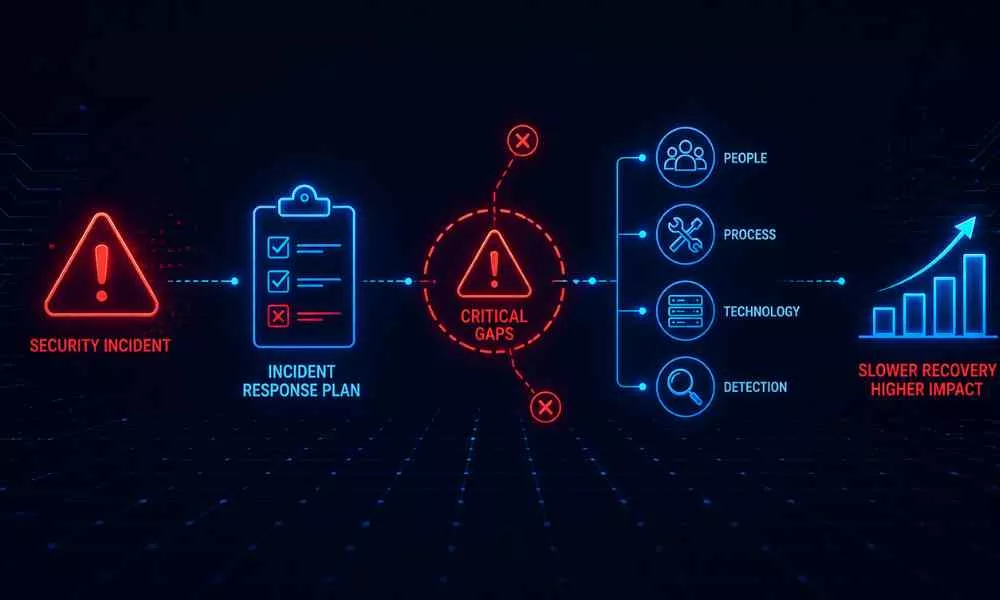
What are Critical Gaps Sabotaging Modern Incident Response Plans?
A documented strategy does not equate to real-world readiness. When an organization suffers an extended operational outage, it is typically because their IRP relies on theoretical assumptions rather than practical validation.
The following structural blind spots frequently cause standard incident response procedures to collapse during a live crisis:
1. Treating Log Health as a Dashboard Checkbox
During an active forensic investigation, visibility is everything. Many organizations integrate complex detection tools but fail to actively verify log ingestion. Security analysts regularly realize mid-crisis that a critical telemetry feed broke months prior, or that an attacker successfully unhooked PowerShell Module and Script Block logging. If your log collection infrastructure is unmanaged, your visibility disappears when you need it most.
2. The Isolation of the Security Team (The Cross-Functional Gap)
Cybersecurity incidents are not purely technical events; they are organizational crises. If an IRP excludes executive leadership, legal counsel, compliance, and public relations until after systems are encrypted, containment delays multiply exponentially. For instance, if your technical team must halt operations to contain an infection but lacks a pre-approved RACI matrix indicating who has the organizational authority to “flip the kill switch,” hesitation can cost hours of widespread exposure.
3. Assuming Corporate Networks Will Be Available for Communication
When an advanced adversary or a widespread ransomware simulation takes down an enterprise network, primary internal channels like corporate email, Microsoft Teams, and Slack are either entirely locked or compromised. Discussing a live investigation on an impacted network allows attackers to monitor the defense strategy in real-time. Without a dedicated, secure, out-of-band communication framework completely decoupled from the corporate identity infrastructure, coordination breaks down immediately.
4. Overlooking Help Desk and Frontline Vulnerabilities
The initial point of detection often starts at the user help desk via an employee reporting strange computer behavior or frequent account lockouts. If frontline support teams are not explicitly trained in incident handling best practices, their standard troubleshooting routines, such as rebooting systems, running generic cleaning tools, or resetting local configurations, can inadvertently destroy invaluable volatile memory images and forensic evidence.
5. Blind Spots Across Cloud, SaaS, and OT Environments
Many legacy incident response plans are tailored for on-premises IT architecture. Modern infrastructure requires unified visibility that spans multi-cloud environments, decentralized SaaS applications, and Operational Technology (OT) or Industrial Control Systems (ICS). When an organization maintains weak network segmentation or fails to expand their IR playbooks into their cloud and OT footprints, threat actors leverage these blind spots to move laterally across environments undetected.
How to Scale up the Incident Response Maturity?
Building sustainable cyber resilience requires moving past basic document compliance. Security leaders evaluate their operational readiness by mapping their programs to a standardized incident response maturity model:
| Maturity Level | Strategy Characteristics | Operational Reality |
| Level 1: Documented | Boilerplate Strategy | A written document exists to pass an audit or secure insurance, but it contains outdated contact lists and unverified procedures. |
| Level 2: Tabletop Tested | Scenario Discussion | Stakeholders meet periodically to walk through hypothetical attacks, clarifying strategic alignment and policy expectations. |
| Level 3: Operationally Validated | Functional Exercises | Technical teams actively test infrastructure plays, validating forensic tools, log collection health, and out-of-band communication networks. |
| Level 4: Continuously Rehearsed | Cross-Functional Drills | Executive leadership, general counsel, and PR teams participate in active, coordinated crisis exercises alongside technical defenders. |
| Level 5: Threat-Informed | Adaptive Resilience | Active simulations are built dynamically using localized threat intelligence, recreating hyper-realistic adversary behaviors under pressure. |
Is your incident response plan ready for a real-world cyber crisis?
Move beyond static documentation and build operational resilience. Ampcus Cyber helps organizations assess incident response maturity, identify critical gaps, conduct tabletop and technical exercises, and develop threat-informed response capabilities that stand up under pressure.
| Connect with Ampcus Cyber to evaluate, validate, and strengthen your incident response readiness before the next attack tests it for you. |
Enjoyed reading this blog? Stay updated with our latest exclusive content by following us on Twitter and LinkedIn.