









Every CISO knows the feeling. Audit season arrives, and the same requests land in the same inboxes: screenshots of access controls, logs from three different systems, sign-off emails buried in someone’s archive from eight months ago. The controls are sound. The security program works. Yet the team spends weeks proving it, chasing down artifacts that already exist somewhere in the organization.
This is the quiet crisis in compliance today. Frameworks are well understood, tools are mature, and the teams know what “good” looks like. The bottleneck is not strategy or intent but evidence management. It is the unglamorous work of collecting, organizing, and presenting proof that controls are operating as designed.
Evidence Management in Brief
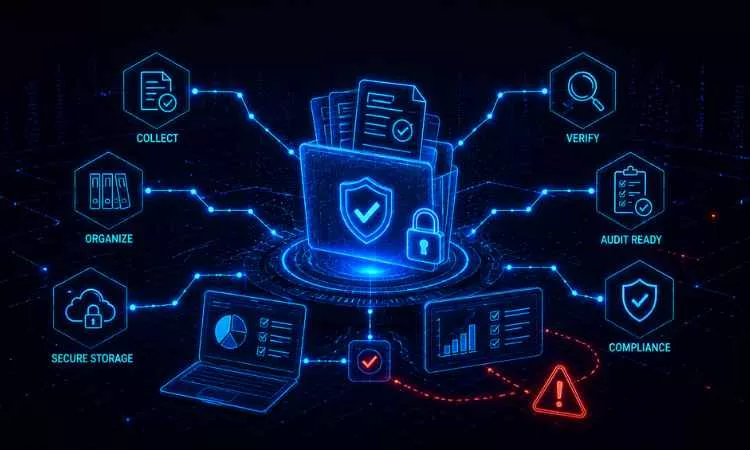
Evidence management is the practice of capturing, storing, and mapping documentation that demonstrates a control is functioning correctly. This includes configuration exports, access reviews, change logs, policy acknowledgments, vendor attestations, and incident records. For every framework a company follows, whether PCI DSS, ISO 27001, SOC 2, HIPAA, or NIST CSF, auditors need current, verifiable proof tied to specific control requirements.
On paper, this sounds like a filing exercise. In practice, it is one of the most resource intensive parts of any compliance program. Evidence lives across cloud consoles, ticketing systems, identity providers, spreadsheets, and email threads. Someone must find it, confirm it is current, format it for the auditor, and repeat the process for every overlapping framework the organization maintains.
Why Evidence Collection is Considered a Bottleneck?
The numbers make the scale of the problem clear. Research from Swimlane found that 92 percent of organizations rely on three or more separate tools just to gather audit evidence, and only 39 percent of the evidence process is automated. Over half of the teams surveyed spend more than five hours a week on manual compliance tasks, and 62 percent describe their evidence gathering as at least occasionally error prone. (Swimlane, GRC Chaos Report)
Hyperproof’s mid-2026 review of IT risk and compliance found a similar pattern at a larger scale. Despite widespread adoption of common controls frameworks and continuous monitoring tools, 76 percent of GRC professionals still spend 30 percent or more of their working hours on repetitive administrative tasks. (Hyperproof, Mid-2026 Compliance Review)
Telos research puts a dollar figure on the drain. IT security professionals field an average of more than 17 audit evidence requests every quarter, spending nearly three working days on each one. Across a year, that adds up to roughly 58 working days per quarter dedicated to responding to evidence requests, at an average cost of $3.5 million annually in security and privacy compliance activity. (Telos, Audit Fatigue Report)
These figures explain why security leaders describe audit prep as a second full-time job for their compliance function. Every new regulation, every new customer questionnaire, every new certification adds another layer of evidence requests on top of an already stretched team.
Where the Hidden Costs Show Up?
The direct labor cost is only part of the story. Manual evidence management creates three deeper problems for CISOs and governance leaders.
The first is duplication. Most frameworks share a large percentage of overlapping controls, yet without a mapped, control-centric structure, teams end up collecting the same access logs and configuration screenshots multiple times a year for different auditors. This is exactly the kind of fragmentation Ampcus Cyber’s Governance, Risk & Compliance services are built to eliminate, by aligning controls once and mapping them across frameworks.
The second is staleness. A spreadsheet captures a moment. By the time that evidence is reviewed weeks later during an audit, the underlying system configuration may have already changed. Auditors increasingly flag this gap, and it directly affects audit outcomes. In fact, research shows that 38 percent of organizations have had an audit report rejected outright by a vendor or prospect due to weak or outdated evidence.
The third is opportunity cost. Every hour a security engineer spends pulling screenshots for an audit is an hour not spent closing a live vulnerability. Evidence management, done manually, pulls the most technically capable people in the organization away from the work that reduces risk.
From Point-in-Time Audits to Continuous Evidence Management
The organizations breaking out of this cycle are shifting from a point-in-time audit mindset to continuous compliance. Instead of scrambling to assemble proof before each audit, controls are validated on an ongoing basis, and evidence is captured automatically as systems operate.
This is the model behind Compliance Compass, Ampcus Cyber’s approach to regulatory compliance across PCI DSS, SOC 1 and 2, ISO 27001, HITRUST, CMMC, and other standards. Rather than treating each certification as a standalone project, compliance is built around a shared control structure that reduces the number of times the same evidence must be gathered and reviewed.
Purpose built platforms extend this further. GRACE centralizes evidence collection into structured repositories tied directly to governance controls, replacing scattered ticketing systems, cloud logs, and shared drives with a single source of truth. Built on a control-centric architecture, controls mapped once against PCI DSS, ISO 27001, SOC 2, or NIST CSF can support multiple certifications simultaneously, cutting down the duplication that drives audit fatigue.
How CISOs Can Fix the Evidence Management Bottleneck?
Solving this is not simply a matter of buying software. It requires a structural decision about how the compliance program is run. A few practical steps make the biggest difference.
Start by mapping controls once across every framework the organization holds, rather than managing each certification in isolation. Overlapping requirements should feed into a single evidence library, not five separate ones.
Automate evidence capture at the source wherever possible. Cloud infrastructure, identity providers, DevOps platforms, and ticketing systems can all feed evidence directly into a governance system through API integrations, removing the need for someone to manually export and upload artifacts.
Decide whether the organization needs a compliance automation tool focused on audit prep, or a broader GRC platform that connects evidence management with enterprise risk and governance. This distinction matters more as regulatory obligations expand, and it is worth exploring in more depth in our earlier piece on choosing between a GRC platform and compliance automation.
Extend the same discipline to third party risk. Vendors and suppliers generate their own evidence gaps, and organizations that still rely on annual vendor reviews face the same staleness problem internally. Our guide to continuous third party risk monitoring covers how to extend evidence-based visibility beyond the organization’s own infrastructure.
Building an Evidence Management Strategy That Scales
Compliance programs will only get more complex as regulations multiply and enterprises adopt more frameworks at once. Organizations that keep treating evidence collection as a manual, reactive scramble will keep losing time, budget, and their best technical talent to audit prep. Those that build evidence management into daily operations, with controls mapped once and evidence captured automatically, turn audit season into a formality instead of a fire drill.
The path forward is not about working harder during audit windows. It is about designing a governance structure where audit readiness is the default state, not a seasonal project.
Ready to stop chasing evidence and start managing it?
| Talk to Ampcus Cyber’s compliance experts about building a continuous, audit-ready evidence management program. |
Enjoyed reading this blog? Stay updated with our latest exclusive content by following us on Twitter and LinkedIn.