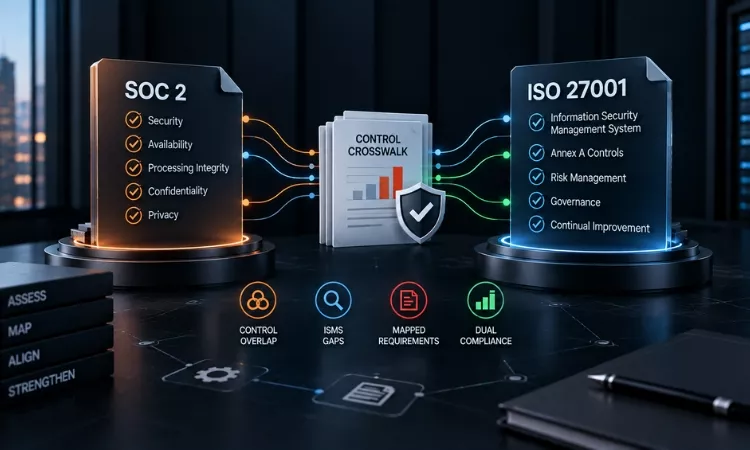









Large enterprises rarely deal with a single compliance obligation. A global organization might need to satisfy ISO 27001, SOC 2, PCI DSS, GDPR, and a handful of sector-specific frameworks simultaneously, often across multiple business units and jurisdictions that each interpret the requirements slightly differently. Recent industry research backs up what most compliance leaders already feel day to day.
Sophos found that organizations manage a median of five compliance standards at once, and that many frameworks require nearly identical information, resulting in heavy duplication of effort across teams.
That duplication is the root of most enterprise compliance pain. The challenges below show up repeatedly across large organizations, and each one points toward the same underlying fix: a single, evidence-backed system of record instead of parallel, disconnected compliance efforts.
Framework Sprawl Across Business Units and Jurisdictions
Large enterprises rarely run compliance from one central function. A finance team might own SOX controls, a security team might own ISO 27001 and SOC 2, and a regional office might be tracking GDPR or a local data protection law entirely on its own. Each group builds its own evidence, control language, and audit calendar, even when the underlying requirements overlap substantially.
This fragmentation means the same encryption policy, access review, or vendor assessment often gets documented three or four separate times in three or four separate formats, none of which talk to each other. When a new framework arrives, whether from an expanding market or a new regulation, the organization frequently builds yet another silo instead of mapping it against what already exists.
Evidence Chaos: Spreadsheets, Screenshots, and Siloed Systems
Compliance evidence at most large enterprises still lives across a patchwork of spreadsheets, shared drives, ticketing systems, and screenshots collected manually before each audit. Nobody owns a single, authoritative view of what evidence exists, when it was collected, or whether it is still current.
This creates two compounding problems.
- The evidence goes stale quickly, since a screenshot taken six months ago says nothing about today’s configuration.
- The same underlying proof, such as an access control review or an encryption setting, often needs to be re-collected separately for each framework it supports, because there is no shared structure connecting evidence to the multiple controls it could satisfy at once.
Duplicated Audit Effort and Audit Fatigue
Audit frequency at large enterprises has climbed sharply. According to A-LIGN’s 2026 Compliance Benchmark Report, 74% of large enterprises now manage four or more audits annually, and nearly all organizations surveyed conduct at least two. Each of those audits typically triggers its own evidence-gathering cycle, even when much of the underlying proof overlaps with an audit completed just months earlier.
The result is audit fatigue across security, IT, and compliance teams, who spend a disproportionate share of their time responding to auditor requests rather than improving the actual control environment. Teams end up managing the audit calendar instead of managing risk, which is precisely backward from what a mature compliance function should look like.
Third-Party and Vendor Risk at Scale
Large enterprises depend on hundreds, sometimes thousands, of vendors and subprocessors, each of which introduces its own compliance exposure. Verifying that every one of those vendors maintains adequate security controls is a massive undertaking on its own, and most organizations still rely on periodic questionnaires and annual reviews rather than ongoing verification.
This creates a significant blind spot. A vendor’s security posture can change between review cycles, and a large enterprise accountable for that vendor’s failures under frameworks like GDPR or DPDPA has little visibility into that drift until something goes wrong.
Governance Gaps for Non-Human and AI Identities
As enterprises deploy AI agents and automation across business functions, a newer compliance challenge is emerging. These systems process data, make decisions, and take actions, but most compliance programs were never built to govern non-human identities the same way they govern employees and vendors. Our detailed guide to Agentic GRC covers why this gap matters, particularly for organizations facing AI-specific regulatory expectations such as the EU AI Act, which require documented risk classification and continuous monitoring that manual compliance processes were never designed to handle.
Legacy Manual GRC vs. a Unified Compliance Platform
| Dimension | Legacy Manual GRC | Unified Platform Approach |
| Framework management | Separate silos per business unit or framework | Single control library crosswalked across 250-plus frameworks |
| Evidence status | Typed into a spreadsheet, easily stale | Derived from live evidence, recomputed as evidence arrives |
| Audit preparation | Rebuilt from scratch for each audit | Reused from a shared, continuously updated evidence base |
| Vendor oversight | Periodic questionnaires and annual reviews | Ongoing verification tied to the same evidence graph |
| Risk visibility | Color-coded heat maps based on subjective scoring | Quantified loss expectancy derived from actual control posture |
How GRACE Addresses These Challenges
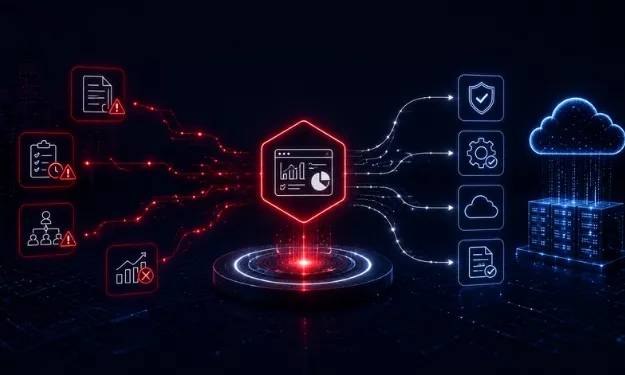
GRACE is built specifically around the gap this pattern reveals: compliance status that gets typed into a box by a person is only as reliable as the person typing it, and it stops being accurate the moment the underlying system changes. GRACE works differently. It maps more than 250 frameworks, including ISO 27001, SOC 2, NIST CSF, PCI DSS, and GDPR, onto a shared library of over 1,500 controls, so a single piece of evidence collected once can satisfy overlapping requirements across every framework it touches, instead of being gathered separately for each one.
Every control status inside GRACE is derived directly from evidence rather than manually entered, and that evidence is collected continuously through built-in discovery across cloud and SaaS environments, removing the need to chase screenshots before each audit cycle. Because every verdict traces back to the specific evidence that produced it, audit responses stop being a reconstruction exercise and become a direct query against an already-maintained system of record. For organizations navigating broader GRC platform decisions, this evidence-first structure is the core distinction between a platform that reduces compliance burden and one that simply digitizes the same manual process.
On the risk side, GRACE’s quantification engine, Grace-Q, replaces subjective heat maps with Monte Carlo simulation over actual control posture, producing annualized loss expectancy with confidence bands instead of a color a team assigned by judgment call. This gives boards and risk committees a number grounded in real evidence, not an estimate shaped by whoever filled out the assessment that quarter.
The Business Case for CISOs at Large Enterprises
Compliance complexity at scale is not going away. As regulatory frameworks continue expanding across data protection, AI governance, and sector-specific requirements, the organizations that keep managing each one in isolation will keep paying the duplication tax in staff time, audit fatigue, and slower response to new obligations. A unified GRC platform turns that duplicated effort into shared infrastructure, where evidence collected once serves every framework it applies to.
For CISOs managing large, multi-framework compliance programs, this shift changes the conversation from headcount and audit calendars toward architecture. The question stops being how many more compliance analysts are needed to keep up and becomes whether the underlying evidence system can scale with the organization’s regulatory footprint without adding proportional manual effort every time a new framework arrives.
Ampcus Cyber’s GRACE platform helps large enterprises replace fragmented, manual compliance work with a single, evidence-backed system of record across every framework they manage.
| Want to see how GRACE can simplify compliance at your organization’s scale? Book a demo now! |
Enjoyed reading this blog? Stay updated with our latest exclusive content by following us on Twitter and LinkedIn.