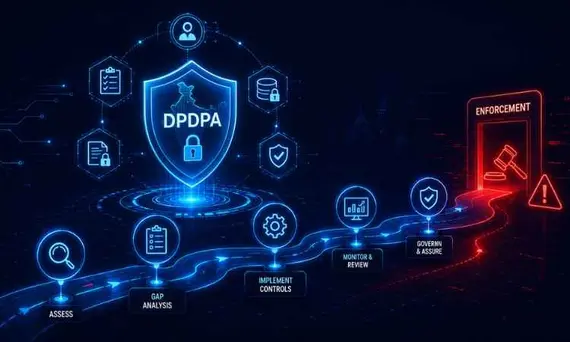










For years, Indian enterprises treated data protection compliance the way they treated most regulatory obligations: prepare a policy, run an audit before a deadline, file the report, and revisit it next year. That approach worked reasonably well under earlier, lighter-touch expectations. It does not hold up under the Digital Personal Data Protection Act, 2023, now that the Data Protection Board of India has been formally constituted and enforcement has begun.
The DPB does not review compliance the way an annual auditor does. It investigates specific incidents, specific breaches, and specific complaints, and it asks what safeguards were in place at that moment. A point-in-time audit report, however well produced, cannot answer that question with confidence months after it was signed off.
What the DPB Investigates When a Breach Happens
Under the DPDPA, a Data Fiduciary is the entity that determines the purpose and means of processing personal data, and it carries direct accountability for how that data is protected, even when a processor or vendor handles parts of the work. When a personal data breach occurs, the organization is required to notify both the Board and affected individuals, and the Board’s inquiry naturally centers on what security safeguards existed at the time of the incident, not what existed when the last compliance review was completed.
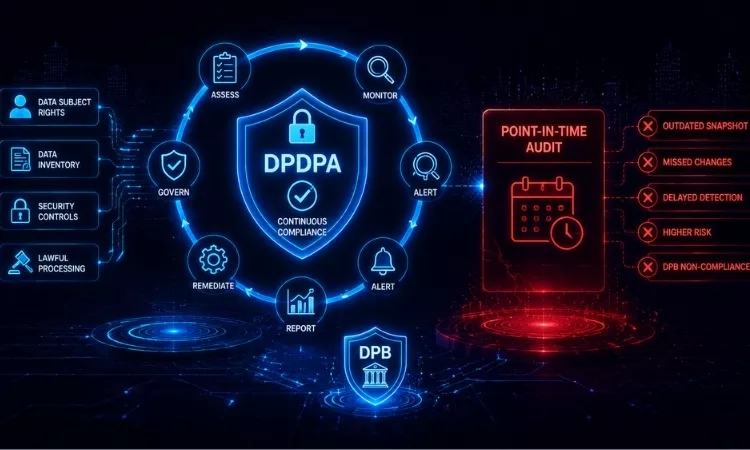
This is where the gap between traditional audit cycles and regulatory expectation becomes clear. An organization that passed a DPDPA readiness assessment in January but suffered a breach in October, after several system changes, vendor onboarding events, and access policy adjustments, cannot simply point back to the January report as proof of ongoing compliance. The Board is empowered to investigate contraventions and impose financial penalties that scale with the severity of the failure, and a documentation gap between audit and incident works directly against the organization under inquiry.
Why a Point-in-Time Audit Report Won’t Hold Up
Personal data environments do not stay still. New vendors get onboarded, consent flows get modified as products evolve, access permissions shift as teams reorganize, and data retention practices change as business needs shift. A single audit captures none of that ongoing movement.
Three specific weaknesses show up repeatedly when organizations rely on periodic audits alone.
1. Evidence Staleness: A report proving reasonable security safeguards existed on a specific date says nothing about whether those safeguards were still active, correctly configured, or unmodified by the time an incident occurred later in the year.
2. Vendor Blind spots: DPDPA accountability follows the Data Fiduciary even when a Data Processor handles the actual data. Annual vendor reviews rarely catch a processor’s configuration drift, a lapsed security control, or a subprocessor relationship that was never disclosed, all of which can surface only through continuous oversight.
3. Breach Notification Pressure: DPDPA breach notification timelines are tight, and organizations that lack continuous visibility into their own data flows and security posture struggle to determine breach scope quickly enough to meet those obligations, let alone demonstrate that reasonable safeguards were maintained in the interim.
The DPDPA Requirements That Demand Continuous Evidence
Several specific provisions push organizations toward continuous compliance rather than periodic review.
- Reasonable security safeguards under Section 8(5): The Act requires Data Fiduciaries to protect personal data through appropriate technical and organizational measures. Regulators and courts interpreting similar language in other jurisdictions have consistently treated this as an ongoing obligation, not a one-time implementation milestone.
- Personal data breach notification: Fast, accurate breach notification depends on knowing what data was affected and how, which requires real-time visibility into data flows and access activity rather than reconstructing the picture after the fact from outdated documentation.
- Data Protection Impact Assessments for Significant Data Fiduciaries: Organizations designated as Significant Data Fiduciaries face heightened obligations, including periodic assessments and independent audits, which are far easier to complete accurately when the underlying evidence has been collected continuously rather than assembled under deadline pressure.
- Vendor and processor accountability: As outlined in our earlier analysis of vendor breach liability under DPDPA, a Data Fiduciary cannot point to a vendor as the source of a breach if it never verified that vendor’s safeguards in the first place. Continuous vendor monitoring closes that gap.
Point-in-Time Audits vs. Continuous Compliance Under DPDPA
| Dimension | Point-in-Time Audit | Continuous Compliance |
| Evidence timing | Captured once, before a set review date | Collected on an ongoing basis as systems operate |
| Vendor oversight | Reviewed annually or at onboarding | Monitored continuously across the vendor relationship |
| Breach readiness | Reconstructed after an incident is discovered | Available immediately from existing evidence records |
| DPB inquiry response | Requires reassembling proof after the fact | Draws directly from a live, timestamped evidence trail |
| Regulatory alignment | Matches older, lighter-touch compliance models | Matches the ongoing safeguard obligations in Section 8(5) |
Building a Continuous DPDPA Compliance Program
A continuous compliance program for DPDPA starts with knowing exactly what personal data the organization processes, where it lives, and who can access it. Many Indian enterprises are still working through this baseline step, since data mapping was rarely a priority under earlier, less specific regulatory expectations. Our overview of the DPDP Rules 2025 breaks down how the operational requirements introduced under the Rules translate into practical obligations for data mapping, consent management, and breach handling.
From there, organizations need automated evidence collection tied directly to DPDPA obligations, including access logs, consent records, encryption status, and vendor security attestations, refreshed continuously rather than compiled once a year. This evidence needs to be mapped against the specific provisions a Data Fiduciary is accountable for, so that a DPB inquiry can be answered with current, verifiable proof rather than a document search.
Organizations already building broader DPDPA compliance programs are increasingly folding this continuous evidence layer into their existing GRC processes, rather than treating DPDPA as a separate, standalone exercise disconnected from other compliance work.
The Business Case for CISOs and Data Protection Officers
Regulatory penalties under DPDPA scale with the severity of the violation, and an organization’s ability to demonstrate ongoing safeguards, rather than a single historical snapshot, directly affects how an inquiry unfolds. Continuous compliance also reduces the operational burden on privacy and security teams, since evidence does not need to be reconstructed from memory and scattered documentation every time a regulator, customer, or internal audit committee asks a question.
For Data Protection Officers specifically, this shift changes the nature of the role from periodic project management toward ongoing operational oversight, with the ability to answer, at any point in time, what personal data is being processed, how it is protected, and where accountability sits across every vendor relationship. Organizations building this out often start with a structured DPDPA readiness assessment to establish the baseline before layering in continuous evidence collection.
In a Nutshell:
According to the Ministry of Electronics and Information Technology, the Digital Personal Data Protection Act and its accompanying Rules establish a phased framework for implementation, with the Data Protection Board of India now operational and empowered to investigate contraventions as they occur. The government’s official notification confirming the Board’s establishment outlines the core principles the Act is built around, including accountability and security safeguards that apply throughout the data lifecycle rather than at a single compliance checkpoint.
Ampcus Cyber helps Indian and multinational organizations build continuous, evidence-backed DPDPA compliance programs that hold up under real DPB scrutiny, not just audit season.
| Talk to our DPDPA compliance experts to assess where your data protection program stands today. |
Enjoyed reading this blog? Stay updated with our latest exclusive content by following us on Twitter and LinkedIn.