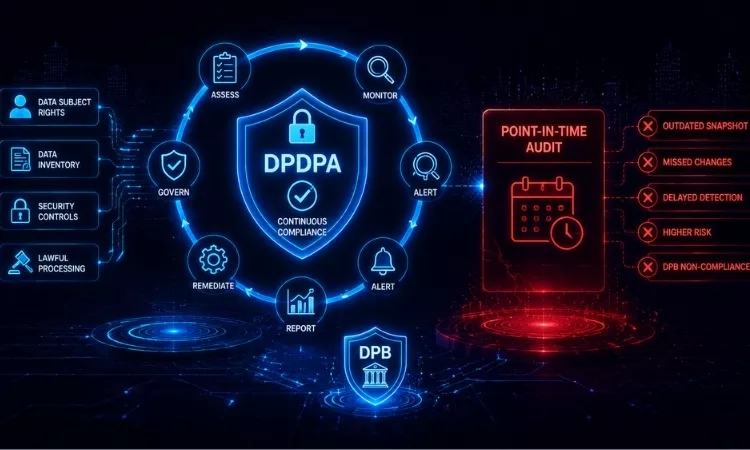











Your organization passed its DPDPA readiness assessment. Policies were written, consent flows were fixed, and vendors were reviewed. Six months later, a marketing team adds a new analytics tool, a developer widens access to a storage bucket, and a vendor quietly moves data to a new region. None of these felt like compliance decisions. Together, they moved you out of compliance without anyone noticing. That silent erosion is compliance drift, and under India’s Digital Personal Data Protection Act, it is where the real regulatory exposure lives.
What Is DPDPA Compliance Drift?
Compliance drift is the gradual gap that opens between the compliant state an organization documented at a point in time and the reality of how its systems, data, and vendors operate over time. Under the DPDPA, a company can be fully aligned on the day of assessment and materially non-compliant weeks later, not because anyone ignored the law, but because small, routine changes accumulated faster than governance could track them. DPDPA compliance is a continuous operating state, not a certificate you earn once and file away.
Why DPDPA Makes Drift So Dangerous
The Digital Personal Data Protection Rules, 2025 were notified by MeitY on 13 November 2025, activating the Act and setting a phased path to compliance, with most core obligations for data fiduciaries taking effect by 13 May 2027. The Data Protection Board of India is being established to investigate complaints, adjudicate, and impose penalties. Three features of this regime make drift especially costly.
- Enforcement is continuous, not periodic : The Board can call for information and act on complaints at any time. There is no annual window during which you simply need to look compliant. Your posture is tested against your live operations, whenever they are examined.
- Penalties are material : The Act allows penalties of up to 250 crore rupees per instance for failing to take reasonable security safeguards to prevent a breach. A single drifted control can carry a nine-figure consequence.
- Breach timelines are unforgiving : On a personal data breach, organizations must notify affected individuals and report to the Board, with a detailed report due within seventy-two hours. Drift that has quietly weakened a control tends to surface at the worst possible moment, under a clock.
The phased runway to 13 May 2027 can create a false sense of comfort. Organizations that treat the timeline as breathing room, rather than as a window to build durable governance, often drift furthest, because they achieve early readiness and then let it decay while enforcement machinery quietly comes online around them.
Where DPDPA Compliance Drift Happens?
Drift rarely comes from a dramatic failure. It accumulates in ordinary operational changes that no one flags as a privacy event.
- Consent and notice changes : A product team edits a signup flow, adds a pre-ticked box, or launches a feature that collects additional data. The notice no longer matches what is collected, and consent quietly becomes invalid.
- Shadow data and new data flows : Every new SaaS tool, integration, or AI plugin creates a fresh path for personal data. Data spreads into systems that were never part of the original data map, outside the reach of your controls.
- Retention and erasure gaps : DPDPA requires personal data to be erased once its purpose is served. Backups, archived logs, and duplicate copies keep dormant data alive long past its lawful life, turning a clean retention policy on paper into a violation in practice.
- Vendor and third-party drift : You remain accountable for what your processors do with personal data. A vendor changes subcontractors, shifts storage to a new region, or lets a data-processing clause lapse, and your compliance drifts with theirs. This is why third-party data risk is one of the most common and least visible sources of DPDPA exposure.
- Security control decay : Access creeps as employees change roles, encryption is skipped on a new database, and logging is switched off to reduce noise. Rule 6 of the DPDP Rules mandates reasonable safeguards such as encryption, access control, and logging, and each silently weakened control widens the gap. Anchoring these safeguards to an established framework like ISO/IEC 27001 gives organizations a defined baseline to measure decay against.
The Real Cost of Drift
The penalty is only the first cost; the deeper damage lands afterward. Loss of customer trust, stalled enterprise deals, cyber-insurance complications, and reduced valuation typically outweigh the fine itself, and they recover far more slowly. Because DPDPA places accountability with leadership rather than the compliance office alone, drift is now a board-level risk. Regulators increasingly weigh whether prevention and monitoring were funded and sustained, not just whether a breach occurred. A program that was real on assessment day but quietly decayed afterward offers little defense.
How to Close the DPDPA Drift Gap
Drift is a governance problem, so the answer is continuous governance, not another one-time audit.
- Maintain a living data map : Know what personal data you hold, why, where it lives, and how it moves, and update the map as systems change rather than once a year.
- Monitor controls continuously : Replace point-in-time checks with real-time visibility into control health, so a disabled log or an over-permissioned account is caught when it happens. A GRC platform such as GRACE centralizes evidence, maps controls to obligations, and surfaces drift the moment it appears rather than at the next audit. A continuous approach mirrors the ongoing risk-management posture encouraged by the NIST Privacy Framework.
- Govern vendors year-round : Move from one-time questionnaires to continuous monitoring of processor security, data location, and contractual obligations, since your exposure follows your supply chain.
- Keep evidence continuous : DPDPA readiness must be demonstrable at any moment, so evidence of consent, erasure, access control, and breach readiness should be captured automatically and always kept audit ready.
- Assign clear ownership : Drift thrives where accountability is vague. Name owners for each control and data domain so that changes are caught by people, not only by tools.
Close the Gap Before the Board Does
DPDPA compliance is not something you pass but sustain. The organizations that stay compliant are the ones that can see drift the moment it starts, not the ones that scramble when a complaint arrives.
Find out where your gaps are today with Ampcus Cyber’s DPDPA Self-Assessment Tool, then talk to our team about turning point-in-time readiness into continuous, evidence-backed compliance that holds up whenever the Data Protection Board comes calling.
| Book a consultation with Ampcus Cyber and put continuous DPDPA governance to work. |
Enjoyed reading this blog? Stay updated with our latest exclusive content by following us on Twitter and LinkedIn.