










TL;DR
- AI agents create vulnerabilities in reasoning, memory, and tool permissions, and traditional penetration testing was not built to reach any of those layers.
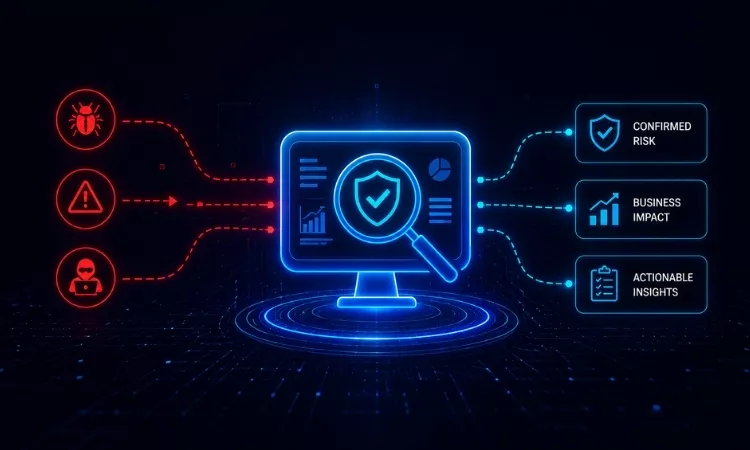
- Mirror tests AI agents the way an attacker would: probing prompt handling, tool misuse, memory manipulation, and multi-agent trust boundaries, then proving exploitability instead of just raising alerts.
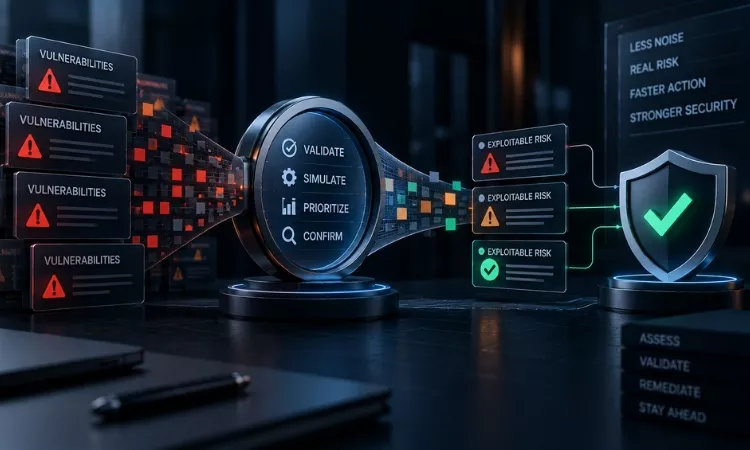
- The strongest programs run both together: vulnerability management supplies the raw findings, exposure validation confirms which ones deserve immediate action, and mobilization closes the loop.
AI agents introduce a new class of security vulnerabilities. Unlike traditional applications, they can interpret instructions, access sensitive data, retain context, and take actions through connected tools and APIs. This creates attack surfaces that conventional penetration testing was not designed to assess.
Traditional testing focuses on code, configurations, and network paths. It does not fully test how an agent handles malicious instructions, manipulated context, memory, tool permissions, or autonomous actions.
That is the gap Mirror, an AI-powered penetration testing platform, is built to close. It tests AI agents from an attacker’s perspective, identifying and validating vulnerabilities across reasoning, memory, tool use, and agent-to-agent trust boundaries.
Why Do AI Agents Need a Different Kind of Security Testing?
AI agents need different testing because they act, not just return answers. A standard application follows fixed code paths written by a developer. An AI agent reasons through a request, decides which tool to call, and executes that decision with real permissions attached to it.
That autonomy changes the attack surface. An attacker does not need to break authentication or exploit a buffer overflow. Instead, they can manipulate what the agent believes it should do. A hidden instruction inside a webpage, a document, or a support ticket can redirect the agent toward an action the business never intended.
Agents also carry memory across sessions. What an agent learns today can shape what it does next week. If that memory gets poisoned once, the damage repeats every time the agent recalls it. Testing an agent means testing its judgment under pressure, not only its code.
What Vulnerabilities Are Unique to AI Agents?
AI agents carry vulnerability classes that do not exist in traditional software. The OWASP Top 10 for LLM Applications and the newer OWASP Top 10 for Agentic Applications, published under OWASP’s GenAI Security Project, both catalog these risks, and Mirror tests against them directly.
- Prompt injection and goal hijacking, where attacker content changes what the agent believes its task is
- Excessive agency, where an agent holds more permissions or tool access than its job requires
- Tool misuse, where an agent uses a legitimate API or plugin in an unsafe or unintended way
- Memory and context poisoning, where false information planted in a conversation or document corrupts future decisions
- Identity and privilege abuse, where an agent inherits credentials it should never hold
- Multi-agent trust boundary violations, where one compromised agent manipulates or impersonates another in a shared workflow.
Each of these can exist without a single line of vulnerable application code. That is why scanning source code alone cannot catch them.
How Does Mirror Test AI Agents for Security Vulnerabilities?
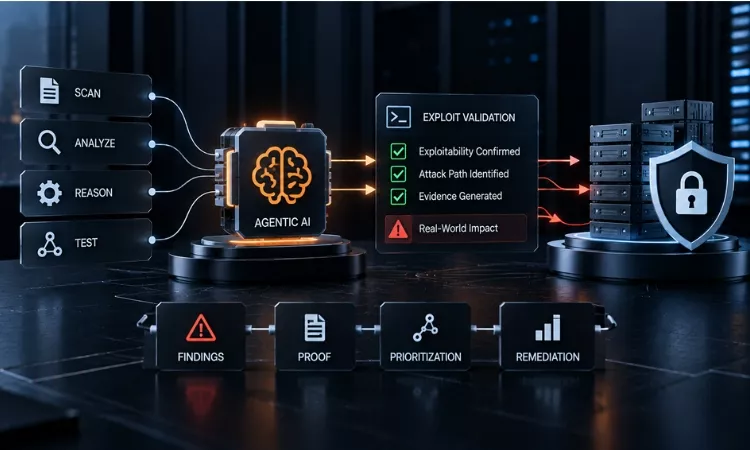
Mirror tests AI agents by running adversarial scenarios against the agent’s reasoning, its tools, and its memory, then validating whether each weakness is exploitable.
Mirror starts by mapping what an agent can do. This means inventorying every tool, API, data source, and permission the agent can reach, since an attacker needs only one overlooked capability to cause damage.
From there, Mirror runs targeted adversarial testing. It injects crafted instructions through the same channels a real attacker would use, including documents, emails, tickets, and tool outputs. It tests whether the agent can be pushed to call a tool outside its scope, leak data through its responses, or accept a false memory that changes its future behavior.
Mirror also tests multi-agent workflows, where one agent hands tasks to another. A single compromised agent in that chain can pass along tainted instructions or impersonate a trusted peer, and Mirror chains these scenarios the way a determined attacker would.
Every confirmed weakness gets validated through proof-of-exploit evidence: the exact prompt or sequence used, the action the agent took, and the business impact if left unaddressed. This mirrors how Ampcus Cyber’s AI Red Teaming and Security Testing service approaches agentic systems.
How Is Testing an AI Agent Different From Testing a Web Application?
Testing an AI agent differs because the vulnerability often sits in a decision, not a fixed request.
A web application vulnerability usually lives in a specific line of code or configuration, such as a missing input check. Fixing that line closes the door for good.
An AI agent vulnerability often lives in how the model interprets instructions. The same prompt injection technique that fails today might succeed tomorrow after a model update or a new tool integration. One-time testing falls short for agentic systems the same way it falls short for continuously deployed applications.
Mirror treats AI agents the same way it treats fast-moving codebases: as systems that need retesting every time their environment changes, not once a year on a fixed schedule.
What Happens After Mirror Finds a Vulnerability in an AI Agent?
Mirror treats every finding as a live issue that gets retested, not a static line in a report.
Once a vulnerability is confirmed, the finding moves into the tools security and engineering teams already use for tracking and remediation. Teams get the reproduction steps needed to fix the underlying permission, tool configuration, or prompt gap, rather than a vague severity score.
After a fix ships, Mirror retests the same attack path automatically. This matters for AI agents, since a patch that closes one prompt injection route can leave a related route open if the underlying reasoning flaw was not fully addressed. Continuous validation closes that gap instead of assuming a single fix holds.
Why Does Continuous AI Agent Testing Matter for Enterprises Now?
It matters because AI agent adoption is outpacing the governance built to oversee it.
Enterprises are giving AI agents access to customer data, financial systems, and internal tools faster than security teams can review each integration. Under frameworks like the EU AI Act, NIST AI RMF, and ISO/IEC 42001, organizations must show evidence of testing and oversight for high-risk AI systems, not just a policy document in a folder.
Boards and auditors increasingly ask a direct question: can you prove your AI agents were tested against real attack techniques, and was that testing recent. A pentest report written before an agent’s last permission change does not answer that question. Continuous, evidence-backed testing does.
Ready to see where your AI agents are exposed?
| Book a free Mirror demo and get evidence-backed answers instead of another list of alerts. |
People Also Ask:
Can AI agents be penetration tested like normal software?
Does Mirror replace human AI red teamers?
How often should AI agents be tested for security vulnerabilities?
Enjoyed reading this blog? Stay updated with our latest exclusive content by following us on Twitter and LinkedIn.