










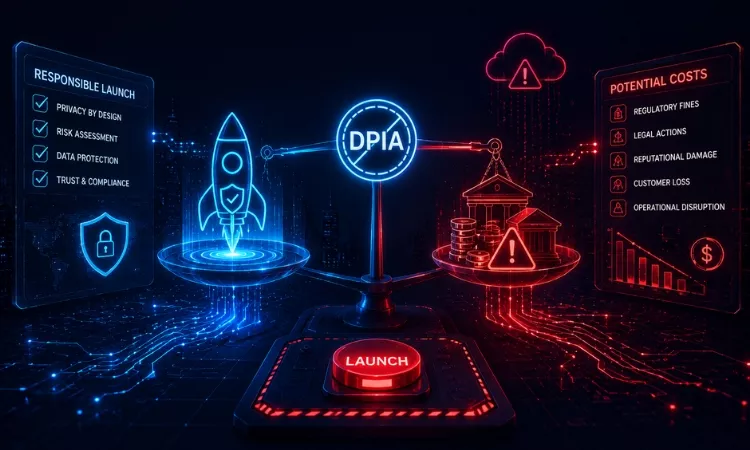
Product launches run on momentum. A release date gets locked, engineering commits to the sprint, marketing books the announcement, and the pressure to ship on time starts to override almost every other consideration. Somewhere in that rush, the Data Protection Impact Assessment gets pushed to “after launch,” or quietly dropped. On paper, this looks like a sensible way to protect the timeline. In practice, it is one of the most expensive corners an organization can cut, because the bill rarely arrives on launch day. It shows up months later, and for governance leaders the uncomfortable part is that the shortcut is almost always invisible.
What Is a DPIA?
A data privacy impact assessment (DPIA) is a structured review that identifies and reduces privacy risk before a project begins processing personal data. In practice, it documents the following:
- What data you collect and the specific purpose behind collecting it.
- How that data flows through your systems, and who is able to access it.
- What could go wrong for the people the data describes, and how severe that harm would be.
- Which safeguards apply, so remaining risk is either reduced or formally accepted by a named owner.
The purpose is to surface high-risk processing early, while design decisions are still inexpensive to change. Regulators treat a completed DPIA as evidence of accountability, which means it also proves that privacy was built into the design rather than bolted on afterward. A repeatable DPIA process supported where needed by DPO as a Service, turns this review from a last-minute scramble into a standard release gate.
Why Teams Skip the DPIA at Launch?
The reasons will be familiar to anyone who has sat through launch planning:
- Fixed deadlines: The release date is locked, and the assessment feels like something that can wait until after go-live.
- Unclear ownership: Product, legal, security, and engineering each assume another function is handling it.
- Misread triggers: Teams assume a DPIA only applies to large platforms, when one feature that profiles users or track location can cross the threshold.
- Paperwork mindset: The assessment gets filed as documentation instead of treated as a design input that shapes the build.
This is where the damage starts! A DPIA produced after the code is written loses its main advantage, which is the ability to shape the product while change is still cheap. Once the feature is live, every recommendation becomes a retrofit, and retrofits must compete with the next roadmap item for the same engineering hours.
What is the Real Cost of Skipping a DPIA?
The expense arrives in four layers, and each one compounds the last:
- Regulatory exposure: Under the accountability principle, an organization that skips a required assessment carries the full weight of that decision, and supervisory authorities can act on the omission itself.
- Remediation cost: Controls that could have been designed in, such as data minimization, tighter access, and retention limits, now have to be engineered into a running system that already holds live records.
- Commercial friction: A missing DPIA becomes a visible gap in the security questionnaire during procurement, which slows or blocks the sale.
- Reputational damage: A privacy failure attached to a new product draws scrutiny from customers and regulators at the same moment.
A continuous risk assessment and management potentially stops these costs from stacking on top of each other.
What Skipping a DPIA Looks Like in Practice?
Consider a pattern that plays out often. A product team adds a personalization feature that quietly begins profiling user behavior to tailor recommendations. The launch hits its date, the early metrics look strong, and the feature gets celebrated internally.
Four months later, an enterprise prospect sends a security questionnaire that asks for the DPIA covering that exact processing. There is no record, because the assessment was never run. The deal stalls while the security team works to produce evidence after the fact, and the privacy team discovers that the feature collects more data than its stated purpose needs.
The fix now touches live production data, the sales cycle has slipped a full quarter, and the board wants to know why a routine assessment was missed. None of this required bad intent. It only took a fixed deadline, an unclear owner, and the quiet assumption that the DPIA could wait until later.
DPIA Rules Under GDPR Article 35 and DPDP 2025
The obligation is not open to interpretation. Under GDPR Article 35, a DPIA is mandatory before any processing likely to result in a high risk to people’s rights, with clear triggers that include:
- Profiling with significant effects on the individuals concerned.
- Large-scale processing of special category data, such as health, biometric, or financial information.
- Systematic monitoring of a publicly accessible area on a large scale.
You can read the full requirement in GDPR Article 35, and guidance from the UK Information Commissioner’s Office is direct on timing, stating that the assessment must be completed before the service launches so its findings can still influence the design.
India has moved along the same line. The DPDP Rules 2025, notified in November 2025, require every Significant Data Fiduciary to carry out a DPIA together with an independent audit at least once every twelve months. For any organization operating across the EU, the UK, and India, the direction of travel is consistent, and a launch that processes personal data sits squarely inside these requirements.
How a Missing DPIA Blocks Enterprise Deals
Privacy governance has become a purchasing criterion rather than a courtesy. When a large customer evaluates a supplier, its third-party risk team asks for proof that privacy risk was assessed before the product went live. A blank answer suggests that other controls may be missing too, and the supplier drifts down the shortlist. The same question surfaces in audits for SOC 2, ISO 27001, and HITRUST, where assessors expect to see assessment records tied to significant changes.
Organizations that treat the DPIA as a standing element of their governance program answer these questions in minutes, while those that skipped it spend weeks reconstructing evidence after the fact, usually with a contract or a certification sitting on hold. A mature third-party risk management practice, backed by a compliance, converts these requests into routine reporting instead of recurring fire drills.
How to Build DPIA Into Your Launch Process
The fix is process, not heroics. Four habits move the assessment from an afterthought to a standard gate:
- Screen early: trigger a DPIA at the first design review, automatically, whenever a feature touches personal data.
- Assign an owner: give the assessment a named owner, a clear template, and a defined route to sign-off before release.
- Feed findings back: push results into the backlog with the same priority as security bugs, because that is effectively what they are.
- Keep it current: treat data governance as a living discipline so the assessment stays accurate as the product evolves.
Handled this way, the DPIA stops behaving like a launch obstacle and starts working as an early warning system that protects the very timeline it was once blamed for slowing.
| Talk to Ampcus Cyber’s privacy and governance specialists to build the DPIA into your product lifecycle before your next launch, instead of after your next audit finding. |
Enjoyed reading this blog? Stay updated with our latest exclusive content by following us on Twitter and LinkedIn.