









Not every project requires a Data Privacy Impact Assessment (DPIA) but missing one when it’s legally required can lead to regulatory penalties and increased privacy risk. Learn what a DPIA is, when GDPR and DPDPA mandate it, the key steps involved, and how to build privacy into your organization’s processes from the start.
Organizations today collect, process, and store more personal data than at any point in history, customer records, employee files, biometric identifiers, behavioral analytics, and more. With this scale comes regulatory scrutiny. Data protection laws around the world, from the EU’s GDPR to India’s DPDPA, now require organizations to formally evaluate privacy risk before they process certain categories of personal data.
That formal evaluation is called a Data Privacy Impact Assessment (DPIA). This guide answers the fundamental questions organizations need to address before, during, and after conducting a DPIA.
What Is a Data Privacy Impact Assessment (DPIA)?
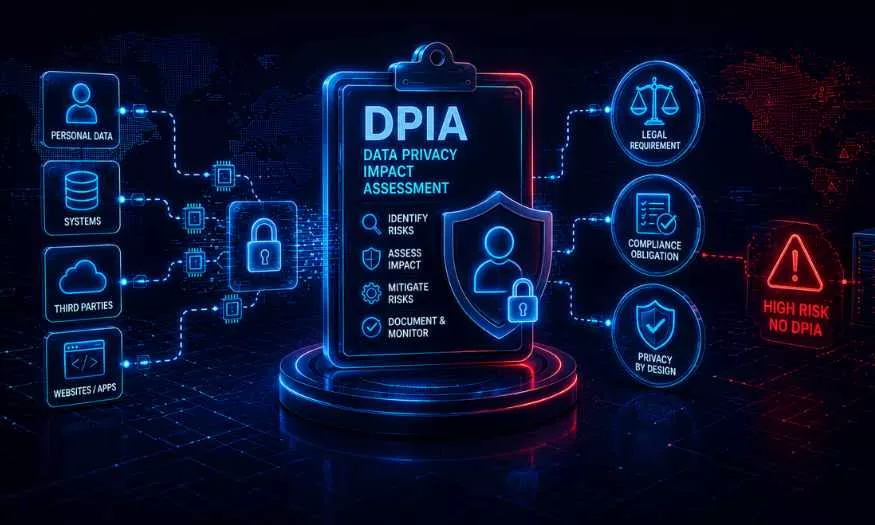
A Data Privacy Impact Assessment is a structured process used to identify, evaluate, and mitigate privacy risks arising from a data processing activity before that activity begins. Rather than reacting to privacy incidents after they occur, a DPIA embeds privacy considerations directly into project design, a principle commonly known as “privacy by design.”
At a practical level, a DPIA typically documents:
- The nature, scope, and purpose of the intended data processing.
- The categories of personal data involved and the individuals affected.
- The necessity and proportionality of the processing relative to its purpose.
- The risks the processing poses to the rights and freedoms of data subjects.
- The technical and organizational measures proposed to mitigate those risks.
The concept originates in Article 35 of the EU General Data Protection Regulation, which formalized the DPIA as a mandatory accountability mechanism for high-risk processing. Since then, similar assessment requirements have appeared in privacy frameworks globally, including India’s Digital Personal Data Protection Act (DPDPA), where they are referred to as Data Protection Impact Assessments. If you’re still building foundational knowledge of these frameworks, our guide on what GDPR is and how it affects data privacy worldwide is a useful starting point.
Why Is a DPIA Important?
A DPIA matters for reasons that extend well beyond ticking a compliance box.
- It reduces regulatory exposure: Regulators increasingly expect organizations to demonstrate proactive risk management, not just reactive breach response. A documented DPIA is direct evidence that privacy was considered before processing began.
- It catches design flaws early: Identifying a privacy risk during the design phase of a project is far cheaper, in engineering effort, legal exposure, and reputational cost, than discovering it after deployment or, worse, after a breach.
- It builds stakeholder and customer trust: Enterprise customers, investors, and procurement teams increasingly evaluate vendors on their privacy maturity. A rigorous DPIA process signals that data governance is embedded in how an organization operates, not bolted on afterward.
- It supports broader audit readiness: DPIA documentation feeds directly into the evidence base auditors and regulators expect to see, complementing broader initiatives like continuous cybersecurity audit readiness.
Who Is Responsible for Conducting a DPIA?
Responsibility for a DPIA typically sits with the data controller, the organization that determines the purposes and means of processing personal data. In practice, execution is usually a cross-functional effort involving:
- The Data Protection Officer (DPO), who oversees the assessment methodology and sign-off
- Project or product owners, who supply details on data flows and processing purpose
- IT security and engineering teams, who assess technical safeguards and residual risk
- Legal and compliance teams, who interpret regulatory obligations and thresholds
Where an organization lacks in-house privacy expertise, many engage external specialists to run the assessment independently and objectively, an approach that also strengthens the credibility of the DPIA if challenged by a regulator.
When Is a DPIA Legally Mandatory?
This is the question most compliance teams need answered. Under GDPR, a DPIA is legally required whenever a type of processing is “likely to result in a high risk to the rights and freedoms of natural persons.” Regulatory guidance and case law have converged around several trigger scenarios, including:
- Systematic and extensive profiling or automated decision-making, especially where it produces legal or similarly significant effects on individuals.
- Large-scale processing of special category data, such as health records, biometric data, genetic data, or data revealing racial or ethnic origin
- Systematic monitoring of publicly accessible areas on a large scale, such as CCTV networks or location tracking.
- Use of new technologies where the privacy impact is not yet well understood, including many AI and machine learning deployments.
- Large-scale processing of data relating to vulnerable individuals, including children or employees.
- Matching or combining datasets from different sources beyond the data subject’s reasonable expectations.
Data protection authorities across the EU also publish binding lists of processing types that automatically require a DPIA, so organizations operating in multiple jurisdictions should check local supervisory authority guidance rather than relying solely on the general GDPR threshold.
India’s DPDPA introduces a comparable, though narrower, obligation. Organizations classified as Significant Data Fiduciaries (SDFs) are required to conduct DPIAs (referred to under DPDPA as Data Protection Impact Assessments) on an annual basis, alongside algorithmic transparency audits. For a full breakdown of these obligations, see our guide on DPDPA compliance rules and business impact.
Where Does the DPIA Requirement Apply?
DPIA obligations are jurisdiction-specific but increasingly global in practice:
- European Union / UK: Mandatory under GDPR (and UK GDPR) for high-risk processing, with detailed guidance published by supervisory authorities such as the UK Information Commissioner’s Office.
- India: Mandatory annually for Significant Data Fiduciaries under the DPDPA.
- Other jurisdictions: Several U.S. state privacy laws (such as California’s CPRA and Virginia’s VCDPA) impose comparable “data protection assessment” requirements for high-risk processing, including profiling, targeted advertising, and sale of personal data.
Multinational organizations processing data across regions should treat DPIA as a baseline governance practice rather than a jurisdiction-by-jurisdiction checklist, since the underlying risk categories tend to overlap substantially across frameworks.
How Is a DPIA Conducted?
While methodologies vary by framework, a defensible DPIA process generally follows these stages:
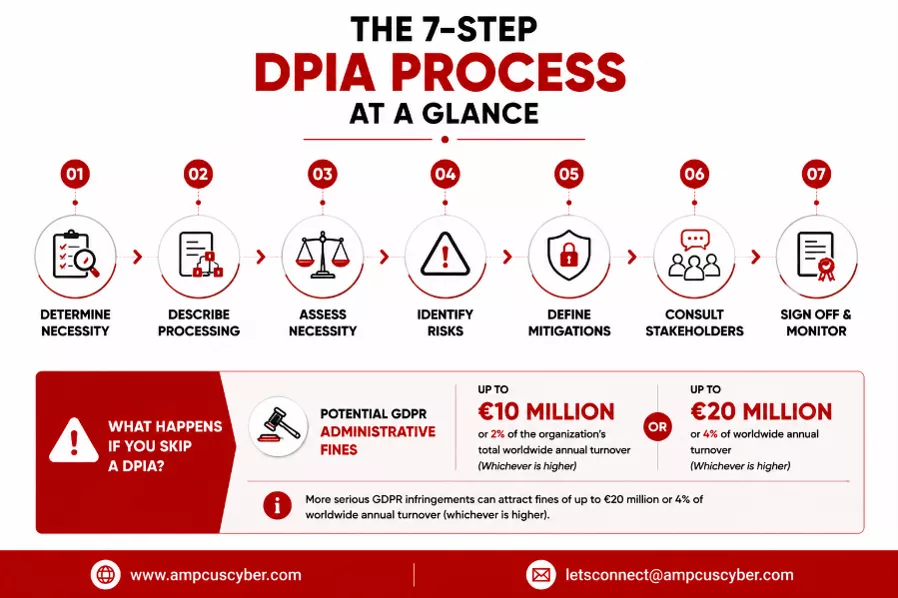
- Determine necessity: Screen the processing activity against regulatory trigger criteria to confirm whether a DPIA is required.
- Describe the processing: Document data flows, purposes, retention periods, and any third parties or processors involved.
- Assess necessity and proportionality: Confirm the processing is limited to what is genuinely required to achieve its purpose.
- Identify and evaluate risks: Assess likelihood and severity of risks to data subjects, including unauthorized access, loss of control over data, or discriminatory outcomes.
- Define mitigating measures: Document technical and organizational controls, such as encryption, access restrictions, anonymization, or reduced retention periods.
- Consult stakeholders: Where appropriate, consult the DPO, and in some high-risk cases, the relevant supervisory authority before processing begins.
- Sign off and monitor: Formally approve the assessment and revisit it whenever the processing activity materially changes.
Organizations that lack a mature internal privacy function often benefit from a structured, externally facilitated Data Privacy Impact Assessment engagement to ensure the process meets regulatory expectations and produces audit-ready documentation.
What Happens If You Skip a DPIA?
Failing to conduct a legally required DPIA carries real, quantifiable consequences. Under Article 83 of the GDPR, failing to carry out a DPIA when required, or carrying it out incorrectly, falls into the lower tier of infringements, exposing organizations to fines of up to €10 million, or 2% of total worldwide annual turnover of the preceding financial year, whichever is higher. Where the failure is tied to more fundamental violations, such as processing without a valid legal basis or disregarding a supervisory authority’s prior consultation requirement, penalties can escalate to the upper tier: €20 million, or 4% of total worldwide annual turnover of the preceding financial year, whichever is higher.
Regulators may also order the processing activity to stop entirely until a valid assessment is completed, which can halt product launches or entire business lines. Beyond the regulatory penalty, organizations risk deploying products or systems with unaddressed privacy flaws, flaws that are considerably more expensive to fix in production than at the design stage, and that can trigger lasting reputational damage if they surface as a breach or public complaint.
Final Thoughts
A DPIA is not simply a compliance formality, it is a structured risk management discipline that protects individuals, reduces regulatory exposure, and strengthens organizational trust. As data protection laws mature and expand globally, the question for most organizations is no longer whether a DPIA applies, but how well it is executed. Building DPIA practice into standard project governance, rather than treating it as an afterthought, is the most reliable way to stay ahead of both regulatory obligations and privacy risk.
| Determine if your organization needs a DPIA. Explore our services to understand legal requirements, reduce privacy risks, and build a compliant, privacy-first governance framework. |
Enjoyed reading this blog? Stay updated with our latest exclusive content by following us on Twitter and LinkedIn.