








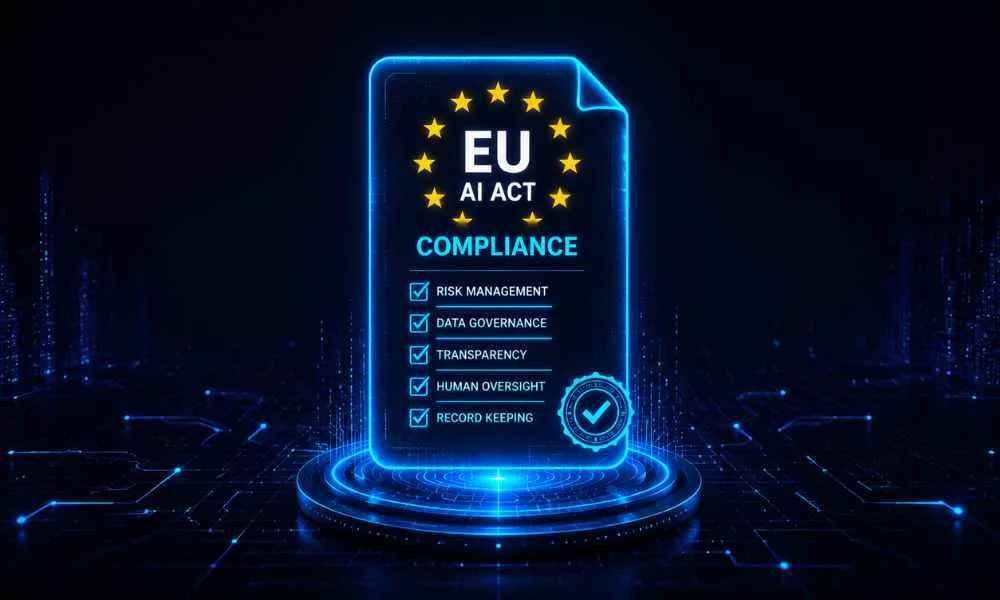
Prepare your enterprise for upcoming EU AI Act compliance deadlines. Master Article 50 disclosure rules and high-risk deployer mandates to mitigate risk.
The era of treating data privacy and artificial intelligence as separate legal tracks is officially over. As global organizations navigate the regulatory landscape of mid-2026, the intersection of the European Union’s General Data Protection Regulation (GDPR) and the EU AI Act has become the central focus for corporate legal, security, and compliance teams. Enterprise leaders must transition from passive monitoring to active governance to meet looming enforcement deadlines without disrupting their technology stacks.
Phased Compliance Timeline for Enterprise Deployers
The EU AI Act use a tiered enforcement strategy. As an enterprise deployer, understanding when your specific operational obligations kick in is critical to avoiding massive financial penalties and protecting corporate credibility.
| Date | Milestone | Key Requirement |
| 2 February 2025 | Prohibited AI Practices (Article 5) | Ban on unacceptable-risk AI practices, including social scoring, workplace emotion recognition, and untargeted biometric scraping. |
| 2 August 2025 | New GPAI Models | Governance obligations apply to newly released General-Purpose AI models, including technical documentation, transparency, and copyright compliance requirements. |
| 2 August 2026 | Article 50 Transparency Rules | Transparency obligations become applicable, including informing users when interacting with AI systems and disclosing certain AI-generated or manipulated content. |
| 2 December 2026 | Watermarking & New AI Prohibitions | Deadline for legacy systems to comply with synthetic content watermarking requirements. Ban on AI systems generating non-consensual intimate imagery (NCII) and child sexual abuse material (CSAM) takes effect. |
| 2 August 2027 | Legacy GPAI Models | General-Purpose AI models placed on the market before 2 August 2025 must comply with applicable Chapter V obligations. |
| 2 December 2027 | Annex III High-Risk AI Systems | Compliance obligations apply to standalone high-risk AI systems used in areas such as employment, education, essential services, and law enforcement. |
| 2 August 2028 | Annex I Regulated Product AI Systems | Requirements apply to AI systems embedded in regulated products, including medical devices, aviation, and automotive systems. |
Provider vs. Deployer Transparency Under Article 50
A common compliance misstep is conflating the transparency obligations of AI providers (those who develop or heavily modify a model) with enterprise deployers (those who use AI tools in a business capacity).
Article 50 splits responsibilities precisely:
- AI Providers (Article 50(2)): Responsible for technical provenance tracking. They must ensure that synthetic audio, image, video, or text outputs are marked in a machine-readable, robust format (such as digital watermarking or cryptographic metadata tags).
- Enterprise Deployers: Face strict disclosure and consumer-facing labeling duties rather than backend watermarking. If your business operates an AI system, you must:
- Inform natural persons clearly that they are interacting with an AI system (e.g., customer support chatbots), unless it is completely obvious from the context.
- Disclose if text published to inform the public on matters of public interest is artificially generated, unless it has undergone human editorial review and responsibility.
- Clearly label deepfakes or synthetic media that mimics real individuals, places, or historical events to prevent public deception.
High-Risk Systems and the Recalibrated Deployer Timelines
Following the May 2026 political finalization of the Digital Omnibus on AI, the compliance timeline for standalone high-risk AI systems categorized under Annex III (such as AI used in recruiting, resume ranking, or credit scoring) has been officially postponed to December 2, 2027. This gives corporate legal teams a much-needed 16-month extension to establish structural compliance.
While provider obligations operate on independent phased timelines, enterprise deployers must build operational workflows to execute the following core mandates ahead of the revised 2027 deadline:
- Human Oversight: Implement operational guardrails that ensure meaningful human review of AI outputs to actively mitigate automation bias.
- Data Governance: Ensure training, validation, and testing data utilized in localized fine-tuning or prompt-engineering environments is high-quality, relevant, and continuously monitored for systemic bias.
- Log Retention: Automatically capture and securely store technical system logs generated by the high-risk AI system. Under Article 26(6), deployers must retain these logs for a period appropriate to the system’s intended purpose, spanning a statutory minimum of six months, unless sector-specific laws require longer retention.
Compliance Risks of Shadow AI Under GDPR Article 28
When employees routinely input corporate data or customer information into unvetted consumer AI tools to draft communications or summarize code, they create significant regulatory exposure. This phenomenon is known as Shadow AI.
However, corporate legal teams must be precise about the exact nature of this infraction. Using an unvetted tool is not an automatic GDPR data breach in itself; the violation hinges on Article 28 of the GDPR.
Data Transfer Infraction Path: Employee Inputs Corporate Data – Consumer LLM Platform – No Valid DPA? – GDPR Article 28 Violation
Article 28 mandates that any data transfer to a third-party processor must be governed by a binding Data Processing Agreement (DPA). If an employee pastes personal data into a consumer-grade tool that lacks an enterprise-grade DPA, the organization has executed an unauthorized data transfer. Furthermore, because consumer platforms frequently retain prompt inputs to retrain their underlying models, the enterprise loses control of its data assets, directly violating the fundamental GDPR principles of data minimization and purpose limitation.
The Intersection Between the AI Act and EDPB Guidance
Compliance with the EU AI Act does not grant an exemption from data privacy. In fact, recent regulatory guidance from the European Data Protection Board (EDPB) highlights severe enforcement friction points regarding data subject rights, specifically the right to erasure (the “Right to Be Forgotten”) within trained AI models.
Critical Compliance Risk: The EDPB notes that if an AI model is trained or fine-tuned on unlawfully processed personal data, the subsequent live deployment of that entire model can be legally challenged. Because reversing memorization or extracting a single individual’s data footprint from deep neural networks is technically complex, organizations must maintain strict data lineage from day one.
Action Plan for Enterprise Compliance
To ensure your organization meets upcoming milestones without disrupting core business operations, compliance and security teams should execute a structured readiness plan:
- Conduct an AI Inventory (Immediate Phase): Discover and catalog every AI application across departments, explicitly identifying “Shadow AI” tools introduced without formal IT approval.
- Determine Your Legal Role (Risk Classification Phase): Document whether you act as a provider or a deployer for each specific tool to assign proper compliance workflows and legal accountability.
- Deploy Interface Disclosures (UI/UX Engineering Phase): Update application of UI layers to include conspicuous, explicit notices for natural persons interacting with automated agents or consuming synthetic media.
- Audit Data Provenance (Continuous Governance Phase): Ensure any vendor models or internal fine-tuning sets fully comply with GDPR data minimization standards and possess clear Data Processing Agreements.
Secure Your 2026 Compliance Posture
Is your global data infrastructure ready for the upcoming enforcement deadlines? Navigating the dual complexities of active GDPR rules and phased AI Act mandates requires direct alignment between technical security controls and international law.
| Connect with an Ampcus Cyber for a free consultation! |
Enjoyed reading this blog? Stay updated with our latest exclusive content by following us on Twitter and LinkedIn.