








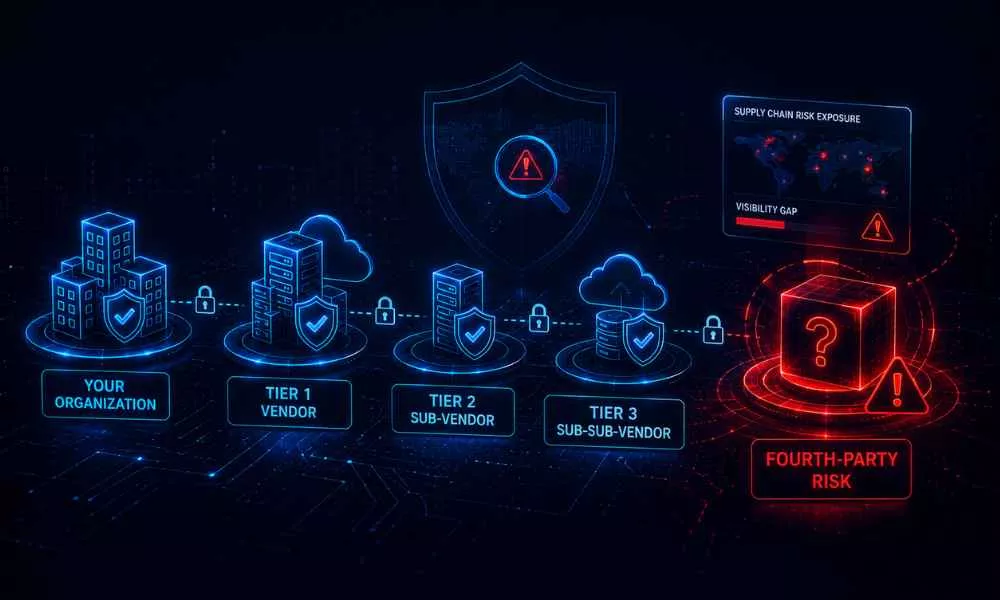
Your greatest vendor risk may not come from the vendors you assess, but from the vendors they rely on. Fourth-party risk arises when your suppliers depend on subcontractors, cloud providers, payment processors, or outsourced service providers that you never vetted. Learn why traditional third-party risk management falls short, how hidden supply chain dependencies create cybersecurity and compliance risks, and the practical steps organizations can take to improve visibility and resilience.
Most third-party risk management (TPRM) programs are built around a simple assumption: if you assess your vendors thoroughly enough, you’ve covered your exposure. Send the questionnaire, review the SOC 2 report, sign the contract, monitor annually.
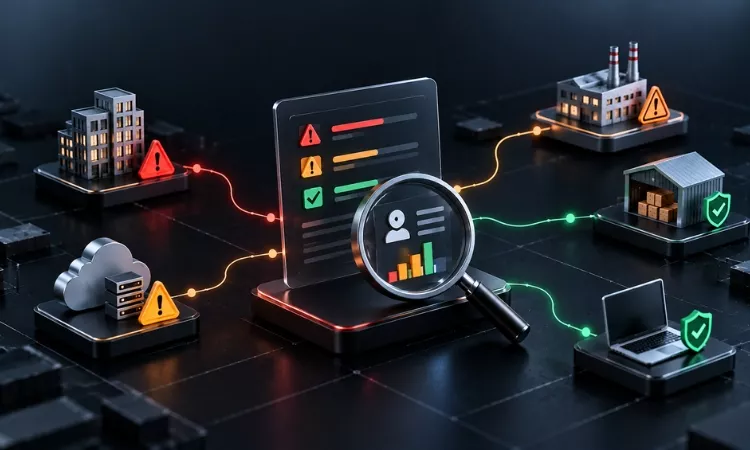
That assumption breaks down the moment you look at how your vendors operate. Your SaaS provider hosts your data on a cloud platform you never selected. Your payroll vendor routes payments through a processor you’ve never heard of. Your managed security provider outsources parts of its SOC operations to a subcontractor whose name never appears in your contract. None of these organizations answered your questionnaire. None of them signed your SLA. Yet a breach, outage, or compliance failure at any one of them can hit your organization just as hard as if it happened at your direct vendor.
This is fourth-party risk, and it’s the blind spot sitting just past the edge of where most vendor risk programs stop looking.
What is Fourth-Party Risk?
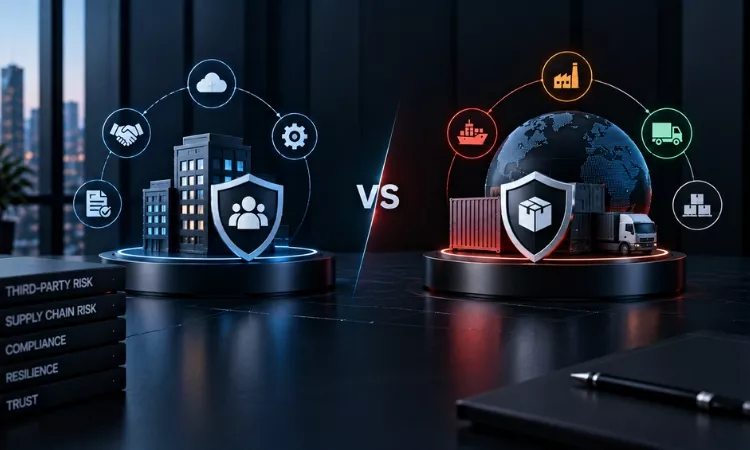
A third party is any vendor, supplier, or partner your organization contracts with directly. A fourth party is your vendor’s vendor: the subcontractor, cloud host, payment processor, or outsourced service provider that your third party relies on to deliver its service to you.
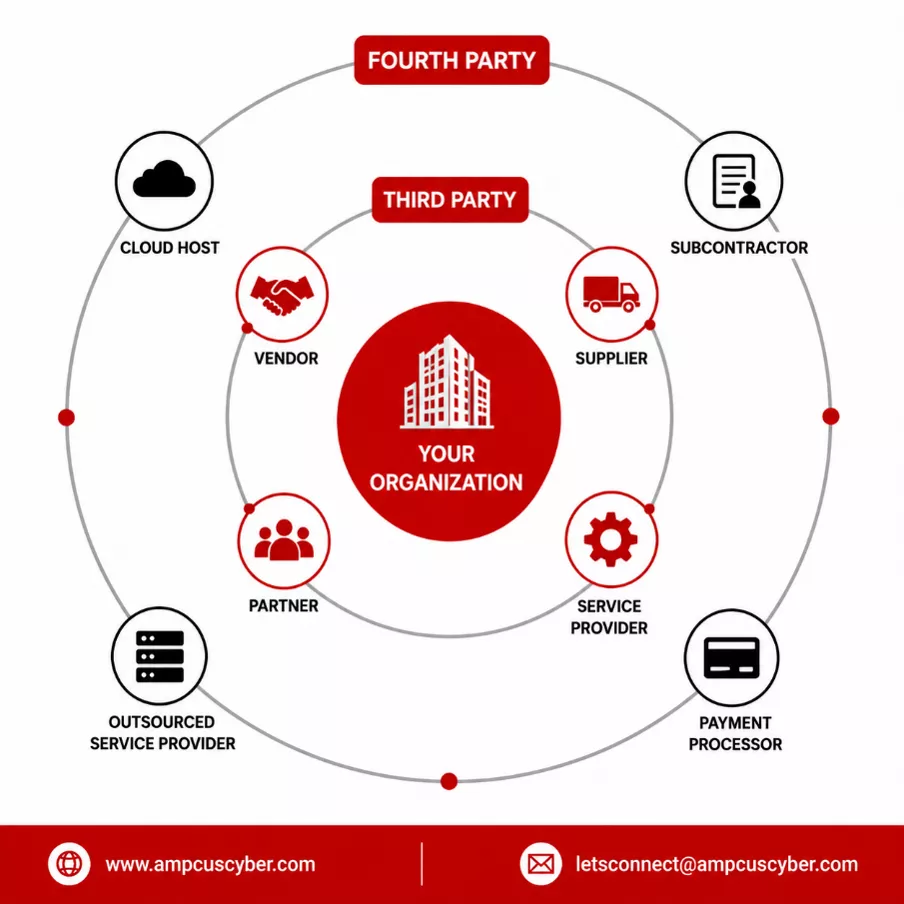
You have no direct relationship with a fourth party. No contract, no audit rights, no questionnaire response, often not even visibility that the relationship exists. But the risk transfers anyway. If your SaaS vendor’s authentication provider gets breached, your credentials are exposed. If your core processor’s cloud host suffers an outage, your operations stop, regardless of how airtight your contract with the processor was.
Fourth-party risk, then, is the cybersecurity, operational, compliance, and reputational exposure your organization inherits from an entity it never directly vetted, simply because that entity sits somewhere in your vendor’s supply chain.
Why the Distinction Matters More Than It Sounds
It’s tempting to treat this as a semantic exercise: third party, fourth party, does the label really change anything? It changes everything about how the risk must be managed, because the core lever most TPRM programs rely on, direct oversight, simply isn’t available.
With a third party, you can write security requirements into the contract, request evidence, run an assessment, and walk away if the vendor doesn’t meet your bar. With a fourth party, none of that leverage exists natively. You’re relying entirely on your third party to have done its own due diligence on the subcontractors it uses, and on that third party being willing to disclose who those subcontractors are in the first place.
This visibility gap is exactly what makes fourth-party risk dangerous. It doesn’t show up in your vendor inventory. It doesn’t get flagged by a standard questionnaire. It sits underneath your direct relationships, invisible until an incident forces it into view.
How This Plays Out in Practice
A few patterns show up repeatedly when fourth-party risk materializes:
Concentration risk: If a large share of your vendors all relies on the same cloud provider, payment processor, or authentication service, that shared dependency becomes a single point of failure across your entire vendor ecosystem. An outage or breach at that one fourth party doesn’t create one problem; it creates simultaneous problems across every vendor that depends on it.
Cascading compromise: Attackers increasingly target the weakest, least-visible link in a supply chain rather than the well-defended organization at the end of it. A compromise several layers removed from your organization can still travel upstream and land squarely in your environment, particularly when that fourth party has broad access or trusted status within your vendor’s infrastructure.
Compliance exposure without contractual reach: Regulations like GDPR, HIPAA, and PCI DSS don’t stop caring about your data once it passes through a fourth party. If sensitive data is mishandled at that level, your organization can still be held accountable, even though you never had a direct relationship with the entity responsible. Frameworks including NIST SP 800-161, the U.S. supply chain risk management standard, and in the EU, the Digital Operational Resilience Act (DORA), now explicitly expect organizations to account for these extended dependencies, not just their immediate vendor tier.
Where Vendor Programs Fall Short
Here’s the pattern that shows up across most mature-looking TPRM programs: strong controls at the third-party layer, and almost nothing beyond it.
The questionnaire is thorough. The SOC compliance review is done annually. The contract includes breach notification clauses and right-to-audit language. All of that is necessary, and none of it reaches the fourth party.
This gap tends to persist for a few structural reasons:
- Subcontractor disclosure isn’t standard practice: Many vendor contracts don’t require disclosure of who the vendor’s own critical suppliers are, so the fourth-party layer stays invisible by default rather than by evasion.
- SOC reports get skimmed, not read: A SOC 2 report often names subservice organizations and describes whether they’re carved out of or included in the audit scope, but that section is frequently overlooked in favor of the headline opinion. Understanding the carve-out versus inclusive audit distinction is often the fastest way to surface which fourth parties are actually in scope.
- Annual reviews can’t keep pace with a vendor’s own vendor changes: Even organizations that ask about subcontractors during onboarding rarely revisit the question. A vendor’s technology stack and subcontractor relationships shift constantly, and a point-in-time review misses that drift entirely.
- Risk tiering usually stops at the third-party level: Vendors get tiered by criticality and access; the fourth parties behind them typically don’t get tiered at all, even when they support the organization’s most critical vendors.
Managing Fourth-Party Risk Without Direct Control
Extending oversight into a layer you can’t directly contract with requires a different set of levers than traditional TPRM. A few practical starting points:
- Push disclosure requirements into third-party contracts: Require critical vendors to identify their own critical subcontractors as a condition of onboarding, and build in an obligation to notify you of material changes to that subcontractor list.
- Prioritize by criticality, not completeness: You will not achieve full visibility into every fourth party in your ecosystem, and chasing that goal wastes effort. Focus on the fourth parties that support your most critical third parties, particularly those with access to sensitive data or systems.
- Read the subservice organization sections of SOC reports closely: This is one of the most practical, already-available sources of fourth-party intelligence most organizations aren’t fully using. It tells you not just who the fourth party is, but whether their controls were tested as part of the audit.
- Map concentration risk explicitly: Identify where multiple vendors converge on the same fourth party. That concentration point deserves its own risk assessment, separate from any individual vendor relationship, because its failure mode affects your whole ecosystem at once, not just one relationship.
- Build fourth-party scenarios into incident response planning: If a critical fourth party goes down or is breached, your response plan should already account for that scenario, rather than being improvised in real time while your third party works out its own response.
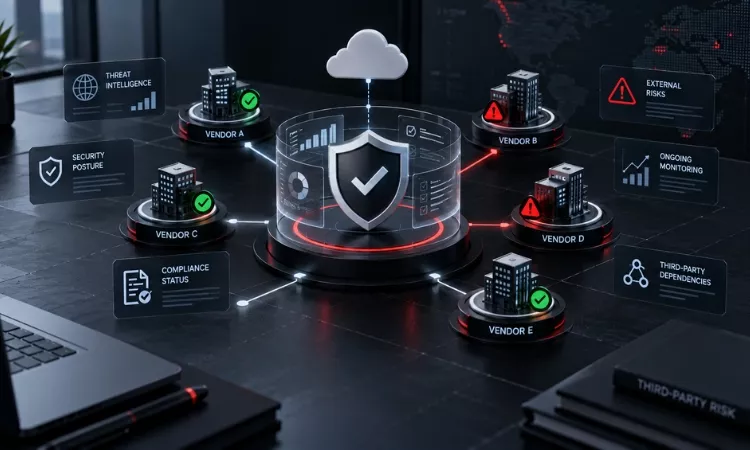
- Move from annual snapshots to continuous monitoring: A once-a-year questionnaire was already a weak signal for third-party risk; it’s an even weaker one for a layer you don’t have direct access to. Continuous monitoring of vendor security posture and disclosed subcontractor relationships closes at least part of that timing gap. This is the same shift driving modern, automation-enabled TPRM programs more broadly, and it applies with even more force once fourth parties enter the picture.
The Bigger Shift: Risk Networks, Not Risk Chains
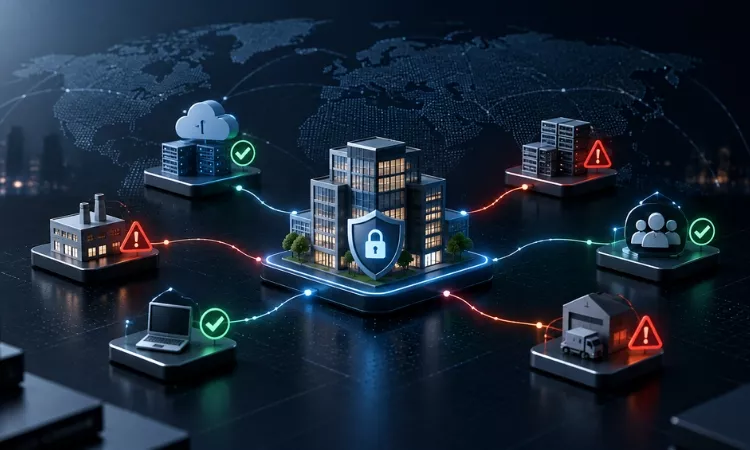
Perhaps the most useful reframe for security teams is this: modern vendor ecosystems don’t behave like simple chains, where risk passes cleanly from fourth party to third party to you. They behave like networks, where a single fourth party can sit underneath dozens of your direct vendors simultaneously, and a vulnerability can travel through multiple paths at once.
Regulators are increasingly explicit about this. Guidance from financial oversight bodies and frameworks like NIST’s broader security standards now treat supply chain risk management as something that must extend meaningfully beyond the direct vendor tier, not stop there. Organizations are expected to know their critical dependencies several layers deep, even without direct contractual reach into every one of them.
Closing the Gap
Fourth-party risk isn’t a reason to abandon third-party risk management, it’s a reason to extend it. The organizations getting this right aren’t the ones chasing exhaustive visibility into every vendor’s vendor. They’re the ones being deliberate about where the stakes are highest: concentrated dependencies, critical data flows, and the subcontractors their most important vendors can’t operate without.
If your program still stops at the third-party questionnaire, the honest question to ask isn’t whether fourth-party risk exists in your ecosystem. It’s how much of it you’re currently unable to see.
| Strengthen Your Third-Party Risk Program! Discover how Ampcus Cyber helps organizations uncover hidden fourth-party risks. Call our third-party risk experts now! |
Enjoyed reading this blog? Stay updated with our latest exclusive content by following us on Twitter and LinkedIn.