











Mean Time to Detect (MTTD) and Mean Time to Respond (MTTR) are two of the most important cybersecurity metrics for measuring incident response effectiveness. MTTD shows how quickly your team identifies threats, while MTTR measures how fast those threats are contained and resolved. Learn the differences, calculation methods, benchmarks, and proven strategies to improve both metrics and reduce attacker dwell time.
Speed is a potential asset in cybersecurity. The longer a threat sits undetected inside a network, the more damage it can do and the longer it takes to contain, the costlier the breach becomes. Two metrics sit at the center of this conversation: Mean Time to Detect (MTTD) and Mean Time to Respond (MTTR).
These terms are often used interchangeably, but they measure two very different stages of the incident response lifecycle. Understanding the distinction and knowing how to improve both, is essential for building a resilient security operations program.
This guide breaks down what MTTD and MTTR mean, how they’re calculated, why they matter, and how organizations like yours can reduce both.
What Is Mean Time to Detect (MTTD)?
Mean Time to Detect is the average time it takes a security team to discover that a threat, breach, or anomaly exists within their environment, from the moment it first occurs to the moment it’s identified.
MTTD reflects the visibility and maturity of an organization’s monitoring capabilities. A low MTTD means threats are being caught quickly, often before they escalate. A high MTTD signals blind spots in logging, alerting, or threat-hunting processes, the kind of gap attackers rely on to move laterally, exfiltrate data, or establish persistence undetected.
What Is Mean Time to Respond (MTTR)?
Mean Time to Respond is the average time it takes a security team to contain, mitigate, or fully resolve a threat after it has been detected. It covers everything from triage and investigation to containment, eradication, and recovery.
MTTR reflects the efficiency of an organization’s incident response process. A shorter MTTR means less downtime, smaller blast radius, and lower financial and reputational impact. A longer MTTR often points to manual workflows, unclear escalation paths, or under-resourced response teams.
MTTD vs MTTR: What’s the Difference?
The simplest way to think about it: MTTD measures how fast you see a problem. MTTR measures how fast you fix it.
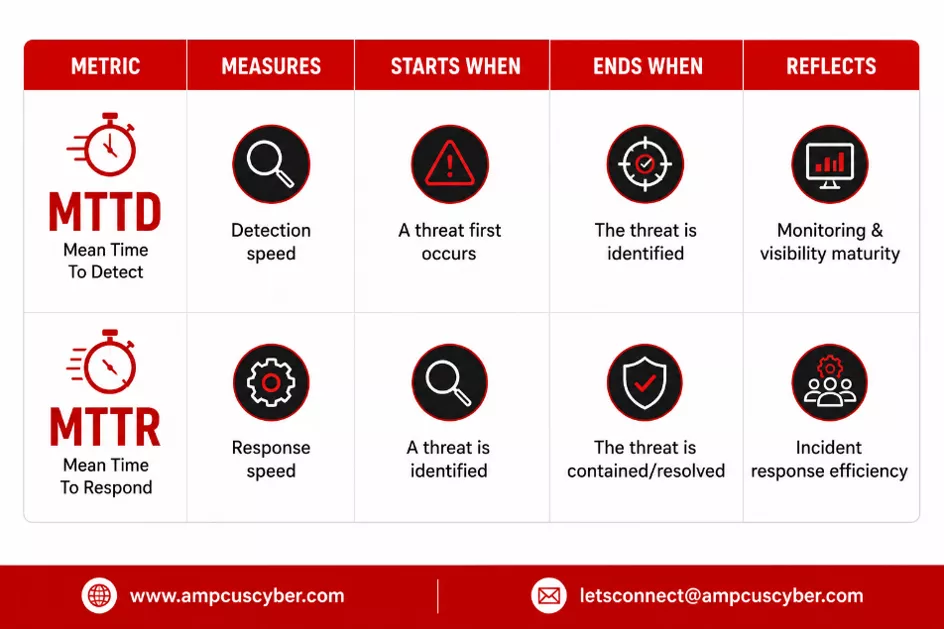
Together, MTTD and MTTR make up the total dwell time of an incident, the full window an attacker has to operate inside your environment. Reducing either metric shrinks that window; reducing both is the goal of every mature security program.
How Do You Calculate MTTD and MTTR?
Both metrics use a similar formula structure, total time divided by total number of incidents.
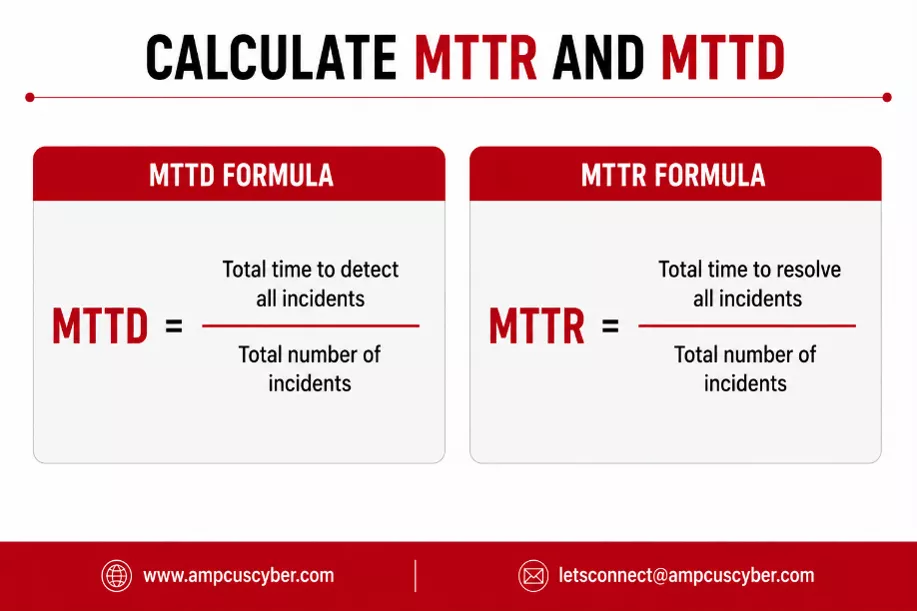
For example, if a security team detected 10 incidents over a month with a combined detection time of 50 hours, their MTTD would be 5 hours. If those same 10 incidents took a combined 30 hours to resolve after detection, their MTTR would be 3 hours.
Why Do MTTD and MTTR Matter in Cybersecurity?
These metrics aren’t just reporting statistics, they directly correlate with breach cost, regulatory exposure, and business continuity.
- Reduced dwell time: The combined MTTD + MTTR window is how long an attacker has free rein. Every hour saved reduces potential damage.
- Lower breach costs: Industry breach reports have consistently linked faster detection and containment to significantly lower average breach costs.
- Regulatory compliance: Many frameworks and regulations (GDPR, HIPAA, PCI DSS) require timely breach notification, which depends on how fast you can detect and respond.
- Stakeholder trust: Boards, customers, and partners increasingly ask for MTTD/MTTR as proof of security maturity.
- SOC performance benchmarking: These metrics let CISOs measure whether investments in tooling, staffing, or automation are paying off.
What Is a Good MTTD/MTTR Benchmark?
There’s no universal “good” number, benchmarks vary by industry, organization size, and threat landscape. That said, general guidance security teams often reference:
- MTTD: Best-in-class SOCs aim for detection in minutes to a few hours. Industry averages, unfortunately, have historically stretched into days or weeks for organizations without mature monitoring.
- MTTR: Leading teams target response and containment within hours. Less mature programs may take days.
The direction that matters most isn’t hitting a specific number, it’s showing consistent, measurable improvement over time. A SOC Maturity Assessment is one of the most reliable ways to benchmark where your detection and response capabilities currently stand.
How Can You Improve MTTD and MTTR?
To reduce MTTD:
- Deploy and tune Managed Detection and Response (MDR), SIEM, XDR, or EDR platforms for full-stack visibility
- Use behavioral analytics and threat intelligence to catch anomalies, not just known signatures
- Centralize logs across endpoints, network, cloud, and identity systems
- Run continuous threat hunting rather than relying solely on automated alerts
- Reduce alert fatigue with smarter correlation and prioritization
To reduce MTTR:
- Build and regularly test incident response playbooks
- Adopt SOAR (Security Orchestration, Automation, and Response) to automate containment steps
- Define clear escalation paths and decision-making authority
- Run tabletop exercises and red team/blue team drills
- Pre-stage forensic and containment tools so responders aren’t scrambling mid-incident
Who Is Responsible for MTTD and MTTR?
Responsibility typically spans several roles:
- SOC analysts monitor alerts and drive early detection
- Incident responders own containment, eradication, and recovery
- Threat hunters proactively search for hidden threats that automated tools miss
- CISOs and security leadership set the strategy, budget, and tooling that make low MTTD/MTTR achievable
- Managed security service providers (MSSPs), when engaged, extend detection and response coverage beyond in-house capacity, especially for 24/7 monitoring
Final Thoughts
MTTD and MTTR aren’t just acronyms for a security dashboard, they’re a direct reflection of how prepared an organization is to face real-world threats. Detecting fast means less time for attackers to operate. Responding fast means less damage when they do.
Organizations looking to strengthen both metrics need the right mix of technology, trained people, and tested processes. That’s where a dedicated security partner can make the difference, providing 24/7 monitoring, rapid incident response, and continuous improvement so your MTTD and MTTR keep trending in the right direction.
Want to see how your organization’s detection and response times measure up?
| Ampcus Cyber’s security operations and incident response experts can help you benchmark, strengthen, and continuously improve both. |
Enjoyed reading this blog? Stay updated with our latest exclusive content by following us on Twitter and LinkedIn.