









Cyberattacks are not slowing down. According to IBM’s 2025 Cost of a Data Breach Report, the global average time to identify and contain a data breach stands at 241 days and while that marks the lowest lifecycle in nine years, it still represents over eight months of potential attacker dwell time. The number underscores one uncomfortable truth: having a Security Operations Center (SOC) is not enough. What matters is how capable that SOC truly is.
That is precisely what a SOC Maturity Assessment measures, not just whether you have security tools and analysts in place, but whether they function as a cohesive, intelligence-driven, and continuously improving defense capability. For CISOs, security leaders, and compliance teams, this assessment is the starting point for meaningful, measurable improvement.
This guide breaks down everything you need to know what SOC Maturity Assessment is, why it matters, the maturity levels it maps, the frameworks that guide it, and how to get started.
What is a Security Operations Center (SOC)?
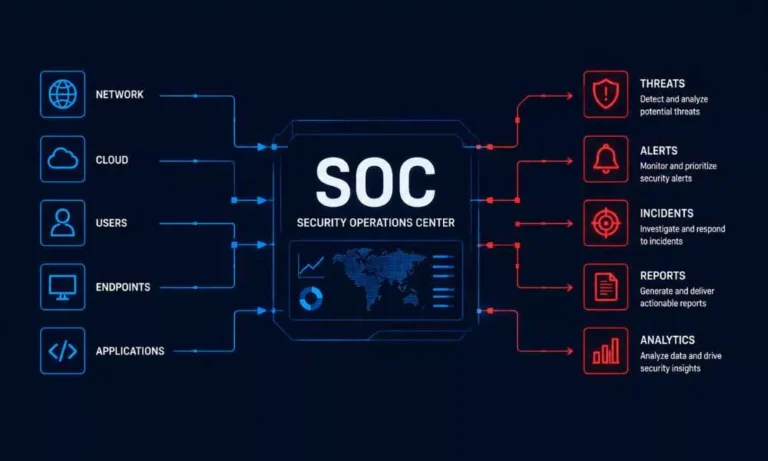
A Security Operations Center (SOC) is a centralized unit either in-house, outsourced, or hybrid, responsible for monitoring, detecting, analyzing, and responding to cybersecurity threats and incidents in real time. It functions as the nerve center of an organization’s cyber defense, combining people, processes, and technology into a unified security function.
Core SOC capabilities include:
- Log ingestion and correlation via Security Information and Event Management (SIEM) platforms.
- Threat detection and alert triage through automated rules and analyst investigation
- Incident response and containment powered by Security Orchestration, Automation, and Response (SOAR)
- Threat intelligence consumption and operationalization via Advanced Threat Intelligence Management.
- Vulnerability tracking and remediation coordination.
- Compliance monitoring and reporting.
However, even organizations with a functioning SOC often struggle with alert fatigue, slow mean-time-to-detect (MTTD), inconsistent playbooks, or poor threat intelligence integration. SOC Maturity Assessment exists to identify and fix precisely these gaps.
What is SOC Maturity Assessment?
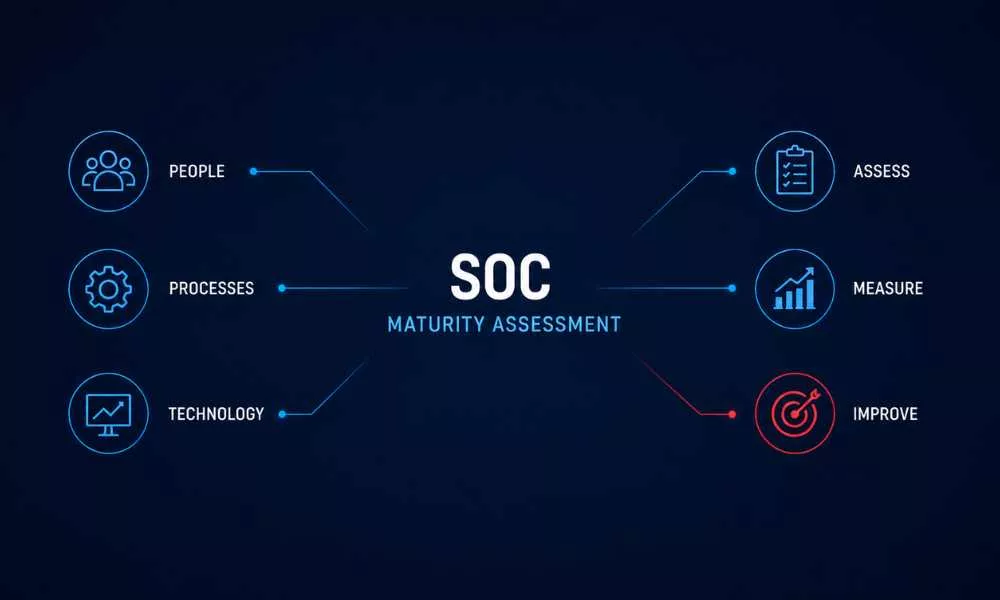
A SOC Maturity Assessment is a structured evaluation of your Security Operations Center’s current capabilities, processes, technologies, and people, measured against a defined maturity model or industry framework. It answers the fundamental question: “How effective is our SOC, and where do we need to improve?”
Unlike a standard security audit, which verifies compliance with specific controls, a SOC Maturity Assessment evaluates the depth and sophistication of security operations across multiple dimensions. It produces a maturity score or rating for each domain, a prioritized gap analysis, and a roadmap for uplift.
The output of a SOC Maturity Assessment typically includes:
- A current-state maturity score across functional domains.
- A gap analysis identifying control weaknesses and capability shortfalls.
- A target-state maturity level aligned to a business risk appetite.
- A phased improvement roadmap with prioritized, actionable recommendations.
- Metrics baselines for MTTD (Mean Time to Detect) and MTTR (Mean Time to Respond).
Think of it as a health check for your SOC, not to assign blame, but to create a clear, evidence-based picture of where you stand and what your next step forward looks like.
Why is a SOC Maturity Assessment Important?
The cybersecurity threat landscape is evolving faster than most SOC teams can keep up with. Adversaries now deploy AI-assisted attack tooling, living-off-the-land techniques, and multi-stage ransomware campaigns specifically designed to evade immature SOCs. Investing in a SOC Maturity Assessment delivers several strategic benefits:
1. Visibility into real-world effectiveness: Most organizations overestimate their SOC’s capability. The assessment replaces assumptions with data, showing whether detection rules fire on real attack patterns, and whether analysts have the skills and playbooks to respond correctly.
2. Justified security investment: Boards and C-suites increasingly demand ROI from security spending. A maturity assessment provides the evidence base, showing where gaps exist, what the risk of exposure is, and which investments will deliver the greatest risk reduction.
3. Regulatory and compliance alignment: Frameworks such as NIST CSF, PCI DSS, HIPAA, and HITRUST all reference security monitoring and incident response requirements. A mature SOC makes compliance demonstrably easily.
4. Reduction of dwell time and breach impact: According to IBM’s 2025 Cost of a Data Breach Report, organizations with extensive AI-powered SOC automation contained breaches 80 days faster on average and saved $1.9 million per incident compared to organizations without those capabilities, out of a global average breach cost of $4.44 million.
5. Continuous improvement of culture: A maturity assessment institutionalizes the discipline of measuring, benchmarking, and improving security operations, moving the SOC from a reactive cost center to a proactive strategic asset.
The 5 SOC Maturity Levels Explained
SOC maturity is typically measured across five levels, commonly modeled on the Capability Maturity Model Integration (CMMI) framework adapted for security operations. Each level describes the SOC’s operational sophistication, consistency, and strategic value.
Level 1: Initial (Ad Hoc)
Security operations are largely unstructured and reactive. There are no formal processes, documented playbooks, or consistent tooling. Incidents are handled case-by-case, often by IT generalists rather than dedicated security analysts. Detection is primarily reactive, meaning the organization often learns about breaches from third parties.
Indicators: No SIEM, no defined incident response plan, high alert backlog, no threat intelligence program.
Level 2: Developing (Repeatable)
Basic security monitoring is in place. A SIEM may be deployed, and basic use cases are active, but coverage is limited. Incident response processes exist but are not consistently followed. Some threat intelligence is consumed but not operationalized. Analyst capacity is limited and heavily reliant on tier-1 triage.
Indicators: Basic SIEM deployment, limited log sources, informal IR process, minimal automation.
Level 3: Defined (Standardized)
The SOC operates with documented, consistently followed processes and playbooks. Detection use cases are mapped to threat frameworks such as MITRE ATT&CK. SOAR is in place for routine task automation. Threat intelligence is actively integrated into detection rules. Metrics such as MTTD and MTTR are tracked.
Indicators: SIEM + SOAR integration, MITRE ATT&CK mapping, formal playbooks, dedicated analyst tiers.
Level 4: Managed (Quantitatively Managed)
The SOC uses data and metrics to manage performance proactively. Detection engineering is a formalized discipline. Purple team exercises and red team assessments are used to validate and improve detection coverage. Threat hunting is conducted regularly using hypothesis-driven methods. Leadership receives SOC dashboards and risk-based reporting.
Indicators: Active threat hunting, purple team exercises, KPI-driven management, advanced UEBA/behavioral analytics.
Level 5: Optimizing (Continuous Improvement)
The SOC operates at a strategic level, continuously benchmarking against industry peers and threat actor TTPs. Machine learning and AI augment analyst workflows. Threat intelligence is produced, not just consumed. The SOC directly informs organizational risk decisions and security investment priorities.
Indicators: AI/ML-augmented detection, proprietary threat intelligence production, full MITRE ATT&CK coverage, continuous capability improvement cycle.
What Core Domains are Evaluated in a SOC Assessment?
A comprehensive SOC Maturity Assessment does not look at technology alone. It evaluates the full spectrum of SOC capability across these core domains:
1. People & Organization: Analyst skill levels, staffing ratios (Tier 1/2/3), training programs, retention strategies, role definitions, and escalation paths are all assessed. A technically strong SIEM is wasted without trained analysts who can interpret its output.
2. Processes & Playbooks: Are incident response procedures documented, tested, and consistently followed? This domain assesses playbook completeness, escalation workflows, post-incident review discipline, and the quality of incident response planning.
3. Technology & Tooling: Coverage and configuration of SIEM, SOAR, EDR, XDR, threat intelligence platforms, and log management solutions. This domain also evaluates integration maturity between tools.
4. Detection Engineering: The quality, quantity, and coverage of detection rules and use cases. Assessed against MITRE ATT&CK to identify technique coverage gaps. Includes false-positive rates, alert tuning discipline, and use case lifecycle management.
5. Threat Intelligence: How intelligence is sourced, processed, distributed, and operationalized into detection and response. Includes feed quality, analyst training on intelligence consumption, and integration with SIEM/SOAR.
6. Incident Response & Recovery: End-to-end IR capability, from initial detection through containment, eradication, recovery, and lessons learned. Evaluated against NIST SP 800-61 and similar standards.
7. Metrics & Reporting: Whether the SOC tracks and reports meaningful KPIs, MTTD, MTTR, alert volume, false-positive ratio, escalation rates, and whether leadership receives risk-contextualized reporting via SOC metrics and reporting.
8. Governance & Compliance: Alignment of SOC operations with regulatory and compliance requirements. Includes risk assessment and management processes and evidence collection for audits.
How to Conduct a SOC Maturity Assessment: The 5 Phases
A SOC Maturity Assessment follows a structured methodology typically executed in five phases:
Phase 1: Scoping & Planning
Define the scope, which SOC functions, technologies, and business units are in scope. Agree on the maturity model or framework being used. Identify key stakeholders: SOC leadership, analysts, CISO, IT ops, and compliance teams.
Phase 2: Document Review & Data Collection
Review existing SOC documentation: policies, playbooks, runbooks, architecture diagrams, SLAs, training records, and metric reports. This provides the baseline for what should happen.
Phase 3: Interviews & Workshops
Conduct structured interviews with SOC analysts, threat hunters, managers, and cross-functional stakeholders. Gap between documented process and actual practice is often revealed here.
Phase 4: Technical Testing & Validation
Validate actual detection coverage through controlled attack simulations or review of historical alert data. This may include purple team assessments or log-source coverage analysis against MITRE ATT&CK.
Phase 5: Findings, Scoring & Roadmap
Score each domain against the maturity model. Document findings and prioritize gaps by risk impact and remediation effort. Deliver a phased roadmap aligned to the organization’s risk appetite and budget.
Top SOC Maturity Frameworks (NIST CSF, SOC-CMM, and MITRE ATT&CK)
Several industry-recognized frameworks inform and structure SOC Maturity Assessments:
MITRE ATT&CK Framework: The most widely used adversary behavior is taxonomy. SOC detection coverage is mapped against ATT&CK tactics, techniques, and sub-techniques to identify detection blind spots. Essential for detection engineering maturity scoring.
NIST Cybersecurity Framework (CSF): Provides a five-function model, Identify, Protect, Detect, Respond, Recover, that map naturally to SOC capability domains. NIST CSF 2.0, released in 2024, adds a Govern function directly relevant to SOC leadership and oversight.
SOC-CMM (SOC Capability Maturity Model): A dedicated SOC maturity model developed specifically for security operations evaluation. It assesses five aspects: business, people, process, technology, and services, each across five maturity levels.
CMMI (Capability Maturity Model Integration): The foundational process maturity model from which most SOC models are derived. Provides the five-level maturity structure widely referenced in SOC assessments.
SANS SOC Survey & Benchmark Data: SANS annually surveys SOC teams globally. Their benchmark data provides industry-comparative context for maturity scoring, helping organizations understand how their SOC compares to peers.
Open CSIRT Foundation SIM3 Model: Specifically designed for CSIRT and SOC maturity evaluation, SIM3 (Security Incident Management Maturity Model) assesses 44 parameters across organization, human, tools, and process dimensions.
7 Common Security Operations Gaps Revealed by Assessments
Based on consistent findings across SOC assessments, these are the most frequently identified capability gaps:
Alert fatigue and poor triage prioritization: Many SOCs generate far more alerts than analysts can meaningfully investigate, leading to suppression of legitimate signals. Poorly tuned SIEM rules are frequently cited as the root cause.
Limited MITRE ATT&CK detection coverage: Most Level 2 SOCs detect only 30–40% of MITRE ATT&CK techniques. Entire tactic categories such as Lateral Movement, Defense Evasion, and Exfiltration are frequently underrepresented in detection of use cases.
Incomplete or untested playbooks: Playbooks exist on paper but are rarely tested in exercises. Analysts deviate from the process under pressure, leading to inconsistent incident response outcomes.
No formal threat hunting program: Threat hunting, proactive, hypothesis-driven searching for attacker activity not caught by automated rules, is absent or informal in the majority of SOCs assessed at Level 2.
Siloed threat intelligence: Intelligence feeds are subscribed to but not operationalized. IOCs sit in a TIP (Threat Intelligence Platform) that is not integrated with the SIEM or SOAR, making them irrelevant to active detection.
Weak log coverage and data quality: Critical data sources, cloud workloads, OT/IoT environments, SaaS applications, are not ingested into the SIEM. Analysts cannot detect what they cannot see.
No post-incident review discipline: Lessons learned are not formally captured or tracked, meaning the same incident patterns recur without improvement to detection or response processes.
Internal vs. Third-Party SOC Assessments: Which is Best?
The question of who performs the assessment significantly impacts its quality and credibility.
Internal Assessment: SOC leadership can conduct a self-assessment using frameworks like SOC-CMM or NIST CSF. This is low-cost and builds internal awareness but is limited by cognitive bias; teams tend to overrate their own capabilities and blind spots in areas where the team lacks expertise.
Third-Party / External Assessment: An independent cybersecurity firm with deep SOC expertise brings objectivity, benchmark data, adversary perspective, and framework proficiency that internal teams rarely possess. External assessors can also validate actual detection capability through simulated attack scenarios.
Hybrid Approach: Organizations often benefit most from a combination: internal self-assessment as a baseline, followed by external validation and independent gap analysis. This balances costs with credibility.
For organizations subject to regulatory oversight particularly in financial services, healthcare, or critical infrastructure, an external SOC Maturity Assessment provides the independent evidence that regulators and auditors require.
How Often Should You Perform a SOC Maturity Assessment?
SOC maturity is not a one-time destination it is a continuous journey. The frequency of assessment should reflect the pace of change in your threat environment, your technology stack, and your organization’s risk profile.
Annual assessment is the baseline recommendation for most organizations. A yearly cadence provides a consistent benchmark for measuring improvement, aligns with annual security program planning cycles, and satisfies many regulatory expectations around periodic security reviews.
Trigger-based reassessment is warranted whenever a significant change occurs, such as:
- A major security incident or breach
- Significant changes to the SOC toolset (new SIEM, SOAR, or EDR deployment)
- Substantial changes to organizational structure or threat landscape
- Mergers, acquisitions, or expansion into new regions or industries
- Regulatory changes or new compliance requirements
Continuous monitoring through SOC KPI dashboards, tracking MTTD, MTTR, use case coverage, and alert-to-incident conversion rates, serves as the between-assessment pulse check that keeps maturity improvement on track.
Pairing regular assessments with Ampcus Cyber’s Metrics and Reporting services ensures leadership has ongoing visibility into SOC performance, not just a snapshot every twelve months.
Is your SOC operating at full potential?
Most enterprise SOCs operate between Level 2 and Level 3, leaving critical detection gaps that adversaries exploit.
| Get a picture of where you stand and how to move forward. Call our experts now! |
Enjoyed reading this blog? Stay updated with our latest exclusive content by following us on Twitter and LinkedIn.