









Organizations are adopting artificial intelligence to automate decisions, improve operational efficiency, and uncover business insights across functions such as finance, healthcare, manufacturing, and customer service. As these systems become responsible for high-impact decisions, organizations need more than performance metrics to establish confidence in their use. Governance teams, regulators, customers, and business leaders increasingly expect visibility into how models are developed, evaluated, and maintained throughout their lifecycle.
This growing need for transparency has made AI model cards an essential component of responsible AI governance. A model card serves as a standardized document that explains what a model is designed to do, how it performs, the data used during development, its limitations, potential risks, and the controls required for its safe deployment. Rather than treating machine learning models as black boxes, organizations can use model cards to improve accountability, strengthen governance, and support regulatory compliance.
This guide explains what an AI model card is, why it matters, what information it should contain, and the best practices organizations should follow when creating one.
What Is an AI Model Card?
An AI model card is a structured document that provides a comprehensive overview of an artificial intelligence or machine learning model. It summarizes the model’s intended purpose, development process, evaluation results, known limitations, ethical considerations, and governance requirements in a format that can be understood by both technical and business stakeholders.
The concept was introduced to improve transparency in machine learning systems and has since become an important practice for organizations building trustworthy AI. Instead of relying solely on technical documentation, model cards present information that helps governance teams, auditors, security professionals, and decision makers determine whether a model is appropriate for a specific business use case.
A well-prepared model card answers important questions about how a model was built, where it performs effectively, where it may produce unreliable outcomes, and what controls should be implemented before deployment.
What is the Significance of AI Model Cards Important for AI Governance?
AI governance depends on visibility and accountability. Without consistent documentation, organizations struggle to understand how models operate, evaluate associated risks, or demonstrate compliance with emerging regulations.
Model cards provide a standardized approach to documenting critical information throughout the model lifecycle. They help governance teams with risk assessment before deployment, enable auditors to review evidence more efficiently, and support security professionals in identifying potential vulnerabilities. Business leaders also gain greater confidence when approving AI initiatives because they can understand both the capabilities and the limitations of the underlying model.
As global regulations continue to evolve, maintaining detailed model documentation is becoming a governance expectation rather than an optional best practice. Organizations that establish documentation standards early are better positioned to respond to regulatory reviews, customer due diligence requests, and internal audit activities.
What Information Should an AI Model Card Include?
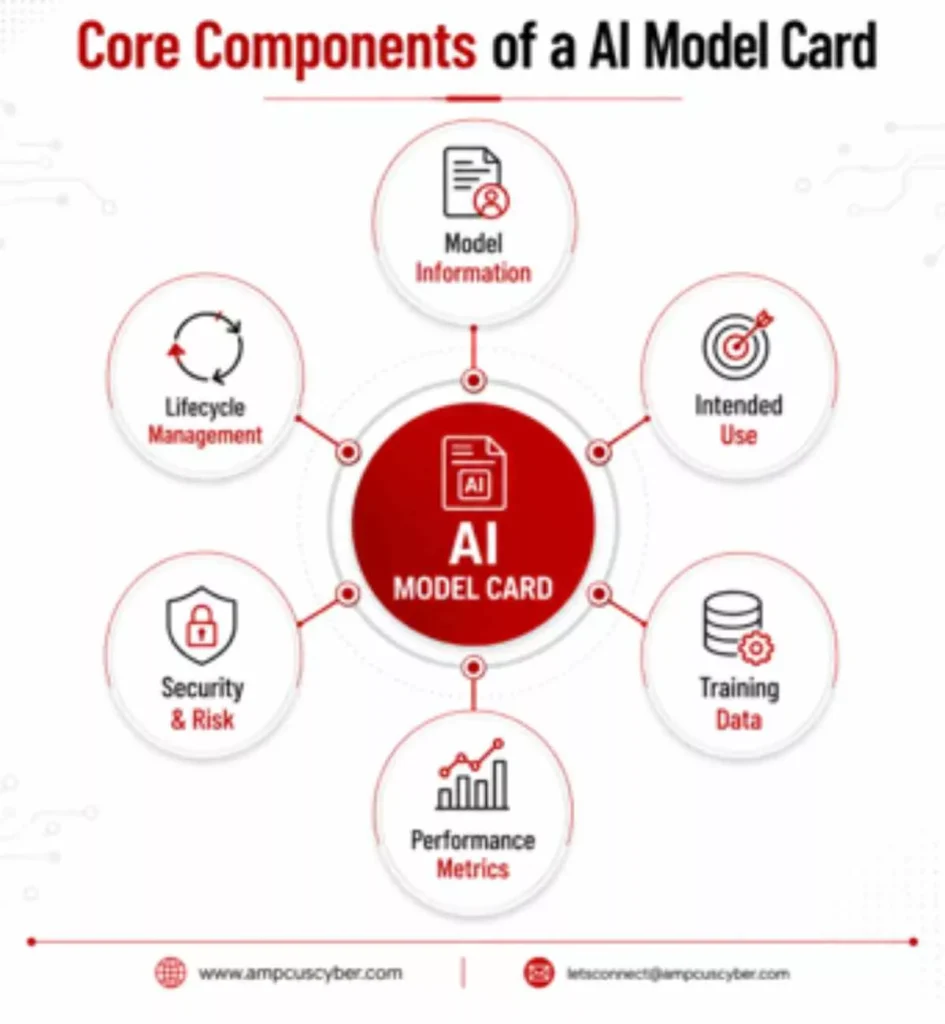
Although organizations customize templates based on their governance requirements, most AI model cards contain a common set of information that supports transparency and accountability throughout the model lifecycle.
The document typically begins with basic administrative details, including the model name, version, owner, development team, deployment status, and business objective. This information establishes ownership and helps governance teams track changes over time.
A comprehensive model card also explains the intended use of the model. It should clearly identify approved business scenarios, expected users, operating environments, and situations where the model should not be used. Defining these boundaries reduces the likelihood of inappropriate deployment.
Training data is another critical section because the quality and diversity of data directly influence model performance. Organizations generally describe the data sources, collection methods, preprocessing activities, geographic coverage, and any known limitations without exposing sensitive information.
Performance evaluation should include more than a single accuracy score. Metrics such as precision, recall, false positive rates, false negative rates, and evaluation across different user groups provide a balanced understanding of model behavior. Where applicable, fairness assessments should explain how bias testing was performed and describe any remaining limitations.
Many organizations also document cybersecurity considerations, including protection against adversarial attacks, data leakage risks, model access controls, and monitoring requirements. Finally, the model card should describe maintenance procedures, version history, retraining plans, and continuous monitoring activities to support long-term governance.
Who Uses AI Model Cards Across an Organization?
Although data scientists create much of the technical documentation, model cards provide value across multiple business functions.
CISOs use model cards to understand cybersecurity risks associated with AI deployments and evaluate whether appropriate security controls are in place. Governance leaders review the documentation to verify compliance with internal policies and external regulations. Risk management teams assess operational, ethical, and business risks before approving production deployments.
Internal auditors rely on model cards as evidence during governance reviews, while compliance professionals use them to demonstrate accountability under emerging AI regulations. Procurement teams also benefit from requesting model cards when evaluating third-party AI solutions because they provide greater transparency into vendor-developed models.
By presenting technical information in a structured and accessible format, model cards enable collaboration between technical specialists and executive decision makers.
How Do AI Model Cards Support Regulatory Compliance?
Regulators increasingly expect organizations to demonstrate transparency, accountability, and responsible governance throughout the AI lifecycle. Model cards contribute to these objectives by documenting how models are developed, evaluated, deployed, and continuously monitored.
Comprehensive documentation allows organizations to demonstrate that they have assessed potential risks, validated model performance, established human oversight, and implemented appropriate governance controls. These records also simplify regulatory reviews because much of the required evidence is already maintained in a standardized format.
Model cards align closely with widely recognized governance frameworks, including the NIST AI Risk Management Framework (AI RMF) and ISO/IEC 42001, both of which emphasize documentation, risk management, lifecycle governance, and continuous improvement. Many organizations also integrate model cards with AI inventories, risk registers, impact assessments, and governance workflows to establish a more mature AI assurance program.
What Are the Best Practices for Creating AI Model Cards?
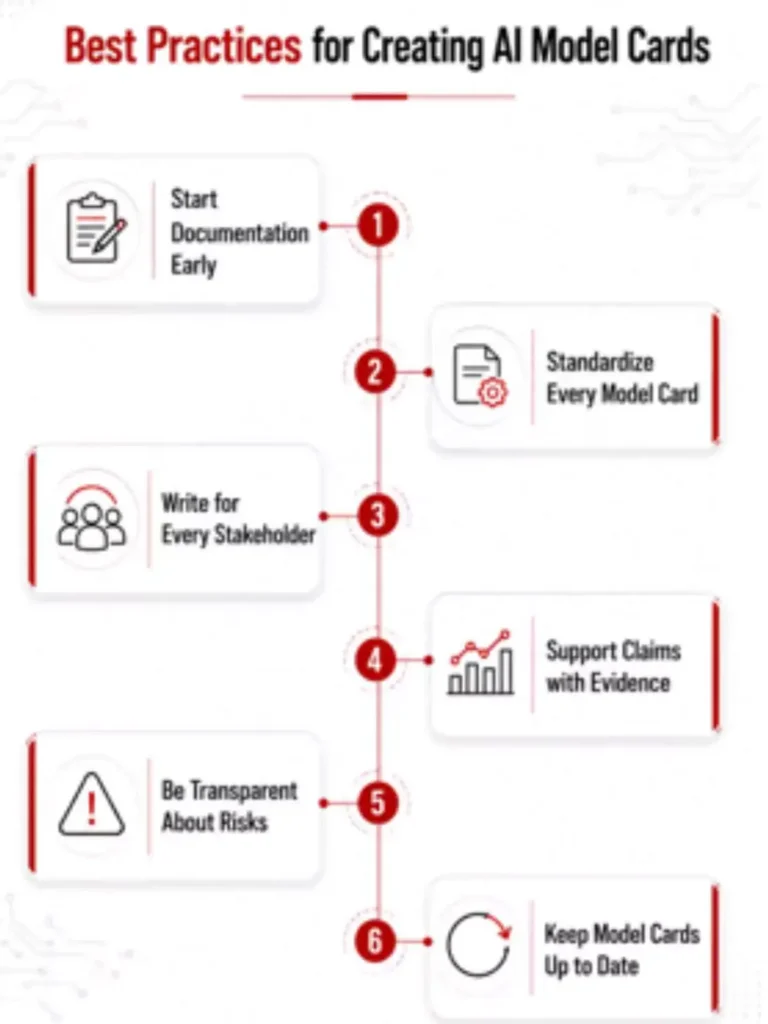
Creating an effective model card requires more than completing a template. Organizations should integrate documentation into the entire AI development lifecycle so that governance information remains accurate as models evolve.
Documentation should begin during model development rather than after deployment. Recording important decisions throughout the project reduces the risk of missing critical governance information later. Organizations should also establish standardized templates so that every model is documented consistently, making reviews and audits more efficient.
Model cards should be written for a broad audience that includes executives, auditors, compliance professionals, cybersecurity teams, and technical practitioners. Clear language improves collaboration across departments while reducing misunderstandings during governance reviews.
Performance claims should always be supported by measurable evaluation results instead of general descriptions. Equally important is documenting known limitations, assumptions, and residual risks because transparency strengthens organizational trust far more than presenting only successful outcomes.
Finally, governance teams should review and update model cards whenever models are retrained, modified, or deployed in new business environments. Keeping documentation current ensures that governance decisions continue to reflect the model’s latest capabilities and risks.
How Can Organizations Implement AI Model Cards Successfully?
Implementing model cards becomes significantly easier when organizations treat them as a mandatory governance artifact rather than an optional document. A standardized template should be incorporated into every AI project from its earliest stages, ensuring that documentation evolves alongside model development.
Organizations should also integrate model cards into approval workflows so that governance committees review documentation before production deployment. Linking model cards with AI risk assessments, security reviews, compliance activities, and continuous monitoring processes creates a centralized governance approach that supports transparency throughout the AI lifecycle.
Periodic reviews remain equally important because models, business requirements, and regulatory expectations continue to evolve. Regular updates ensure that documentation accurately reflects current performance, risks, and governance controls.
Conclusion
As enterprise adoption of artificial intelligence continues to accelerate, transparency has become a foundational requirement for responsible governance. AI model cards provide organizations with a practical and standardized way to document model behavior, intended use, performance, limitations, security considerations, and ongoing monitoring activities.
For CISOs, governance leaders, cybersecurity professionals, and compliance teams, model cards strengthen accountability while simplifying audits, improving regulatory readiness, and supporting informed decision making. Organizations that establish standardized model documentation today will be better prepared to govern increasingly complex AI systems with confidence.
Build transparent, trustworthy, and compliant AI systems with Ampcus Cyber’s AI Governance and AI Assurance services.
| Contact our experts to strengthen your enterprise AI governance program. |
Enjoyed reading this blog? Stay updated with our latest exclusive content by following us on Twitter and LinkedIn.