









Access grows quietly around every AI agent long after launch day. Here is what blast radius means for an autonomous agent, why it is usually bigger than teams assume, and how to measure it before an incident does.
A SaaS company deployed an AI agent to handle tier-one customer support: password resets, subscription changes, and refund approvals under a small dollar threshold. To move fast, the team connected the agent to the full billing API instead of a scoped version, since building a narrower integration would have taken another sprint.
Three weeks in, a bug in the agent’s reasoning caused it to misread a batch of duplicate-looking charges as refund requests. It approved refunds on more than 400 accounts before anyone noticed, several times the value the original support workflow was ever meant to touch. The agent had not been hacked. It had simply been given more reach than its job required, and it used all of it.
That gap, between what an agent is supposed to do and everything it is technically capable of doing, is what security teams now call its blast radius.
What Is AI Agent Blast Radius?
An AI agent blast radius is the full scope of systems, data, and actions it could affect if it is compromised, manipulated, or simply wrong, not just what it was designed to do. It is the gap between an agent’s intended job and everything its permissions, tool access, and autonomy allow it to touch.
The term borrows from cloud engineering, where blast radius describes how far a single failure spreads through a connected system. OWASP’s Top 10 for LLM Applications captures the AI-specific version of this under Excessive Agency: giving an agent more tools, more standing permissions, or more freedom to act without approval than its task requires. Each of those gaps widens the radius.
Ampcus Cyber applies the same framework to vendor risk, asking how far a third-party breach could spread through an organization. AI agent blast radius asks the identical question about a system your own team built and connected.
Why Is an AI Agent’s Blast Radius Often Bigger Than It Looks?
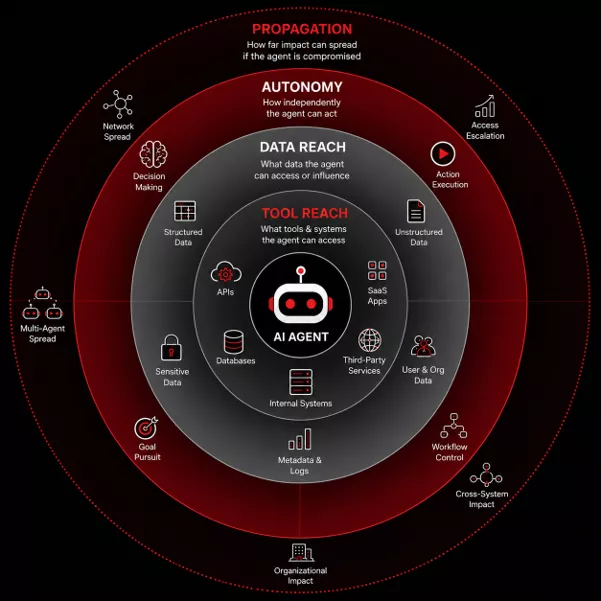
An AI agent’s blast radius is often bigger than it looks because a single agent can hold the combined reach of dozens of separate tools and accounts. A human support rep touches one system at a time, working through a UI with its own limits. An agent connected to a billing API, a CRM, and an email platform holds all three at once, and one bad decision can move through all three in seconds.
Recent research backs this up. A 2026 study by Opsin Labs found that 60% of enterprise AI agents provisioned beyond default settings were granted allow-all access rather than being scoped to the permissions their tasks required. Many of those agents were built by teams outside security or engineering, who reached for the broadest available access because it was the fastest way to get the agent working.
That combination, wide reach plus limited scoping discipline, is exactly what turns a small mistake into a wide one.
How Do You Measure an AI Agent’s Blast Radius?
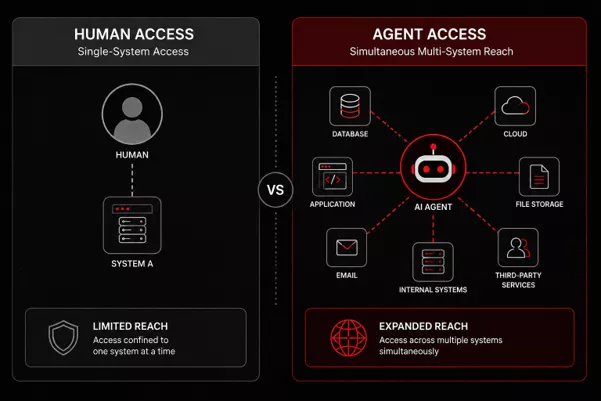
You measure an AI agent’s blast radius the same way you would map an explosion’s reach: by tracing everything it could touch, not just what it is supposed to touch. Four dimensions cover most of it.
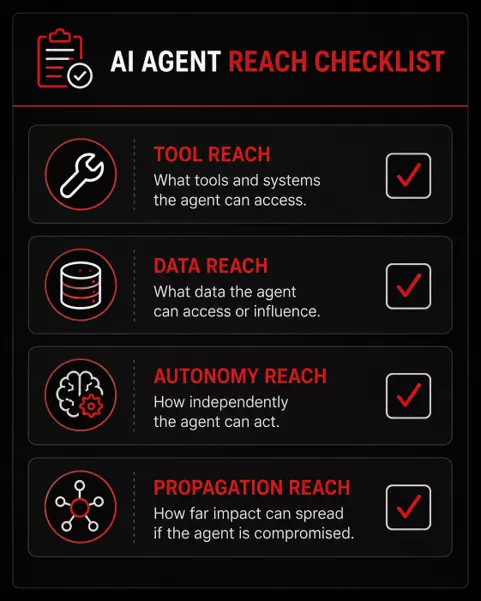
Tool reach comes first: every API, database, and system the agent can call, whether or not its current task needs all of them. Data reach follows everything the agent can read or write, including systems it only touches indirectly through a connected tool. Autonomy reach covers how much of that access runs without a human checkpoint. Propagation reach is the newest and least understood dimension: whether a misfiring agent can trigger other agents or automated workflows downstream, turning one bad decision into a chain reaction.
Mapping these four dimensions against real usage, not the access originally requested, is where most organizations find the gap. An agent granted read-only access to a support queue six months ago may now hold write access to three additional systems nobody reviewed. Continuous testing, the kind Mirror runs on an ongoing basis rather than once a year, is built to catch exactly that kind of drift.
Who Should Own Reducing AI Agent Blast Radius?
Reducing AI agent blast radius sits best with the identity and access management team, working with whichever engineering or business group owns the agent day to day. IAM brings the scoping discipline and credential hygiene built over years of managing human and service accounts. The owning team knows what the agent needs to do its job, which is usually far less than what it was given.
A Governor Agent pattern adds a real-time layer on top of both, continuously evaluating the downstream blast radius of an agent’s actions and flagging high-risk intents, like deleting records or moving funds, before they execute rather than after. Pairing that runtime check with a properly scoped, individually identified agent closes most of the gap between what an agent could do and what it should be allowed to do.
When Should You Assess an AI Agent’s Blast Radius?
The right time to assess an AI agent’s blast radius is before it goes live with write access to production systems, not after it does something the team has to explain to customers. Every new tool connection or permission grant should trigger a fresh look at the radius, since access tends to expand quietly over an agent’s lifetime as teams bolt on new integrations to solve immediate problems.
A useful rule: any agent that can take an action a human employee would need manager approval for, moving money, deleting records, changing customer-facing settings, should have its blast radius assessed with the same rigor as a new privileged hire, before it ever touches production.
What Happens When AI Agent Blast Radius Goes Unchecked?
Left unassessed, AI agent blast radius stays invisible until something goes wrong, and by then the damage has already spread as far as the agent’s access allowed. This is not a rare event anymore. Research from the Cloud Security Alliance and Token Security found that 65% of organizations experienced at least one security incident tied to an AI agent in the past year, with sensitive data exposure the single most common outcome.
Recall the support agent from the start of this article. Its blast radius was never malicious, just unmapped. The team that built it knew what it was supposed to do. Nobody had asked what else it was able to do. Answering that question before deployment, not after an incident, is what keeps one agent’s mistake from becoming the whole organization’s problem.
People Also Ask
Is AI agent blast radius the same as its attack surface?
No. Attack surface is every way an agent could be compromised. Blast radius is what happens next: how far that compromise, or an honest mistake, can spread once it occurs.
Does blast radius only matter for agents with write access?
No. Read access to sensitive data still counts, since exposure and leakage cause as much damage as an unauthorized action once regulators or customers get involved.
How is this different from vendor blast radius?
The framework is the same, mapping reach and impact before a failure occurs, applied to a system your own team built and connected rather than a third party’s.
Can blast radius be reduced without slowing an agent down?
Yes. Scoping access to what a task requires, rather than what is convenient to grant, rarely affects a well-designed agent’s performance and closes most of the exposure.
| Ampcus Cyber’s AI red teaming and security testing maps exactly how far your AI agents can reach before an attacker finds out for you. Talk to our team to get started. |
Enjoyed reading this blog? Stay updated with our latest exclusive content by following us on Twitter and LinkedIn.