










A few months ago, a security team noticed something unusual about an internal AI assistant. It had been built by an engineering team to help developers search documentation and troubleshoot code. Nothing seemed particularly risky, until a routine review revealed that the assistant could retrieve information from a shared repository containing internal project documents.
The model itself wasn’t compromised. The cloud environment wasn’t misconfigured. The repository had the right access controls. The problem was the connection between them.
The AI application had been given broader access than it needed, and no one had a complete view of what data the model could retrieve, which services it could access, or who had approved those permissions. The AI system had effectively become a new security asset, but it wasn’t being managed like one. This is the gap AI Security Posture Management (AI-SPM) is designed to address.
In this blog, we have uncovered almost everything you need to know about AI-SPM.
What is AI-SPM?
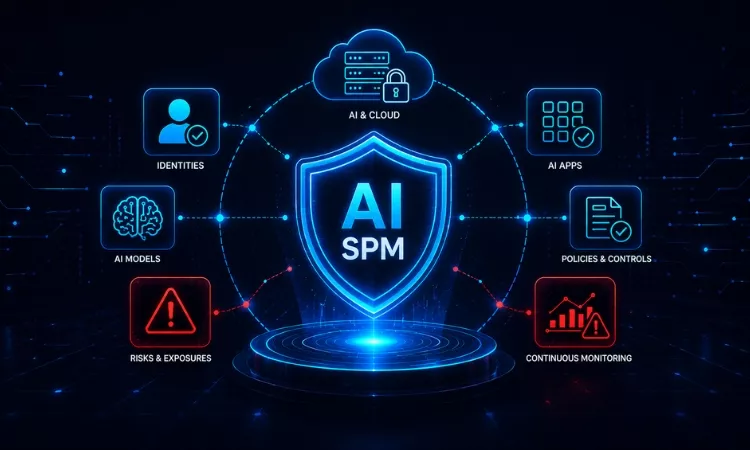
AI Security Posture Management (AI-SPM) is a security discipline that continuously discovers, assesses, and secures an organization’s AI assets, including models, training data, fine-tuning pipelines, vector databases, inference endpoints, and AI agents. It identifies misconfigurations, excessive permissions, data exposure, and compliance gaps across every AI system in use, whether that system was approved by IT or adopted quietly by a business unit.
Enterprises did not wait for security teams before adopting AI. Marketing built a chatbot on a foundation model API. Engineering fine-tuned an open-source model on production data. An analyst connected a coding assistant to the company’s private repositories. Each of these deployments created a new asset that traditional vulnerability scanners, cloud security tools, and data loss prevention systems were never designed to see. AI-SPM exists to close that gap.
What Does AI-SPM are Built Around?
AI-SPM platforms are built around four connected capabilities that work together across the AI lifecycle.
Discovery and inventory build a real-time catalog of every AI model, dataset, and pipeline running in the environment, including the unsanctioned tools that make up Shadow AI. Risk assessment scans that inventory for misconfigurations such as public model endpoints, excessive service permissions, and unencrypted training data. Threat detection watches for AI-specific attacks, including prompt injection, model extraction, and data poisoning, that conventional security tools do not recognize as malicious.
Compliance mapping ties each finding back to the regulatory and internal policy requirements the organization must satisfy, then tracks remediation until the gap closes.
Together, these four functions give security teams a single, continuously updated view of AI risk instead of a point-in-time audit that goes stale the day it is finished.
How Is AI-SPM Different From CSPM and DSPM?
Security teams often ask where AI-SPM fits alongside tools they already run. Cloud Security Posture Management, or CSPM, secures the cloud infrastructure an AI system runs on: virtual machines, storage buckets, containers, and network configuration. Data Security Posture Management, or DSPM, secures the data itself, tracking where sensitive information lives and who can reach it.
AI-SPM secures the layer neither tool was built to see. A cloud storage bucket can be configured correctly and still expose a model’s training data through an insecure API. A dataset can be classified and encrypted and still get pulled into a fine-tuning job without anyone logging that a new AI asset now holds it. AI-SPM connects the infrastructure view from CSPM, the data view from DSPM, and a model-specific view of permissions, lineage, and behavior, so a risk that surfaces in one layer gets traced back to the AI asset responsible for it.
What Risks Does AI-SPM Detect?
AI introduces risk categories that did not exist in traditional application security. Prompt injection manipulates a model’s output by hiding instructions inside content it processes, turning a support ticket or a web page into an attack vector. Data poisoning corrupts a model during training or fine-tuning so it produces biased or manipulated outputs later. Model extraction lets an attacker reconstruct a proprietary model by querying it repeatedly and analyzing the responses.
AI-SPM also catches the quieter risks that cause the most damage in practice. A retrieval-augmented generation pipeline that indexes a shared drive without checking permissions can expose confidential documents to any user who asks the right question. An AI agent granted broad API access to move faster can take actions well beyond what its task required, a governance gap covered under Agentic IAM. AI-SPM flags these conditions before an attacker or a careless configuration turns them into an incident.
How Does AI-SPM Work in Practice?
AI-SPM operates as a continuous cycle rather than a one-time assessment. Automated scans discover new AI assets the moment they appear, whether that is a new model deployed to a cloud AI service or an employee connecting a personal API key to a coding assistant. Each asset is scored against its permissions, data sensitivity, and exposure, so security teams can prioritize the handful of findings that carry real business impact instead of chasing every alert equally.
Many organizations formalize this inventory into a structured AI Bill of Materials, documenting every model, dataset, and dependency an AI system relies on. AI-SPM findings then feed into existing remediation workflows: a ticket for an over-permissioned service account, a policy update for an exposed endpoint, an escalation for a suspected data poisoning attempt. This operational layer is what puts a framework like AI TRiSM into daily practice rather than leaving it as a governance document.
Why Do Enterprises Need AI-SPM Now?
AI adoption inside the enterprise has outpaced the visibility security teams have into it. Research from the Cloud Security Alliance found that 82% of enterprises now have AI agents running in their environment that security teams do not know about, creating what researchers describe as retirement debt: permissions and credentials that outlive the task they were created for and quietly accumulate risk.
That exposure carries a measurable price. IBM’s Cost of a Data Breach Report 2026 found that AI-related breaches cost an average of USD 6 million, about a million dollars more than the global average, with cloud misconfigurations and compromised APIs among the most common root causes.
Regulatory pressure adds to the case. The NIST AI Risk Management Framework gives enterprises a voluntary blueprint for the same controls AI-SPM enforces in practice, and the EU AI Act’s transparency and general-purpose AI obligations are already active, with its high-risk system requirements advancing on a revised timeline that most global enterprises are still tracking closely.
What Are the Limitations of AI-SPM?
AI-SPM is a visibility and posture layer, not a complete AI governance program. It can show that a model has excessive permissions, but it cannot judge whether that model’s outputs are biased, inaccurate, or unsuitable for the decision it supports. Coverage also depends on connectors: an AI-SPM tool can only assess platforms it has been built to recognize, so organizations using newer or niche model providers may have gaps until support catches up. Like any posture tool, AI-SPM produces findings that require skilled review; a flood of unprioritized alerts creates the same fatigue security teams already fight with other tools. Organizations get the most value when AI-SPM sits inside a broader program that includes model validation, human review of high-impact outputs, and formal AI governance policy.
Who Should Own AI-SPM, and How Should CISOs Get Started?
AI-SPM works best when ownership sits jointly with the CISO’s team and the AI or data science function building these systems, since neither group alone has full visibility into how models are built, deployed, and used. A short set of starting steps helps organizations move from scattered awareness to a managed program:
- Inventory First: Run a discovery scan to find every AI model, agent, and pipeline already in production, sanctioned or not.
- Prioritize by Exposure: Focus initial remediation on models with access to sensitive data or the ability to take autonomous action.
- Map to a Framework: Align findings to the NIST AI RMF or ISO/IEC 42001 so audit evidence has a standard structure from day one.
- Assign Accountability: Name a single owner responsible for AI risk reporting, whether that sits in security, compliance, or a dedicated AI governance function.
Treat that list as a starting point rather than a finished program; AI adoption inside most enterprises is still moving faster than any static plan can account for.
Key Takeaway
AI risk does not sit still long enough for an annual audit to catch it. New models, new agents, and new integrations appear inside the enterprise every week, often without a ticket, a review, or a line item in the budget. AI-SPM gives security and governance teams a continuously updated picture of that risk, so decisions about AI adoption get made with evidence instead of assumption.
| Connect with Ampcus Cyber’s AI security specialists to run an AI asset discovery scan and map your current AI posture against NIST AI RMF and ISO/IEC 42001 before your next audit. |
Enjoyed reading this blog? Stay updated with our latest exclusive content by following us on Twitter and LinkedIn.