









A regional lending firm rolled out a machine learning model to automate loan approvals. For the first three months, the model performed exactly as expected. Approval rates held steady, default predictions matched historical patterns, and the credit team trusted the outputs enough to reduce manual review.
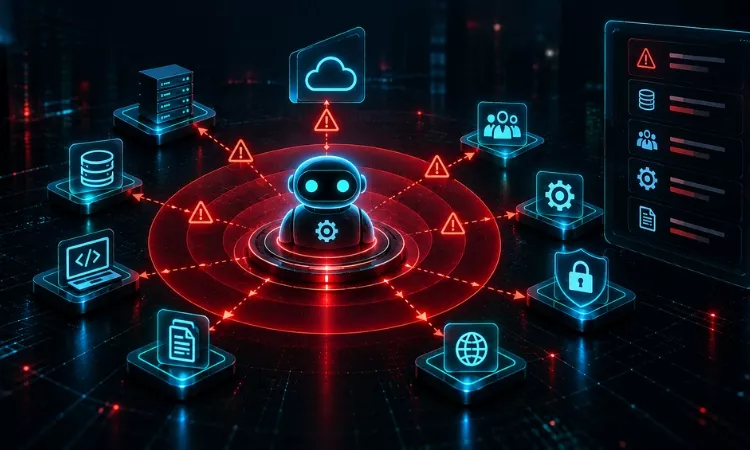
Then the economy shifted. Applicant income patterns changed, spending behavior moved online faster than the training data reflected, and the model kept scoring applicants using assumptions that no longer matched reality. Nobody caught it right away. The model did not crash or throw an error. It simply started making quietly wrong decisions, declining creditworthy applicants and approving riskier ones, for weeks before a compliance audit flagged the pattern.
This is the exact failure that AI model monitoring is built to prevent. A model that works well on day one can behave very differently by day one hundred, and without active oversight, that change often goes unnoticed until it shows up as a customer complaint, a regulatory inquiry, or a financial loss.
What Is AI Model Monitoring?
AI model monitoring is the ongoing process of tracking a deployed machine learning or AI model’s performance, accuracy, and behavior to detect problems as they emerge. It covers everything from prediction accuracy and data drift to bias, latency, and unexpected outputs. Unlike a one-time validation test run before launch, monitoring runs continuously across the model’s entire production life.
The goal is simple. Teams need to know whether a model still performs the way it did when it was approved for use, and if it does not, they need to know quickly enough to act. This applies to traditional predictive models, generative AI systems, and the large language models increasingly embedded in enterprise applications.
Why Does AI Model Monitoring Essential For Enterprises?
AI model monitoring matters because unmonitored models degrade silently, and that silence carries real business and regulatory cost. A model that drifts undetected can produce biased hiring recommendations, inaccurate fraud alerts, or flawed pricing decisions, all while appearing to run normally on the surface.
Regulatory pressure has made this more urgent. Frameworks such as the NIST AI Risk Management Framework and the EU AI Act both expect organizations to demonstrate ongoing oversight of AI systems, not just pre-deployment testing. For enterprises operating in finance, healthcare, or insurance, an unmonitored model is now a compliance gap as much as a technical one.
Monitoring also connects directly to broader AI Trust, Risk, and Security Management practices, since a model behaving outside its intended boundaries is a trust failure as much as a performance issue.
How Does AI Model Monitoring Work?
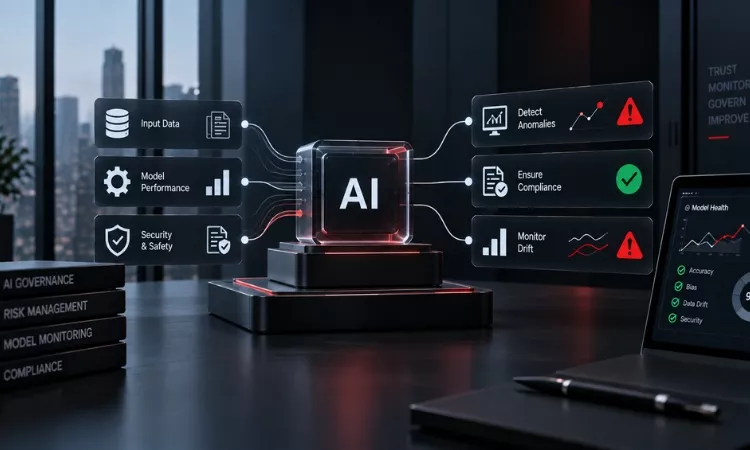
AI model monitoring works by continuously comparing a model’s live behavior against its expected baseline and flagging meaningful deviations. Teams start by defining what normal performance looks like at launch, then instrument the model with automated checks that run against every batch of new predictions.
In practice, this involves several layers working together. Input data is checked for drift, meaning the incoming data no longer resembles the data the model was trained on. Output predictions are checked against ground truth results as they become available, which reveals accuracy decay over time. System-level metrics like latency and error rates confirm the model is technically stable, not just statistically sound. Alerts fire automatically when any of thes move outside defined thresholds, routing the issue to data science, security, or compliance teams depending on severity.
Documentation plays a supporting role here as well. Teams that maintain a clear AI model card for each production model have a documented baseline to monitor against, which makes drift far easier to detect and explain to auditors.
What Metrics Should Organizations Track In AI Model Monitoring?
Organizations should track accuracy, drift, fairness, and operational metrics together, since no single metric tells the full story of model health. The most common categories include:
- Data drift: Changes in the statistical properties of incoming data compared to training data.
- Concept drift: Changes in the relationship between inputs and outcomes, meaning the patterns the model learned no longer hold.
- Accuracy and error rate: How often predictions match actual outcomes once they are known.
- Bias and fairness metrics: Whether outcomes vary unfairly across demographic or protected groups.
- Latency and uptime: Whether the model responds within acceptable time limits under production load.
- Confidence score distribution: Whether the model’s own certainty in its predictions is shifting over time.
A drop of even 5% in prediction accuracy over a quarter can signal a deeper drift problem long before it becomes visible in business results.
What Is The Difference Between AI Model Monitoring And AI Observability?
AI model monitoring tracks predefined metrics against known thresholds, while AI observability goes further by allowing teams to investigate the root cause of unexpected behavior even when they did not anticipate it in advance. Monitoring tells you something is wrong. Observability helps you understand why.
Enterprises need both. Monitoring catches the immediate drift or performance drop. Observability provides the deeper trace, including which inputs, features, or version changes contributed to the shift. Mature AI governance programs treat monitoring as the alarm system and observability as the investigation toolkit that follows it.
Who Should Own AI Model Monitoring In An Enterprise?
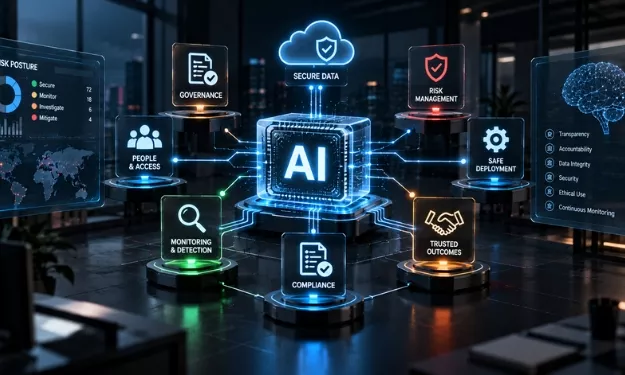
AI model monitoring works best as a shared responsibility between data science, security, and governance teams, with no single group owning it in isolation. Data science teams define performance baselines and interpret drift signals. Security teams treat monitoring as part of the broader attack surface, watching for adversarial manipulation or data poisoning attempts disguised as normal drift. Governance and compliance teams use monitoring evidence to demonstrate accountability during audits.
This shared ownership model aligns with how standards like ISO/IEC 42001 frame AI management, treating monitoring as a lifecycle control rather than a purely technical task. Organizations that have already mapped their journey from ISO 27001 to ISO 42001 tend to fold model monitoring directly into their existing risk committees instead of building a separate structure from scratch.
What Challenges Do Enterprises Face When Monitoring AI Models?
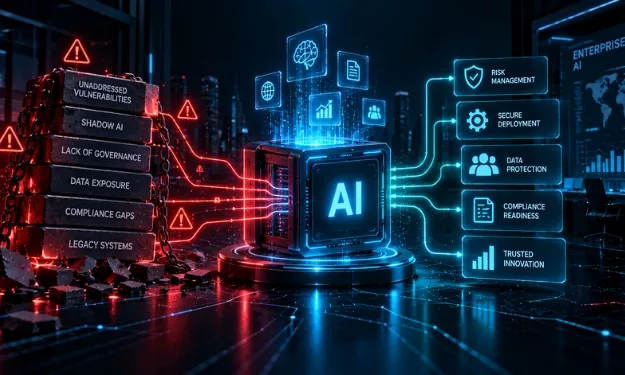
The biggest challenge enterprises face is visibility, since many AI models get deployed outside formal channels and never enter a monitoring program at all. This is closely tied to shadow AI, where business units adopt AI tools or fine-tune models without informing security or IT.
Other common challenges include alert fatigue from poorly tuned thresholds, a shortage of staff who understand both machine learning and security, and the sheer scale of monitoring dozens or hundreds of models across different business units simultaneously. Generative AI adds another layer, since outputs are harder to score against a single ground truth compared to traditional predictive models.
How Can Enterprises Build An Effective AI Model Monitoring Program?
Enterprises can build an effective AI model monitoring program by starting with an inventory of every model in production, then layering automated monitoring, clear ownership, and escalation paths on top of that inventory. The strongest programs treat monitoring as part of a wider AI assurance program rather than a standalone tool purchase, connecting technical monitoring to formal governance, audit trails, and incident response.
A practical starting sequence looks like this: inventory every model, define acceptable performance thresholds for each one, automate drift and bias detection, assign clear owners for alerts, and review monitoring outcomes on a fixed cadence with both technical and compliance stakeholders in the room.
Ampcus Cyber helps enterprises design and operationalize AI model monitoring programs that hold up under regulatory scrutiny.
| Talk to our team about building continuous oversight into your AI deployment lifecycle. |
People Also Ask
Is AI model monitoring the same as model validation?
No. Validation happens before deployment to confirm a model meets performance standards. Monitoring happens continuously after deployment to confirm the model still meets those standards over time.
How often should AI models be monitored?
Most production models need real-time or daily automated checks, with formal performance reviews on a monthly or quarterly cycle depending on how sensitive the use case is.
Does AI model monitoring apply to generative AI and large language models?
Yes. Generative AI models need monitoring for output quality, hallucination rates, prompt injection attempts, and policy compliance, alongside the traditional drift and accuracy checks used for predictive models.
What happens if a company skips AI model monitoring?
Unmonitored models can drift into inaccurate or biased decisions without detection, creating financial loss, customer harm, and regulatory exposure that often surfaces only after significant damage has occurred.
Enjoyed reading this blog? Stay updated with our latest exclusive content by following us on Twitter and LinkedIn.