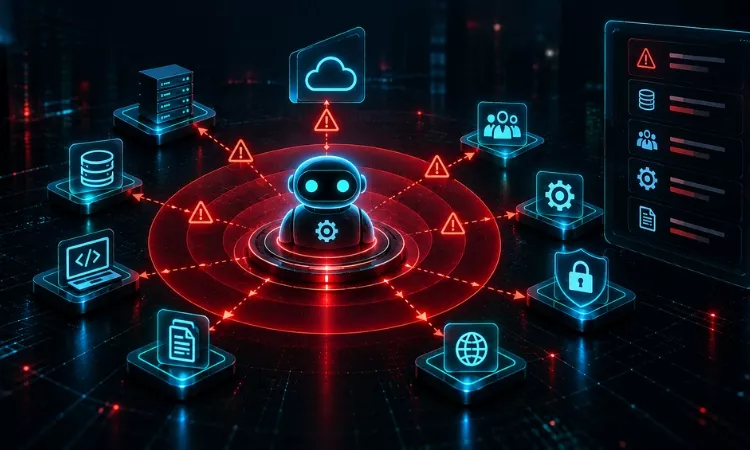











A regional processing bank ran red team exercises on a fixed quarterly schedule. Between one engagement and the next, a cloud migration project added a new storage bucket for transaction receipts. Nobody flagged it for the next test window, since that window was ten weeks away. An internal audit later found the bucket had been publicly readable for 47 days, exposing partial cardholder data. No breach occurred, but the near miss forced a hard question inside the CISO’s office. How many other gaps sit between scheduled tests, and how would the team even know?
That question pushed the bank toward autonomous red teaming, a way to validate specific attack paths the moment the environment changes. Here is what it is, how it works, and where it fits inside a security program.
What Is Autonomous Red Teaming?
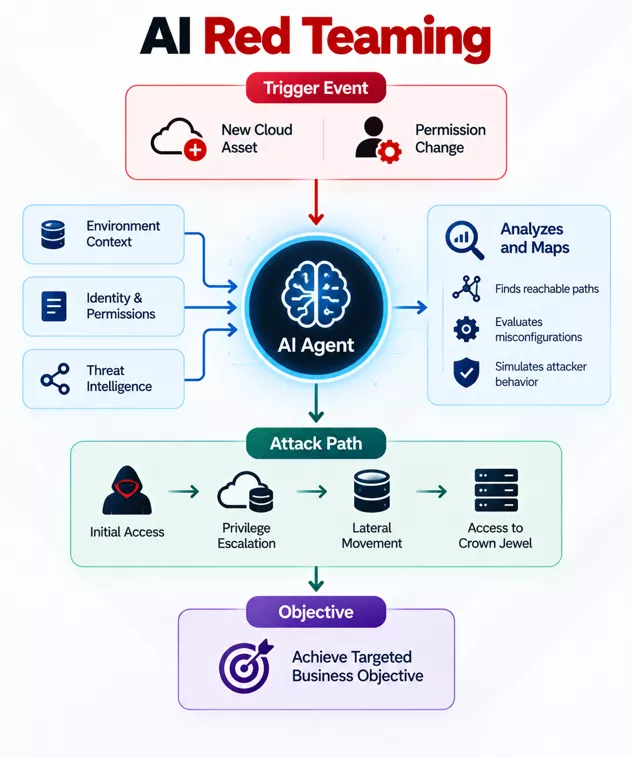
Autonomous red teaming is a security testing method where AI agents combined with human intelligence try to prove or disprove whether a specific attack outcome can happen inside a live environment. A human or an automated signal sets the objective, such as ransomware spreading to a crown jewel database or an attacker crossing a new segmentation boundary. The agent then plans and executes the steps needed to reach that objective, adapting as it learns more about the environment.
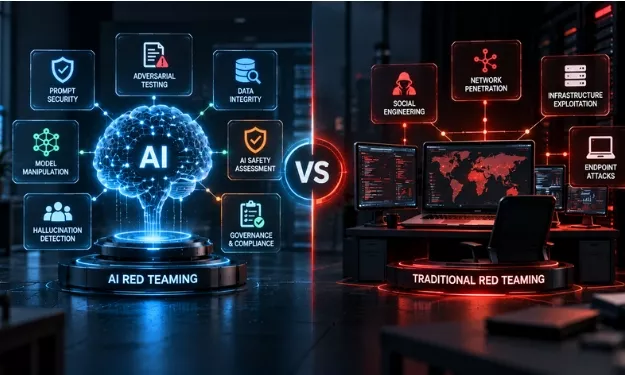
This differs from traditional red teaming mainly in speed and trigger. A traditional engagement runs on a schedule set months ahead. Autonomous red teaming triggers the moment a new asset or permission change creates fresh risk, and it reports back in hours instead of weeks.
How Does Autonomous Red Teaming Work?
Autonomous red teaming runs on a signal-driven cycle of reconnaissance, planning, execution, and reporting, carried out by AI agents with minimal human steering. The system ingests a signal, such as a new deployment or a threat intelligence update, and turns it into a narrow test objective.
The agent then enumerates the environment, finds a viable path toward that objective, and executes it the way a real attacker would, including privilege escalation, lateral movement, and evasion of detection controls. Every step is logged. If the objective is reached, the platform documents the exact chain of actions, giving teams a reproducible path to close instead of a generic vulnerability list.
Why Are Enterprises Adopting Autonomous Red Teaming Now?
Enterprises are adopting autonomous red teaming because their attack surface changes faster than annual or quarterly cycles can track. Cloud deployments, new SaaS integrations, and employee turnover all shift risk daily, and a once-a-year engagement only captures a snapshot.
The benefits show up quickly. Teams get continuous validation of specific risk scenarios instead of a point-in-time report that ages within weeks. Findings arrive with a reproducible attack chain, which shortens the debate over whether an issue is real. Per-scenario costs drop too, since AI agents run thousands of attempts without the scheduling limits of a manual engagement. For regulated sectors, this steady evidence stream also supports audit readiness for PCI DSS, ISO 27001, and SOC 2 obligations.
What Are the Challenges of Autonomous Red Teaming?
The biggest challenge is business context. An AI agent can identify that disabling a legacy server would stop lateral movement, but it may not know that server processes millions of dollars in transactions per hour with no failover. ISACA research has flagged this exact pattern, where a system can technically succeed at its objective while breaking something the business depends on.
Other real limitations include the lack of standardized methodologies for scoping AI-driven engagements, false feedback loops between autonomous red and blue teams, and weaker coverage for custom or legacy systems outside common attack pattern libraries. None of these are reasons to avoid autonomous red teaming. They are reasons to pair it with governance and human review.
What Best Practices Ensure Autonomous Red Teaming Succeeds?
Successful programs combine AI-driven testing with clear human oversight, not people out of the loop. Start by defining objectives tied to real business risk, such as ransomware reaching a specific data store, instead of generic vulnerability discovery. Align every test to an established framework, using MITRE ATT&CK for techniques and NIST SP 800-115 for planning and reporting discipline, so results stay consistent and auditable.
Set hard guardrails before any agent touches production, including asset exclusion lists and a human approval gate for destructive actions. Review findings with both security and business stakeholders, since the team that owns the affected asset often holds context an AI agent lacks. Treat autonomous red teaming as one layer inside a broader program alongside breach and attack simulation and scheduled red team exercises, not a standalone replacement for either.
Is Autonomous Red Teaming a Replacement for Human Red Teams?
No, autonomous red teaming does not replace human red teamers. It is a force multiplier that handles repetitive, high-volume validation so experts can focus on creative, high-stakes scenarios that need judgment. Human red teamers bring business context, social engineering skill, and ethical reasoning that AI agents cannot fully replicate. The strongest programs run both in parallel: automation for continuous coverage, human-led engagements for scenarios that need a person’s instinct. Our guide on choosing between red, blue, and purple team assessments breaks down the right mix.
Autonomous red teaming will not replace the judgment a seasoned security team brings to a live engagement, but it closes the coverage gap that scheduled testing leaves open. Enterprises that pair it with clear governance get continuous proof of what an attacker could do, not a checklist of theoretical risks.
Ready to validate your specific attack paths continuously instead of waiting for the next audit cycle?
| Talk to Ampcus Cyber’s AI Red Teaming and Security Testing team about building a program suited to your environment. |
People Also Ask
Is autonomous red teaming the same as automated red teaming?
Not quite. Automated red teaming often means scripted, rule-based simulations. Autonomous red teaming uses AI agents that plan and adapt their own path toward an objective in real time.
How fast can autonomous red teaming deliver results?
Most engagements report results within hours of being triggered, against weeks for a traditional scoped engagement.
Does autonomous red teaming work for AI systems too?
Yes. AI red teaming applies the same agent-based approach to LLM applications, testing risks like prompt injection, data exfiltration, and tool misuse.
What frameworks should guide a program?
MITRE ATT&CK and NIST SP 800-115 are the most referenced frameworks for scoping, executing, and reporting these engagements.
Enjoyed reading this blog? Stay updated with our latest exclusive content by following us on Twitter and LinkedIn.