








TL;DR
- AI security debt builds up when enterprises deploy AI tools, copilots, and agents faster than they build the governance, visibility, and access controls to manage them.
- The biggest drivers are shadow AI usage, ungoverned AI agents and non-human identities, and AI vendors onboarded without a security review.
- Paying down AI security debt starts with visibility into what AI is running, followed by governance frameworks, vendor due diligence, and continuous testing.
A mid-size insurance carrier’s security team learned about its engineering group’s new AI coding assistant the same week a routine penetration test flagged three exposed API keys. The keys belonged to a copilot the developers had connected to production systems six months earlier, with no security review, no assigned owner, and no log entry the SOC could pull when the audit started asking questions. Nobody had acted maliciously.
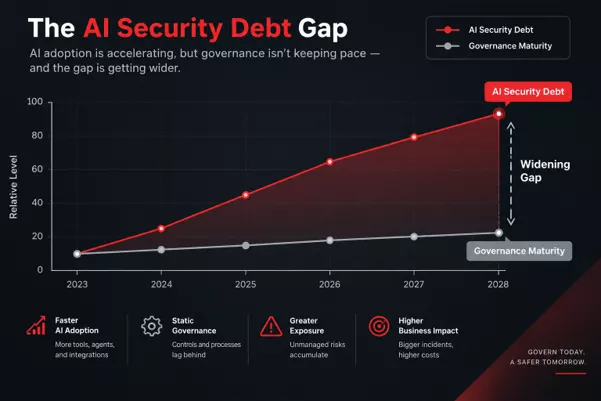
The team was moving fast, and the tool worked well enough that no one looped in security until an outside auditor forced the issue. That gap between AI adoption and AI governance is becoming the default pattern across enterprises. Every unreviewed copilot, every untracked AI agent, and every AI vendor brought on without a security check adds to a ledger that never appears on a balance sheet: security debt. In most organizations, that ledger is growing faster than anyone is measuring it.
What Is AI Security Debt, and How Is It Different From Shadow IT?
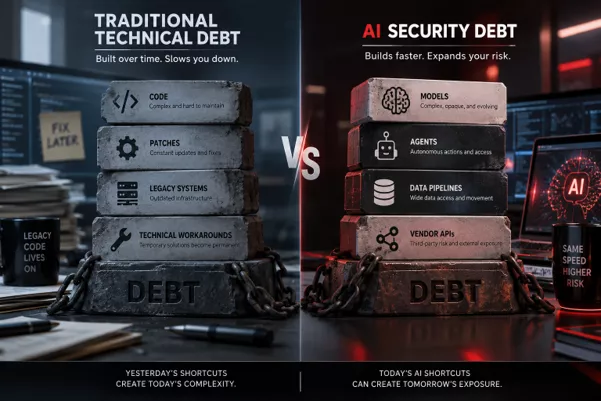
AI security debt is the risk an organization accumulates every time it deploys an AI system faster than it builds the controls to secure and govern it. It behaves like technical debt in software development, where a shortcut taken today becomes a cost paid later, except the interest compounds faster because AI systems touch data, decisions, and access at once.
Shadow IT mostly meant employees signing up for unapproved SaaS tools. AI security debt is a wider problem, because AI systems do not just store data, they act on it and sometimes take action on a user’s behalf. Our recent piece on the hidden governance gap in agentic AI security explains why autonomous agents raise the stakes further, since an agent with standing access can cause more damage than a single unauthorized app.
What Causes Hidden Security Debt in Enterprise AI Adoption?
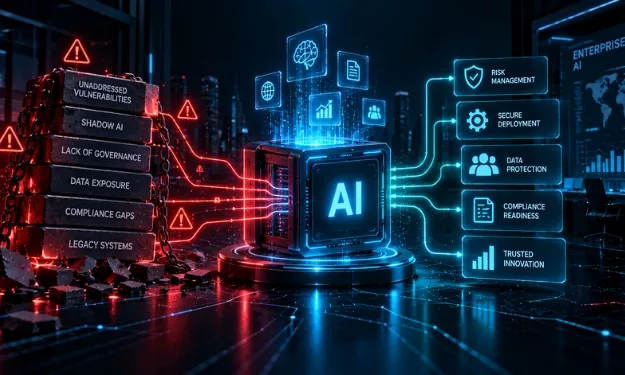
AI security debt usually traces back to four sources: unapproved AI tools, ungoverned AI agents, unvetted AI vendors, and no clear inventory of what AI is running across the environment. ISACA’s research on security debt as an unseen risk to cyber resilience points to the same root cause: AI models get deployed before governance catches up, and the gap becomes a blind spot that erodes trust over time.
Shadow AI Usage
Employees adopt AI tools to move faster, usually with good intentions. Every prompt typed into an unsanctioned tool is a potential data disclosure that security never sees.
Ungoverned AI Agents and Non-Human Identities
AI agents typically run as non-human identities with standing credentials, and most enterprises cannot say how many exist or what each one can access.
Unvetted Third-Party AI Vendors
Procurement teams often approve AI-powered vendors on functionality and price alone. Without a structured AI vendor due diligence process, a vendor’s weak controls become the enterprise’s exposure.
Missing AI Inventory
Security teams cannot govern AI systems they do not know exist. Without a maintained inventory, every new deployment adds debt nobody is tracking.

What Are the Warning Signs of Growing AI Security Debt?
An organization is likely carrying AI security debt if security cannot answer basic questions about what AI is running and who owns it, including:
- Security cannot produce a complete list of AI tools and agents running in production
- The same AI-related audit finding reappears every quarter with no assigned fix owner
- Vendor risk assessments skip the AI features embedded inside existing SaaS platforms
- Service accounts tied to AI agents have no expiration date and no named owner Employees mention using AI tools that were never formally approved
What Happens When AI Security Debt Goes Unaddressed?
Unmanaged AI security debt turns into three concrete costs: data exposure through AI systems nobody was watching, compliance findings tied to regulations such as the EU AI Act and India’s DPDP Rules, and remediation bills that grow every quarter the debt sits unresolved.
Recorded Future’s research on the hidden cost of AI security debt found that shadow AI adoption is on pace to reach 75% of the workforce by 2027, up from 41% in 2022, while AI code assistants could be in daily use by 75% of enterprise engineers by 2028. Each number means a wider blast radius for the next incident.
How Can CISOs and Governance Leaders Pay Down AI Security Debt?
Paying down AI security debt starts with visibility, then moves through governance, vendor review, and testing, because a team cannot govern what it cannot see. A practical AI assurance program gives governance leaders a repeatable structure for this work, not a one-time project.
- Build and maintain an AI inventory, sometimes called an AI-BOM, covering every model, agent, and copilot in use across the business
- Treat every AI agent as a non-human identity with a named owner, an expiration date, and least-privilege access
- Formalize AI vendor due diligence before any AI-powered tool touches production data or customer information
- Run AI-focused red teaming and adversarial testing on a regular cadence rather than a single annual check
- Assign clear governance ownership so AI risk decisions do not default to whichever team deployed the fastest
Forrester’s 2026 technology and security predictions found that most decision-makers expect their technical debt, AI included, to reach moderate or high severity this year, which makes this an executive-level priority.
AI adoption is not slowing down. Enterprises that get ahead of this problem treat AI governance as part of the rollout plan from day one, not a cleanup task for later.
| Talk to Ampcus Cyber’s governance and AI security team about assessing where your AI security debt stands before it shows up in an audit or an incident report. |
People Also Ask:
Is AI security debt the same as technical debt?
Who owns AI security debt inside an organization?
Can AI security debt be eliminated completely?
Enjoyed reading this blog? Stay updated with our latest exclusive content by following us on Twitter and LinkedIn.