








TL;DR
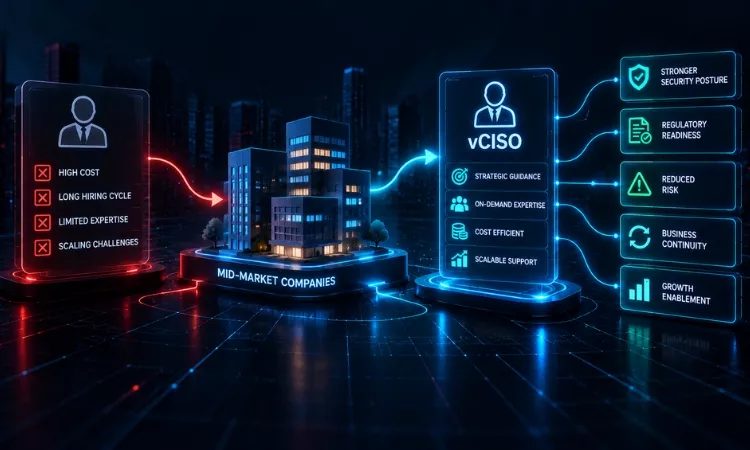
- vCISO gives mid-market companies senior security leadership without the cost and hiring challenges of a full-time CISO.
- It delivers faster, flexible coverage for security strategy, compliance, audits, risk, incident readiness, and board reporting.
- It reduces single-person risk while giving growing companies the expertise and continuity they need as security demands increase.
For a growing mid-market company, the security problem usually arrives before the budget for a security executive does. Customers start sending security questionnaires, auditors ask who owns the program, and the board wants to know whether the company is exposed. Someone has to answer those questions with authority, and that person needs to sit at a senior level. The instinct is to post a job and hire a full-time Chief Information Security Officer. More mid-market leaders are pausing on that instinct and choosing a virtual CISO instead, because the full-time route often costs more, takes longer, and delivers less than they expected.
What Is vCISO?
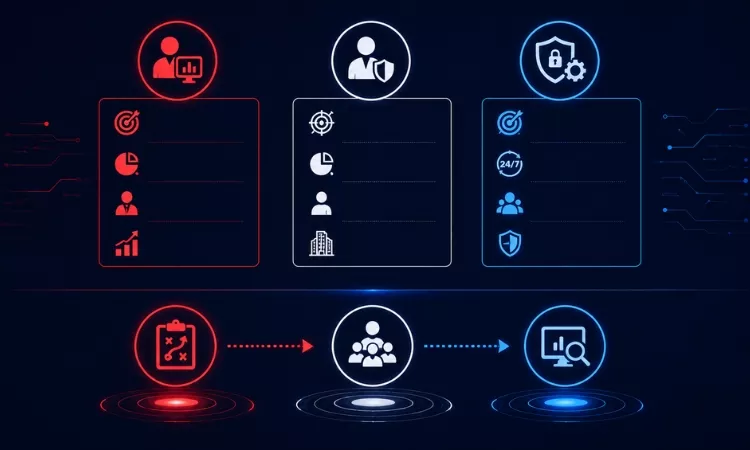
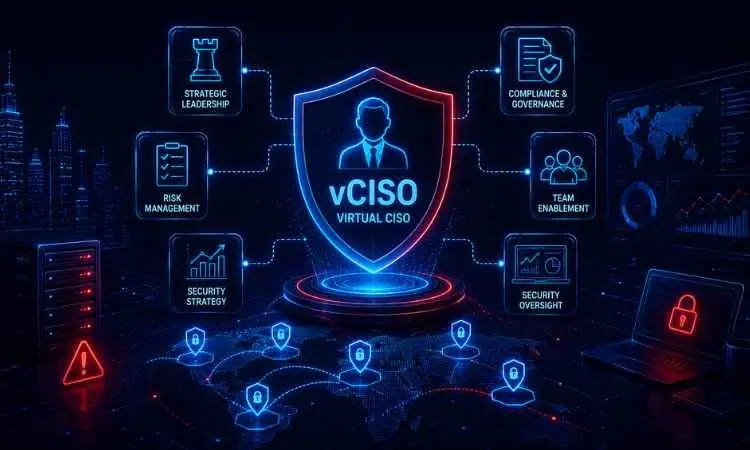
A vCISO, or virtual Chief Information Security Officer, is an experienced security leader who runs your security program on a part-time or shared basis, usually through a service engagement rather than a payroll seat. The role is senior by design, and it carries the same accountability a full-time CISO would hold. In most engagements, a vCISO owns:
- Security strategy and roadmap: The direction, priorities, and multi-quarter plan that ties security spending to business goals.
- Risk and compliance oversight: Keeping frameworks such as SOC 2, ISO 27001, and HIPAA on track and audit ready.
- Policy and governance: Building the security policy and strategy that auditors, customers, and regulators expect to see.
- Incident readiness: making sure the organization can detect, respond to, and recover from a security incident.
- Board and stakeholder reporting: translating technical risk into language the board and enterprise buyers can act on.
A virtual or shared CISO service delivers this leadership as an ongoing relationship, so the accountability sits with a partner rather than an empty seat on the org chart.
Why Mid-Market Companies Struggle to Hire a Full-Time CISO
The full-time hire looks straightforward on a slide, and then reality sets in. The talent is not sitting on the market waiting to be found. The 2025 ISC2 Cybersecurity Workforce Study found that 95% of teams report at least one skills gap, and 59% describe those gaps as critical or significant, up from 44 percent the year before. Even well-funded enterprises struggle to fill senior roles, and mid-market companies compete for the same scarce people with smaller budgets. Three problems tend to surface together:
- Scarce senior talent: Qualified CISOs are in short supply, and the strongest candidates gravitate toward larger pay packages at bigger firms.
- Executive-level cost: A full-time CISO commands senior-executive compensation, plus benefits, equity, recruitment fees, and months of ramp time.
- Retention and burnout: CISO tenure runs short and turnover runs high, so a single hire can leave within a year or two and reset the program.
For a company that does not yet have enough work to keep a CISO busy full time, the math rarely holds together.
vCISO vs Full-Time CISO: The Cost Difference
Cost is where the comparison becomes hard to ignore. A full-time CISO is a fixed, high salary that lands whether the workload is heavy or light in a given month. A vCISO is a defined engagement, scaled to what the business needs. The gap shows up across several lines, not only the headline figure:
- Full-time hire: Base salary, bonus, benefits, equity, recruitment costs, and a ramp period before the program improves.
- vCISO engagement: A predictable retainer, no benefits or equity load, and senior leadership contributing from the first week.
- Flexibility: Coverage can scale up around an audit or funding round, then settle back to a steady state.
That flexibility lets leadership put budget into controls and risk assessment and management rather than into a single salary line that stays fixed regardless of demand.
What Mid-Market Companies Gain From a vCISO
The switch is not only a way to spend less. A well-run vCISO engagement often delivers more than a single hire could, because the value comes from experience and breadth rather than from one person’s hours. Mid-market companies typically gain:
- Immediate seniority: A proven leader guiding the program from day one, with no recruitment gap to wait out.
- Cross-industry experience: Perspective drawn from many security programs, so common and costly mistakes get caught early.
- Independent judgment: An outside view that is harder to pressure into convenient answers. The NIST Cybersecurity Framework now treats this leadership accountability as a core Govern function, and a vCISO fills that role directly.
- Audit and compliance readiness: Frameworks kept current and evidence kept ready, supported by a platform such as GRACE.
- Vendor and third-party oversight: Third-party risk management handled as a standing discipline rather than a last-minute scramble.
- Continuity: The engagement does not walk out the door the way a single employee can, which removes the single-person risk.
When a vCISO Is the Right Fit (and When It Is Not)
A vCISO is not the right answer for every organization, and the honest version of this case matters. The model fits best when a company needs senior security direction but does not yet generate a full week of executive-level security work, which describes most mid-market firms. It also fits companies facing a first major audit, a funding round, or a wave of customer security reviews, where experienced leadership is needed quickly and the timeline is tight.
The model fits less well for very large enterprises with dense, daily security operations that justify a dedicated executive on site, or for organizations in highly regulated settings that require a named, resident officer. Naming these limits up front is part of what a credible partner does, and it helps leadership make the call with clear eyes.
Signs It Is Time to Bring in a vCISO
The need for senior security leadership tends to announce itself. A few signals usually show up before a company decides to act:
- Security questionnaires are stacking up: Enterprise prospects want evidence of governance that the current team cannot produce on its own.
- A first audit is on the horizon: SOC 2, ISO 27001, or HIPAA work has started with no one senior owning the outcome.
- A funding round or acquisition is in motion: Due diligence now includes hard questions about security posture and risk.
- An incident exposed a gap: Something went wrong, and it became clear that no one held the security program end to end.
- The board wants risk reporting: Leadership is asking for a clear view of exposure that the current team cannot assemble.
Any one of these is manageable on its own. Several arriving at once is a sign the company has outgrown an informal approach and needs a leader accountable for the whole program.
How a vCISO Engagement Works in Practice
A good engagement follows a clear arc rather than a vague retainer. It usually starts with a baseline, then moves into planning and steady execution:
- Assess the baseline: A security program maturity assessment shows where the program stands today and where the real gaps sit.
- Set the roadmap: Priorities are sequenced against business goals, budget, and the audits already on the calendar.
- Embed with the team: The vCISO works on a regular cadence with internal staff, so knowledge stays inside the business.
- Report upward: Risk and progress are communicated to the board, auditors, and customers in terms they can act on.
Handled this way, the engagement builds a durable security program instead of leaving behind a shelf of documents that no one maintains.
| Talk to our security leadership team and learn how our virtual CISO can give your business board-level security direction without the cost and delay of a full-time hire. |
People Also Ask:
When should a company hire a vCISO?
Hire a vCISO when you need senior cybersecurity leadership without the cost of a full-time CISO.
Can a vCISO help with SOC 2 and ISO 27001 compliance?
A vCISO can support SOC 2 and ISO 27001 compliance by establishing governance, identifying control gaps, developing policies, managing risks, coordinating evidence, and preparing teams for audits.
How does a vCISO prepare a company for a security audit?
A vCISO prepares a company for a security audit by assessing security posture, identifying control gaps, and creating a prioritized remediation plan.
What should a company look for when choosing a vCISO provider?
When choosing a vCISO provider, evaluate their cybersecurity leadership, industry expertise, compliance and security framework knowledge, and ability to collaborate with internal teams.
Enjoyed reading this blog? Stay updated with our latest exclusive content by following us on Twitter and LinkedIn.