








Many organizations working toward ISO 27001 certification while also aligning to NIST CSF 2.0 end up running two parallel risk assessment efforts. One team builds a risk register for the ISO audit. Another builds a separate maturity assessment against CSF functions. The underlying work, identifying assets, evaluating threats, scoring likelihood and impact, is nearly identical in both cases, yet it gets duplicated because the frameworks are treated as separate projects instead of two expressions of the same underlying risk management discipline.
Building one risk assessment framework that satisfies both standards from the start removes that duplication and gives security and governance teams a single source of truth they can present to auditors, regulators, and the board alike.
Why Map NIST CSF 2.0 and ISO 27001 Together
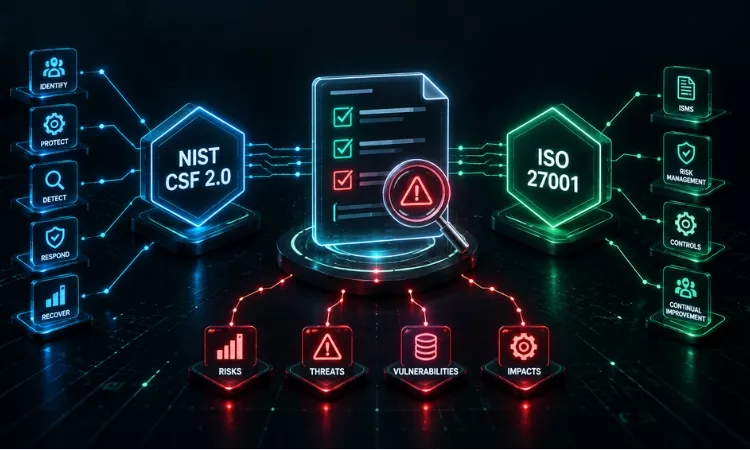
ISO 27001 requires organizations to establish, implement, and continually improve an Information Security Management System, with risk assessment as the foundation that everything else is built on. NIST CSF 2.0 organizes cybersecurity outcomes around six functions: Govern, Identify, Protect, Detect, Respond, and Recover, with Govern added in the 2.0 update to formally elevate risk management strategy and oversight to the same level as the other operational functions.
The overlap between the two is substantial. ISO 27001’s Annex A controls map closely to CSF 2.0’s Protect, Detect, and Respond categories, and both frameworks share the same underlying premise: security decisions should be driven by assessed risk rather than a generic checklist. The practical difference is structural. ISO 27001 is certifiable through third-party audit and requires specific documentation, including a Statement of Applicability and a risk treatment plan. CSF 2.0 is voluntary and functions more as a common language for describing risk posture and maturity, which is exactly why so many organizations use both together rather than choosing one over the other.
Step One: Establish Scope, Assets, and Context
Both frameworks start in the same place: understanding what needs to be protected before deciding how to protect it. This step corresponds to ISO 27001’s context and asset identification requirements and sits within CSF 2.0’s Identify function.
This means building an accurate inventory of information assets, systems, data flows, and third-party dependencies, then determining which of those assets matter most to the business. A risk assessment built on an incomplete asset inventory will produce gaps that surface later, either during an ISO audit or when a real incident exposes a system nobody accounted for. Organizations that skip or rush this step tend to spend far more time later reconciling ISO 27001 evidence against CSF categories, since the underlying data was never captured consistently to begin with.
Step Two: Assess Threats, Vulnerabilities, Likelihood, and Impact
With assets identified, the next step is evaluating specific risks against them. This means identifying realistic threats to each asset, assessing existing vulnerabilities, and scoring both likelihood and impact using a consistent methodology across the entire organization.
ISO 27001 requires this to follow a defined and repeatable risk assessment methodology, documented as part of the ISMS. CSF 2.0 does not mandate a specific methodology, but its Identify function expects organizations to understand risk in a structured way that supports prioritization. Using one consistent scoring approach, rather than different scales for different frameworks, is what allows a single risk register to serve both purposes without translation work later.
Step Three: Map Findings to Both Frameworks at Once
Once risks are scored, each finding should be mapped against both ISO 27001’s Annex A controls and the relevant CSF 2.0 function and category. This is the step most organizations skip, treating ISO evidence and CSF maturity scoring as separate deliverables when they could be produced from the same underlying data.
| Risk Assessment Stage | ISO 27001 Requirement | NIST CSF 2.0 Function |
| Governance and oversight | Leadership commitment, ISMS scope, policy | Govern |
| Asset and context identification | Asset inventory, risk criteria | Identify |
| Control selection and implementation | Annex A controls, Statement of Applicability | Protect |
| Ongoing monitoring | Internal audit, management review | Detect |
| Incident handling | Nonconformity and corrective action process | Respond |
| Continuity and improvement | Continual improvement, corrective action | Recover |
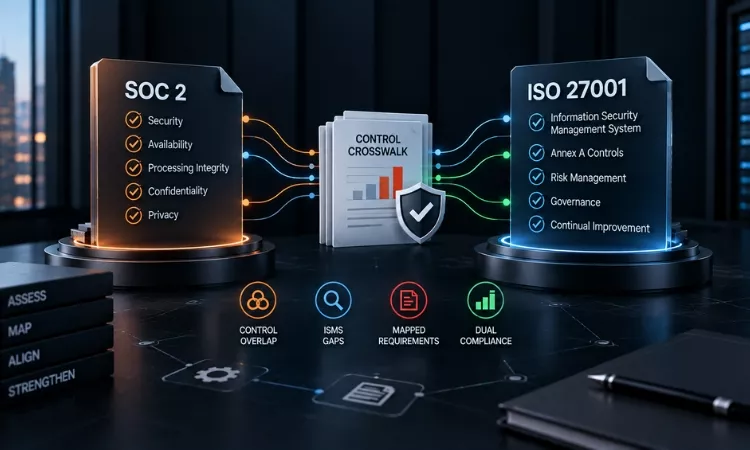
Building this mapping once, as part of the risk assessment methodology itself, means every future audit cycle or maturity review draws from the same evidence base instead of requiring a fresh reconciliation exercise. Our earlier breakdown of ISO 27001 mapping across security standards covers how this same logic extends to SOC 2, PCI DSS, and HIPAA as well, which matters for organizations juggling more than these two frameworks.
Step Four: Treat, Monitor, and Reassess
Risk assessment is not a one-time exercise under either framework. ISO 27001 requires a documented risk treatment plan and ongoing management review, while CSF 2.0’s Detect and Respond functions expect continuous monitoring rather than a static, point-in-time evaluation.
This is where many risk assessment programs quietly fail. A register built once during certification prep goes stale within months, as new systems get deployed, vendors change, and the threat landscape shifts. Reassessment should happen on a defined cadence, and any material change to the environment, a new cloud deployment, a new vendor relationship, an acquisition, should trigger an update to the risk register rather than waiting for the next scheduled review.
Building This Into a Repeatable Program
A risk assessment framework that serves both standards well needs to be owned by a defined process, not reconstructed by whoever happens to be preparing for the next audit. This typically means centralizing the risk register, the control mapping, and the supporting evidence in a single system, rather than maintaining separate spreadsheets for ISO documentation and CSF maturity tracking.
Furthermore, platforms like GRACE are built around this exact idea, crosswalking a single control library across more than 250 frameworks so that one piece of evidence can satisfy multiple overlapping requirements at once, rather than forcing teams to maintain parallel documentation for every framework they need to address.
Organizations with limited internal GRC capacity often bring in outside expertise to establish this methodology correctly the first time. Our Certified NIST CSF 2.0 Specialist training walks through how to build a practical risk management roadmap tailored to CSF 2.0’s structure, which pairs naturally with the risk assessment discipline ISO 27001 already requires.
The Business Case for CISOs and Governance Leaders
A unified risk assessment framework does more than save time during audit season. It gives leadership one consistent view of organizational risk, rather than two competing pictures that need to be reconciled before every board update. This also strengthens the organization’s position with cyber insurance underwriters, who increasingly expect to see structured, framework-aligned risk management rather than an ad hoc set of controls.
For CISOs managing both certification requirements and broader risk maturity goals, one framework also means one story to tell, whether the audience is an ISO auditor, a board committee, or an insurance underwriter evaluating the organization’s risk profile.
Ampcus Cyber helps organizations build unified risk assessment frameworks that satisfy NIST CSF 2.0 and ISO 27001 simultaneously, reducing audit effort while strengthening overall risk visibility.
| Talk to our GRC experts to start mapping a risk assessment framework built for both standards. |
Enjoyed reading this blog? Stay updated with our latest exclusive content by following us on Twitter and LinkedIn.