









Security budgets keep climbing. Gartner projects worldwide spending on information security will reach $240 billion in 2026, a 12.5% increase over the prior year. Despite that growth, many CISOs still struggle to answer a simple board question: how does this specific investment reduce a specific business risk. A strategy built around tools, frameworks, or the latest breach headline rarely survives that question. A strategy built around business risk usually does.
A 3-year cybersecurity strategy gives security leaders enough runway to make deliberate, phased investments instead of reactive purchases, while staying short enough to remain accountable to measurable outcomes. Building one requires a specific sequence of steps, not a single planning workshop.
Start With a Risk Assessment Tied to Business Outcomes
Every credible cybersecurity strategy starts with understanding what the business stands to lose. This is different from a generic vulnerability scan or a checklist audit. It means identifying the systems, data, and processes that matter most to revenue, regulatory standing, and customer trust, then mapping realistic threat scenarios against each one.
A manufacturing company’s biggest exposure might be operational technology downtime. A financial services firm’s might be regulatory penalties tied to data handling failures. A SaaS provider’s might be a breach that damages the trust underlying every customer contract. The threats differ, and so should the resulting strategy. Skipping this step is the single most common reason security roadmaps get rewritten every time leadership changes, since a generic plan has no defensible reason to prioritize one investment over another.
Translate Risk Into a Three-Year Roadmap, Not a Wish List
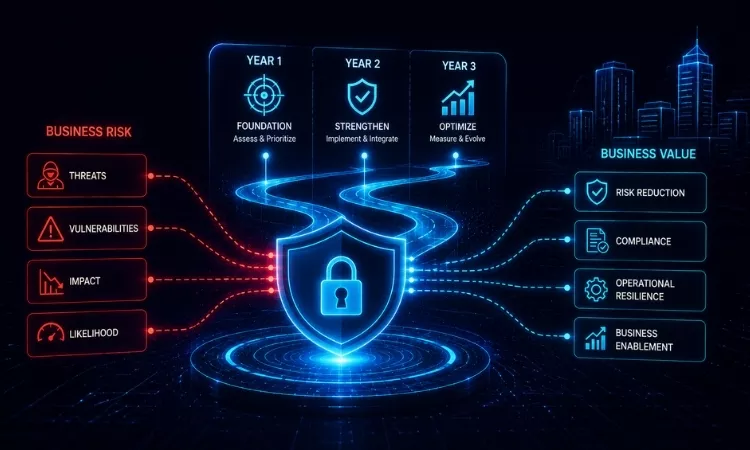
Once risk is mapped, the next step is sequencing the response across three years rather than trying to fix everything in year one. Most organizations do not have the budget, staff, or organizational capacity to address every gap simultaneously, and attempting to do so tends to produce a scattered set of half-finished initiatives.
A workable structure looks like this: Year one addresses the highest-severity, highest-likelihood risks, typically foundational controls such as identity governance, backup resilience, and incident response readiness. Year two builds on that foundation with more advanced capabilities, such as continuous monitoring, threat detection maturity, and deeper third-party risk oversight. Year three shifts toward optimization and resilience testing, confirming that earlier investments reduced risk as intended, rather than simply checking a box.
This phased structure also makes the roadmap easier to defend financially, since each year’s spend maps directly to a measurable reduction in a previously identified risk rather than an open-ended request for more budget.
Anchor the Strategy to a Recognized Framework
A strategy built entirely from internal judgment is hard to benchmark and even harder to communicate to a board that expects familiar reference points. Anchoring the roadmap to a structured framework such as the NIST Cybersecurity Framework gives the plan a common language across security, IT, and business leadership.
The NIST CSF organizes cybersecurity outcomes around six functions: Govern, Identify, Protect, Detect, Respond, and Recover. Mapping the three-year roadmap against these functions helps ensure the strategy covers governance and risk management, not just technical controls, and gives leadership a consistent structure for tracking progress year over year rather than a shifting list of initiatives.
Build In Measurable Maturity Checkpoints
A three-year strategy without measurement checkpoints tends to drift. Security leaders should establish a maturity baseline at the start of the plan, using a structured security program maturity assessment, then reassess at defined intervals, typically annually, to confirm the roadmap is producing real gains rather than just consuming budget.
These checkpoints also create natural opportunities to adjust course. Threat landscapes shift, business priorities change, and a rigid three-year plan that cannot absorb new information will age poorly. The goal is a strategy with enough structure to stay accountable and enough flexibility to adapt as conditions change. Reassessment should also revisit residual risk, since the exposure left over after controls are implemented often shifts as the business itself changes, and a strategy that ignores that drift can quietly fall out of alignment with actual risk.
Point-in-Time Roadmap vs. Risk-Aligned 3-Year Strategy
| Dimension | Point-in-Time Roadmap | Risk-Aligned 3-Year Strategy |
| Starting point | Available tools and current vendor relationships | A business risk assessment tied to revenue, compliance, and trust |
| Planning horizon | Annual budget cycle, reactive to recent incidents | Phased across three years with defined milestones per year |
| Framework alignment | Ad hoc, varies by initiative | Anchored to a structured framework such as NIST CSF |
| Measurement | Activity metrics, such as tools deployed | Maturity checkpoints tied to measurable risk reduction |
| Board communication | Difficult to justify against a shifting list of projects | Clear line from investment to specific risk outcome |
Where a vCISO Fits Into Strategy Development
Not every organization has a full-time executive with the bandwidth to run this process end to end. A Virtual CISO can lead the risk assessment, build the phased roadmap, and present it to the board in language executives already understand, without the cost of a permanent hire. This is particularly valuable for mid-sized organizations that need senior strategic direction but cannot justify a full-time security executive.
A vCISO engagement also brings outside perspective to the prioritization process, since an internal team close to daily operations can sometimes struggle to separate genuine business risk from familiar technical debt. An experienced vCISO service brings that risk-based prioritization discipline from day one, rather than treating it as an afterthought layered onto an existing tool-driven plan.
The Business Case for CISOs and Boards
A three-year strategy tied to business risk changes the nature of budget conversations. Instead of defending individual purchases against competing priorities each quarter, security leaders can show a board exactly how this year’s spend reduces a specific, previously identified exposure, and what the next two years are designed to accomplish. That clarity matters more as security budgets continue their double-digit growth trajectory, since boards increasingly expect a defensible return on that investment, not just a larger number on next year’s line item.
It also protects the strategy against leadership turnover. A roadmap grounded in business risk and measurable maturity checkpoints survives a change in CISO or CIO far better than a plan built around one leader’s personal technology preferences.
Ampcus Cyber helps organizations build risk-aligned, NIST-anchored cybersecurity strategies that hold up across budget cycles and leadership changes.
| Start mapping your organization’s three-year cybersecurity roadmap with our security strategy experts. |
Enjoyed reading this blog? Stay updated with our latest exclusive content by following us on Twitter and LinkedIn.