










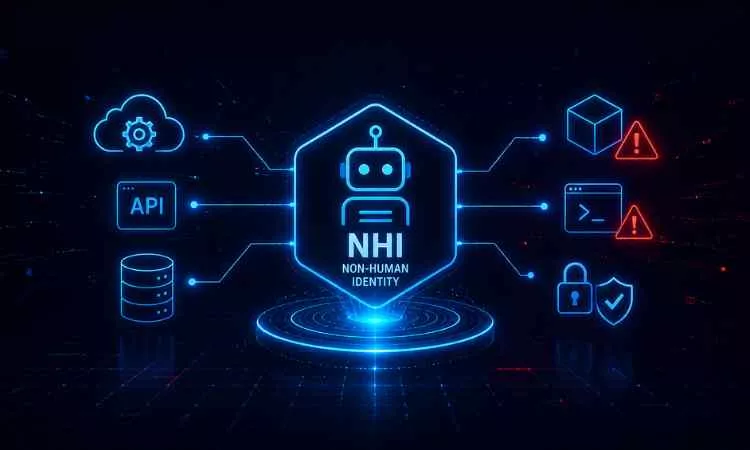
What is a Non-Human Identity (NHI)?
A non-human identity (NHI) is any credential, token, or secret that authenticates a machine, application, automated process, or AI agent to access enterprise resources, with no human directly involved in that specific transaction. NHIs differ from human identities because they can’t perform interactive multi-factor authentication and typically operate continuously rather than during defined working hours.
Every API integration, CI/CD pipeline, cloud workload, and service-to-service call runs on an NHI. Most organizations built their identity programs around people first, which means this entire category has been growing quietly in the background for years, largely without the ownership, rotation, or review that human accounts get by default.
Why Are Non-Human Identities a Growing Risk?
The scale gap is no longer marginal. Palo Alto Networks’ 2026 Identity Security Landscape report, based on a survey of over 2,900 cybersecurity decision-makers, found that machine identities now outnumber human identities 109 to 1 inside the average enterprise, and that nine out of ten organizations experienced a successful identity-related breach in the past 12 months. Separately, CyberArk’s prior-year study put the ratio at 82:1 and found that half of security leaders had already traced a security incident directly back to a compromised machine identity.
The reason this matters more than the ratio alone suggests is that NHIs are structurally harder to secure than human accounts. They can’t complete a push notification or type a one-time code, so multi-factor authentication, the control organizations lean on hardest for people, simply doesn’t apply.
What Types of Non-Human Identities Exist?
NHIs aren’t a single category. They span a range of credential types with different lifecycles, risk profiles, and governance needs.
| NHI Type | What It Authenticates | Typical Lifecycle Risk |
| Service Accounts | Applications and background processes accessing systems | Often created once and never reviewed; frequently over-privileged |
| API Keys | Programmatic calls between services or to third parties | Long-lived by default; commonly hardcoded or leaked in repositories |
| OAuth Tokens | Delegated access granted by a user to an application | Can outlive the original consent; refresh tokens extend access indefinitely |
| Workload/Certificate Identities | Cloud workloads, containers, and machine-to-machine TLS | Expire on a schedule but often auto renewed without re-validation |
| AI Agent Credentials | Autonomous agents acting on a user’s or system’s behalf | Dynamic, task-scoped, and frequently provisioned faster than they can be inventoried |
Why Do Traditional IAM Controls Fail for NHIs?
Most identity and access management frameworks were designed around a human lifecycle: onboarding, role assignment, periodic access review, and offboarding tied to an HR event. NHIs don’t follow that pattern. They’re provisioned by developers, not HR systems, they persist indefinitely unless someone actively deprovisions them, and they generate no “normal” behavior baseline the way a person’s working hours or login geography would. A stolen NHI credential can be used at 3 a.m. from an unusual region without tripping the anomaly detection built for people, which is exactly the blind spot MITRE ATT&CK documents under Application Access Token abuse (T1550.001), where adversaries use stolen OAuth or API tokens to bypass authentication entirely and act with the token’s full granted scope.
What Are the Biggest NHI Risks Enterprises Face?
Three risks recur most often in enterprise environments. Orphaned accounts remain active after the project, developer, or vendor relationship that created them has ended, with no clear owner to notice or revoke them. Excessive privilege accumulates because service accounts are frequently granted broad access to avoid troubleshooting friction, then never scoped back down. Credential sprawl happens when secrets are hardcoded into source code, configuration files, or CI/CD pipelines instead of a managed vault, making them discoverable to anyone with repository access. Any one of these, left unmanaged long enough, becomes a lateral movement path an attacker can walk through without ever needing to compromise a human account. Tracking these gaps alongside a broader continuous threat exposure management program helps surface which NHIs are reachable and exploitable, rather than treating every credential as equal risk.
What Does Good NHI Governance Look Like?
Effective governance starts with a complete inventory: knowing every NHI that exists, what it can access, and who owns it. From there, four practices carry most of the weight. Assign an accountable human owner to every machine credential so there’s someone to answer for it during a review. Enforce least privilege and short credential lifetimes, replacing standing API keys with short-lived, automatically rotated tokens wherever the architecture allows it. Route every secret through a centralized vault rather than allowing it to live in code or configuration files. Extend detection beyond provisioning, since granting access correctly on day one doesn’t guarantee the credential is still being used appropriately on day two hundred; this is where identity threat detection and response closes the gap traditional IAM leaves open, by monitoring what an identity actually does after authentication rather than just what it was granted at provisioning.
NIST and CISA formalized much of this thinking in Interagency Report 8587, released in December 2025, which provides federal implementation guidance for protecting identity tokens and assertions from forgery, theft, and misuse, including key management, token validity periods, and lifecycle controls that apply directly to NHI programs even outside government environments. Mapping an NHI program to broader NIST security standards gives governance leaders a defensible structure auditor already recognize.
How Are AI Agents Changing the NHI Landscape?
AI agents are the fastest-growing and least-governed subset of NHIs. Unlike a static service account, an agent can be provisioned dynamically, request access to new tools mid-task, and act with a scope that shifts based on the goal it’s pursuing rather than a fixed role. Traditional access reviews, built around quarterly cycles and static entitlements, weren’t designed for identities that can mint new permission requests hourly. Governing this category requires the same fundamentals, ownership, least privilege, and continuous monitoring, applied through an identity model built for autonomy rather than retrofitted from a human IAM framework, which is the gap covered in our guide to agentic IAM.
A SIEM platform that correlates NHI activity alongside human identity logs gives security teams the single pane of glass needed to catch an over-privileged agent or a leaked token before it becomes the entry point for a breach, rather than discovering it during incident response.
Non-human identities aren’t a future problem to plan for. They already outnumber the human accounts most security programs are built around, and the gap is widening every quarter.
Not sure how many machine identities are running unmanaged in your environment ?
| Ampcus Cyber’s Identity & Access Management team can run an NHI discovery and governance assessment across your cloud, DevOps, and AI environments. |
Enjoyed reading this blog? Stay updated with our latest exclusive content by following us on Twitter and LinkedIn.