










A regional bank rolled out an AI-driven loan approval model to speed up underwriting decisions. For six months, the model performed well on paper, approval times dropped, and the business team celebrated the efficiency gain. Then a routine regulatory exam asked a simple question “why was a specific applicant denied credit while a similar applicant was approved?” to which nobody on the compliance team could answer with confidence.
The data science team pointed to model accuracy scores, but had no clear, auditable trail showing what data informed the decision or who was accountable for reviewing it. The bank had built an accurate model. It had not built a trusted one.
This gap between a model that works and a model the organization can prove works is where enterprise AI trust lives. It separates AI programs that scale into regulated, high-stakes operations from those that stall at the first audit or board review.
What Is Enterprise AI Trust?
Enterprise AI trust is the verified confidence that an AI system performs reliably, protects sensitive data, and produces decisions an organization can explain, defend, and audit on demand. It is not a feeling or a marketing claim. It is a measurable state, built from documented evidence rather than assumption.
This trust is established across three connected layers: the data layer, which supplies governed and traceable inputs; the model layer, which handles monitoring and explainability; and the decision layer, which ties every output to a named owner and an audit trail. When these layers are connected, governance leaders can answer hard questions about any AI-driven decision without scrambling for evidence after the fact. Our guide on AI TRiSM breaks down how trust, risk, and security management work together across this lifecycle.
Enterprise AI Trust: What CISOs and AI Governance Leaders Need to Know
Enterprise AI trust matters because AI is now shaping decisions that carry legal, financial, and reputational weight, and leaders are personally accountable for those outcomes. Credit approvals, fraud alerts, hiring shortlists, and clinical recommendations are already influenced by AI systems inside large enterprises.
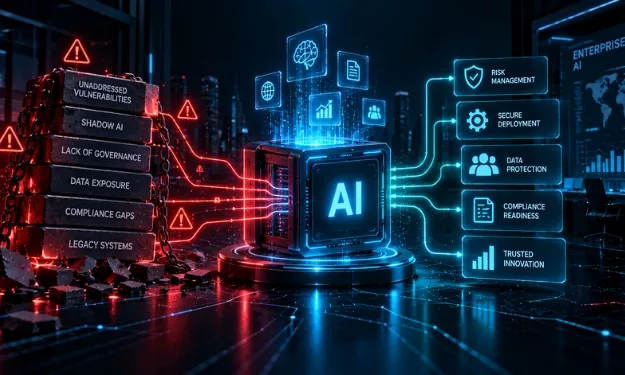
Boards and regulators are no longer satisfied with claims that a model is accurate. They expect documented proof that AI systems are monitored, that access is controlled, and that a human owner can be named for every automated decision. Without that proof, security and compliance teams face longer audits, higher regulatory scrutiny, and slower AI adoption across the business, which undercuts the very efficiency AI was meant to deliver.
What Are the Core Pillars of Enterprise AI Trust?
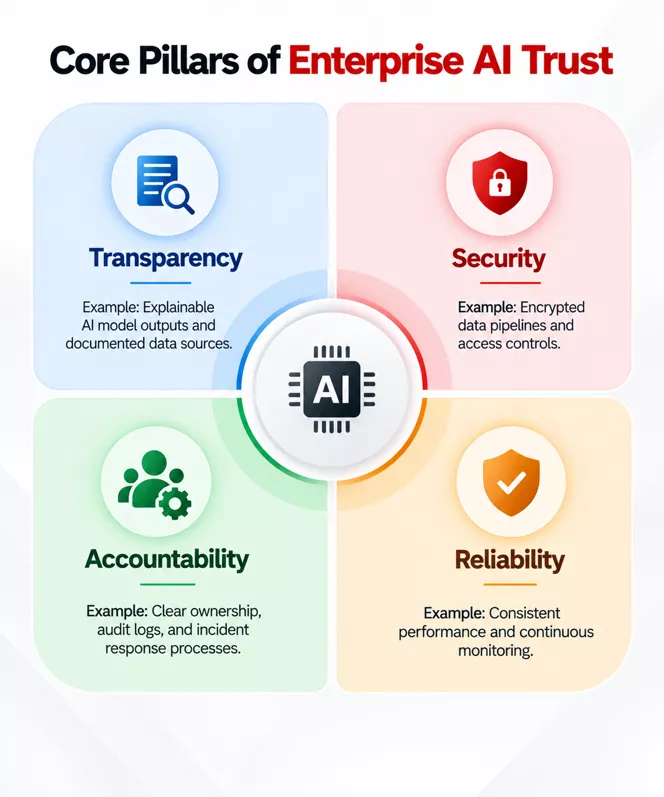
The core pillars of enterprise AI trust are transparency, security, accountability, and reliability, and each one needs its own evidence, not just a policy statement.
- Transparency: Teams can trace where training and inference data came from and how a model reached a specific output.
- Security: The infrastructure, data pipelines, and APIs supporting AI systems are protected using the same rigor applied to production applications.
- Accountability: Named individual or team owns every AI system, with the authority to pause, adjust, or retire it when something goes wrong.
- Reliability: The system behaves consistently across conditions and is monitored continuously for drift, not just tested once before launch.
These pillars work together. A model can be accurate and still be untrustworthy if nobody can explain its reasoning or take responsibility for its outputs. Ampcus Cyber’s overview of AI model cards shows how documentation supports the transparency pillar.
How Is Enterprise AI Trust Different From AI Governance?
Enterprise AI trust is the outcome an organization wants to achieve, while AI governance is the structure of policies, roles, and controls used to achieve it. Governance is the framework. Trust is the measurable result of that framework working as intended.
An organization can have an AI governance policy on paper and still lack trust if the policy is not enforced consistently across every AI system in production. Trust is proven through operational signals such as monitoring dashboards, access logs, and incident response records, while governance defines who is responsible for producing those signals. Our breakdown of agentic GRC explains how governance programs are adapting as AI systems begin acting autonomously.
Which Frameworks Help Enterprises Build AI Trust?
Enterprises build AI trust using structured frameworks rather than internal, ad hoc rules, and two references have become the common starting point: the NIST AI Risk Management Framework and ISO/IEC 42001.
NIST’s framework organizes AI risk management into four functions: Govern, Map, Measure, and Manage. It is voluntary and flexible, which makes it a useful common vocabulary for risk conversations across security, legal, and data science teams. ISO 42001 takes a more prescriptive path as a certifiable international standard for an AI Management System, giving enterprises a structured way to prove governance maturity to regulators, customers, and partners. Many organizations use NIST for ongoing risk assessment and ISO 42001 for formal, third-party validated assurance, since the two frameworks complement each other.
Who Is Responsible for Enterprise AI Trust?
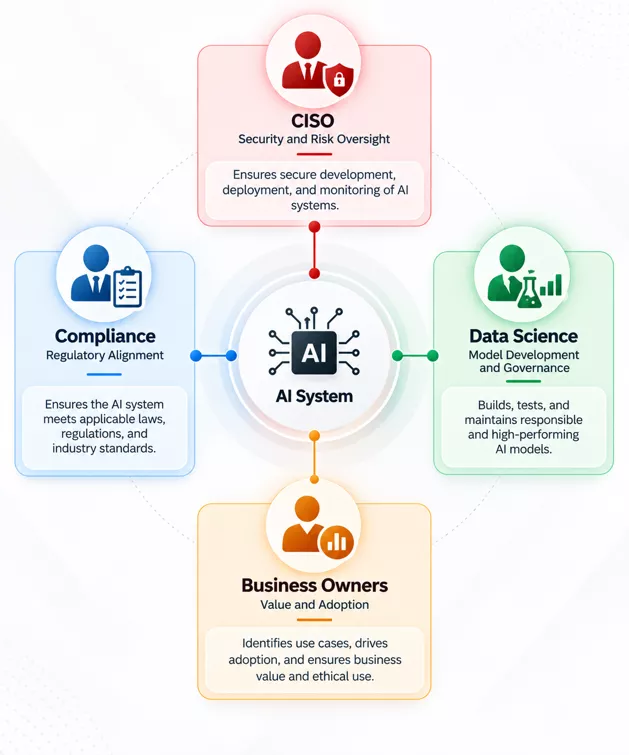
Responsibility for enterprise AI trust sits with a shared group that includes the CISO, governance and compliance leaders, data science teams, and business unit owners, not a single department working alone.
The CISO typically owns the security and infrastructure controls protecting AI systems. Governance and compliance leaders own the policy, documentation, and regulatory mapping. Data science and engineering teams own model performance, monitoring, and technical explainability. Business unit owners are accountable for how AI outputs are used in real decisions. When ownership is unclear, systems drift out of view quickly. This is especially true for non-human identities such as service accounts and AI agent credentials, which our guide on non-human identity risk covers in detail.
How Can Enterprises Measure and Build AI Trust?
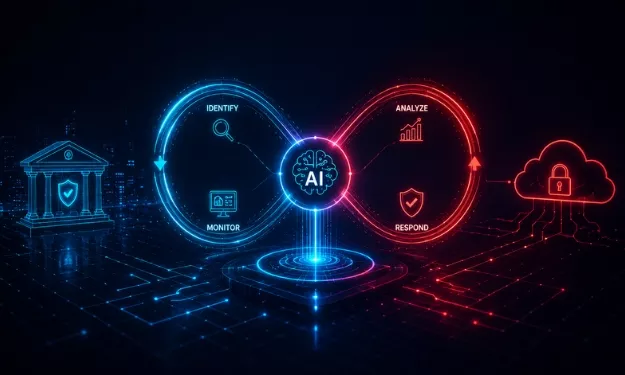
Enterprises measure and build AI trust by treating it as a continuous program with defined metrics, not a one-time launch checklist.
Start with a complete inventory of every AI system in use, including tools adopted informally by business teams. Assign a named owner to each system and document its intended use, data sources, and known limitations. Implement continuous monitoring for accuracy, bias, and drift, and route findings into the same risk register used for other enterprise risks. Run assurance reviews before major model updates, and require AI vendors to demonstrate their own controls through structured due diligence. Ampcus Cyber’s guide to AI assurance programs walks through how to operationalize this across the AI lifecycle.
What Happens When Enterprise AI Trust Breaks Down?
When enterprise AI trust breaks down, organizations face regulatory findings, customer attrition, and internal loss of confidence in AI-driven decisions, often before any single major incident occurs.
The damage rarely starts with a dramatic failure. It starts with small gaps: a decision nobody can explain, an access log with missing entries, a vendor that cannot answer a due diligence questionnaire. Left unaddressed, these gaps compound. Regulators expand audit scope. Customers request proof of AI governance as a contract condition. Internal teams quietly stop relying on AI outputs, which erases the productivity gains the technology was meant to deliver. Rebuilding trust after a public failure takes far longer than building it correctly from the start.
Ready to prove your AI systems are secure, accountable, and audit ready?
| Talk to Ampcus Cyber’s Governance, Risk & Compliance team about building an enterprise AI trust program that holds up under real scrutiny. |
People Also Ask
Is enterprise AI trust the same as AI safety?
No. AI safety focuses on preventing harmful or unintended model behavior, while enterprise AI trust is broader and includes security, accountability, and auditability across the entire AI lifecycle.
Does ISO 42001 certification guarantee enterprise AI trust?
Certification demonstrates that a structured management system exists, but ongoing monitoring and enforcement are still required to maintain trust day to day.
Can smaller organizations build enterprise AI trust without a large GRC team?
Yes. Starting with an AI inventory, named ownership, and basic monitoring builds a strong foundation, even before adopting a full certification program.
How often should AI trust controls be reviewed?
Most enterprises review controls quarterly, with additional reviews triggered by major model updates, new regulations, or incidents involving AI systems.
Enjoyed reading this blog? Stay updated with our latest exclusive content by following us on Twitter and LinkedIn.