







What is Agentic GRC?
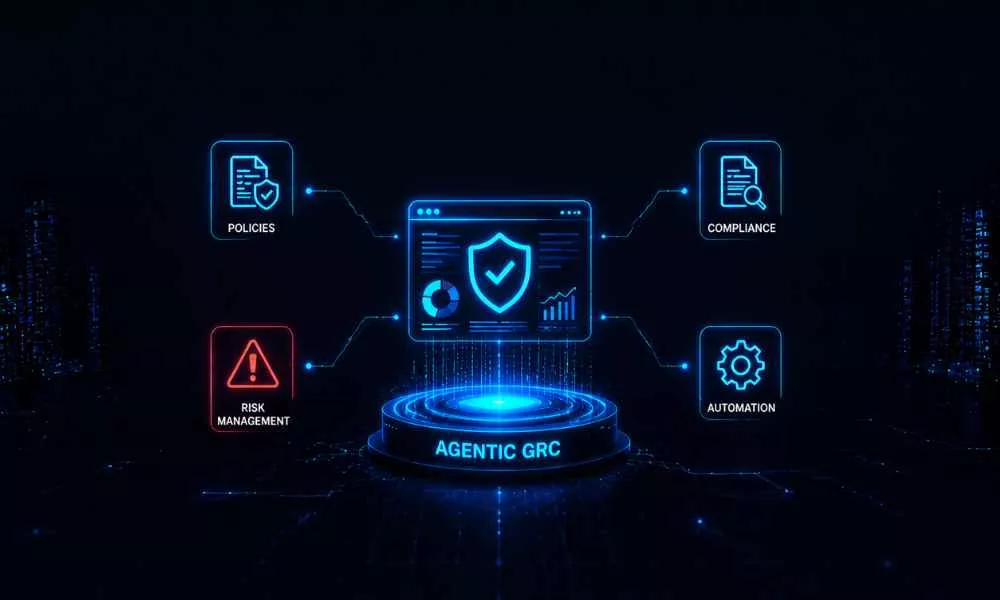
Agentic GRC is an AI-driven compliance framework that deploys autonomous AI agents to continuously manage governance, risk, and compliance workflows. Utilizing multi-step reasoning and open protocols, these agents independently execute evidence collection, semantic gap analysis, and risk remediation without requiring manual human prompting.
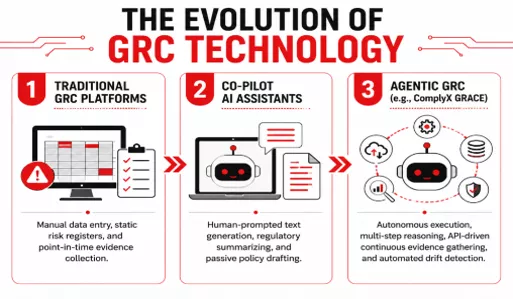
Historically, legacy Governance, Risk, and Compliance (GRC) systems functioned as static repositories, requiring compliance teams to manually track policies and upload point-in-time audit evidence. The subsequent introduction of basic AI “co-pilots” offered text summaries but still depended entirely on manual, human-driven data inputs.
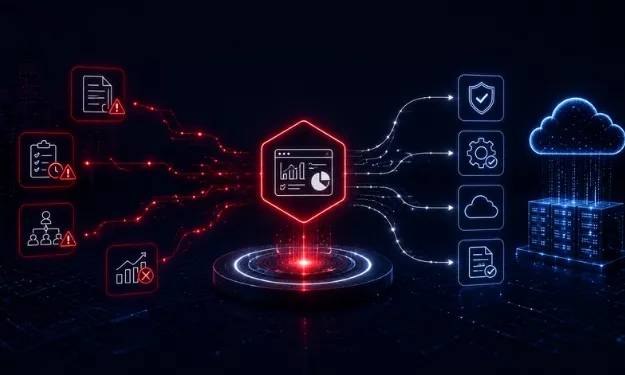
Agentic GRC shifts the industry from passive tracking tools to autonomous compliance monitoring. Rather than operating in isolation, specialized GRC AI agents connect directly to live enterprise networks, cloud architectures, and operational toolsets. This architecture introduces continuous control monitoring, shifting the compliance team’s core responsibility from manual administrative upkeep to strategic AI governance.
What is an AI agent in the context of GRC?
In a compliance environment, an AI agent is a software entity powered by a large language model (LLM) that has been granted agency, the ability to perceive its environment through data integrations, make decisions based on logical reasoning, and take actions using enterprise tools.
Unlike a chatbot that only responds to prompts, a GRC AI agent can be given a high-level goal, such as “Verify our AWS environment against NIST SP 800-53 controls.” The agent then independently breaks that goal down into sub-tasks: it queries the cloud infrastructure, analyzes security configurations, identifies gaps, logs the findings in a risk register, and drafts remediation tickets.
Why is AI compliance automation emerging right now?
The sudden rise of agentic frameworks is a response to an optimization crisis. Modern enterprise data footprints are growing exponentially across multi-cloud environments, while regulatory landscapes are fragmenting rapidly with the introduction of complex frameworks like the EU AI Act and India’s Digital Personal Data Protection Act (DPDPA). Human-operated compliance workflows simply cannot scale to monitor thousands of ephemeral assets in real time.
Furthermore, as business units deploy their own autonomous tools across sales, engineering, and customer service, compliance teams face the rise of Shadow AI (unauthorized AI deployment). Teams need agentic tools just to monitor the unique operational and algorithmic risks that other AI agents are introducing to the network.
Who is legally and operationally accountable when AI runs your compliance?
Accountability cannot be delegated to an algorithm. Under any robust governance framework, the human compliance team remains entirely responsible and liable for all outcomes.
Agentic systems are built explicitly on a human-in-the-loop compliance model. The agent functions as an execution engine that automates data gathering, cross-referencing, and drafting. However, it operates within strict guardrails. Any action that alters a policy, modifies a system configuration, or submits a formal report to a regulator must pass through a mandatory human approval gate. The compliance officer’s role shifts from a mechanical executor to an authoritative reviewer and governor.
Where do these GRC AI agents actually execute workflows?
They do not live in isolated browser windows. GRC AI agents run directly within your enterprise architecture. Using an open connectivity standard like the Model Context Protocol (MCP), they securely link LLMs directly to data sources, production environments, HR databases, identity providers, and code repositories. They observe data lineage in real time, tracking how sensitive information enters your ecosystem, where it is processed, and how it leaves, to ensure your actual daily operations match your stated regulatory policies.
The Technical Lifecycle of an Autonomous Compliance Workflow
To understand how an agent moves from a raw trigger to an auditable compliance outcome without human intervention, we map out the core operational loop.
1. The System Trigger: Real-time or Scheduled Activation.
The workflow initiates based on an event. This could be a scheduled interval (e.g., “Every Monday at midnight”), a webhook from a cloud provider signaling a configuration change, or a user request inside a platform.
2. Contextual Processing & Mapping: Multi-Step Reasoning & MCP Queries.
The agent calls upon its toolsets to pull relevant data. It analyzes gaps, checks past response histories, references mapped regulatory frameworks (like SOC 2 or ISO 27001), and determines the exact compliance path needed, completely bypassing manual spreadsheets.
3. Human-in-the-Loop Validation: Mandatory Human Review Gate.
Before any external action is finalized or an enterprise configuration is changed, the agent packages its findings, outlines its reasoning in plain language, and surfaces it to the compliance team for validation.
4. Automated Action & Immutable Logging: Outcome & Audit Trail Creation.
Upon human approval, the agent executes the outcome: it maps controls, updates risk registers, sends notifications to stakeholders, or issues a Jira ticket. Crucially, it leaves an unalterable log explaining what it did and why for future auditors.
Agentic GRC vs. Traditional GRC Platforms: A Detailed Comparison
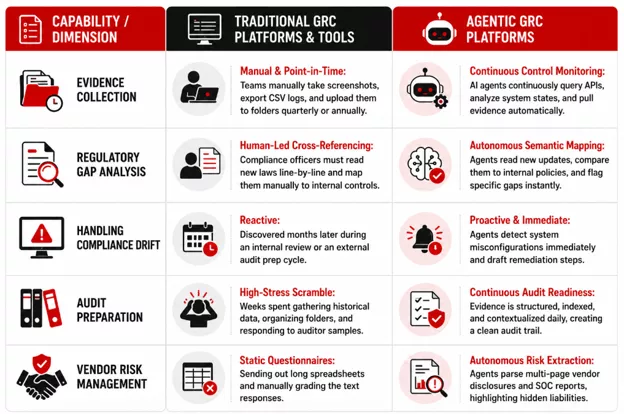
To truly understand how autonomous compliance monitoring transforms an organization, it helps to contrast it directly against legacy approaches. While traditional compliance automation tools automated the storage and tracking of data, they still relied on humans to push data through the pipeline. Agentic systems automate the thinking and execution of the pipeline itself.
Organizations often find themselves evaluating where their current systems fall short, prompting the core operational question: Do I Need a GRC Platform or a Compliance Automation Tool? Agentic architecture effectively bridges this gap by merging broad governance visibility with deep, automated execution.
How AI Compliance Automation Changes the Compliance Team’s Role
The introduction of a digital agentic workforce does not replace human compliance professionals; instead, it optimizes their day-to-day responsibilities. By offloading highly repetitive, administrative tasks, the compliance team can pivot toward high-value risk strategy.
From Data Gatherers to Evidence Architects
Instead of spending hours chasing software engineers for log files, compliance officers become designers of governance guardrails. They define the rules, policies, and parameters that AI agents use to evaluate the company’s compliance posture.
From Point-in-Time Auditing to Managing Continuous Drift
When a system setting changes or an engineer accidentally opens a database to the public, traditional compliance doesn’t catch it until the next audit cycle. With agentic systems running continuous control monitoring, compliance teams monitor live dashboards. The job shifts to handling exceptions, addressing the highly complex, nuanced alerts that agent surfaces when systems deviate from policy limits.
From Output Risk to Action Risk: Managing AI Governance
When compliance teams used static tools, their focus was output risk, ensuring a published report or document was accurate. With Agentic GRC, teams pivot to managing action risk.
Because agents can interact with live corporate environments, compliance professionals become AI Governors. They spend their time defining access boundaries, establishing what an agent can read or modify, and monitoring the AI’s behavioral patterns to prevent unauthorized actions. This discipline is critical when addressing broader organizational governance vacuums caused by rapid technological adoption, prompting leaders to ask a fundamental question about who remains accountable when AI governs your security operations.
Key Regulatory Implications: Navigating NIST, ISO 42001, and the EU AI Act
Deploying autonomous systems inside your business requires strict adherence to global security and algorithmic standards. Agentic GRC platforms are explicitly designed to align with emerging frameworks that govern both traditional data security and specialized artificial intelligence deployments.
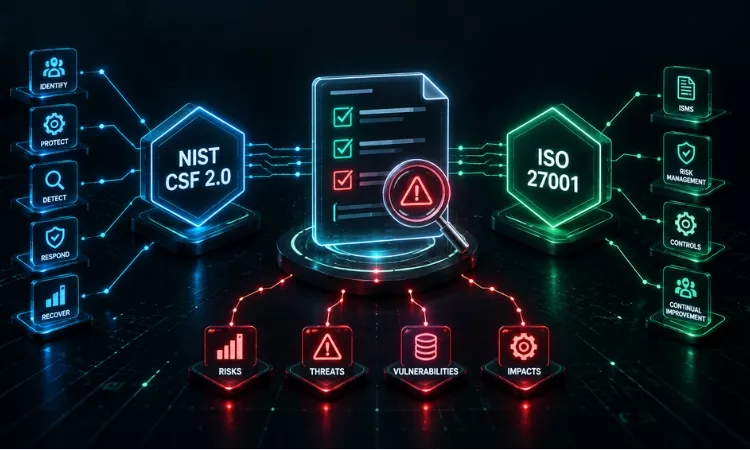
- NIST SP 800-53 & Cybersecurity Framework (CSF): Agentic automation provides the continuous telemetry required to meet strict access control, configuration management, and incident response monitoring standards, replacing manual sampling with exhaustive data coverage.
- ISO/IEC 42001 (AI Management System): As the global benchmark standard for AI governance, the ISO/IEC 42001 Standard requires organizations to systematically assess and mitigate risks related to AI deployment. GRC agents help track algorithmic bias, monitor system transparency, and audit the data lineages feeding your enterprise models.
- The EU AI Act: For enterprises operating in or serving the European market, compliance with the European Parliament EU AI Act demands strict risk classification, logging, and documentation for high-risk AI deployments, tasks uniquely suited for autonomous tracking agents.
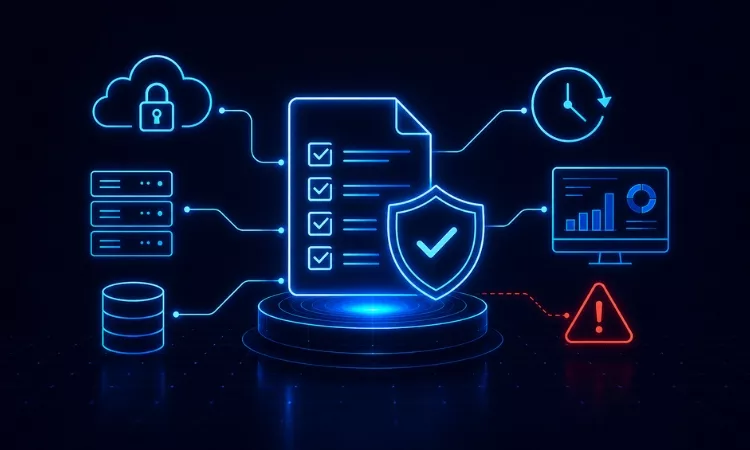
- Continuous Control Auditing: External auditors are increasingly looking for continuous validation rather than retrospective samplings. An agentic platform maintains an unbroken, cryptographically secure audit trail of all automated checks and human approvals, utilizing secure logging architectures backed by TLS 1.3 in-transit and AES-256 at-rest encryption standards, significantly accelerating the path to clean audit certifications.
Is Your Organization Scaling Your Architecture Safely?
Discover how GRACE delivers enterprise-grade AI compliance automation, giving your organization a continuous, real-time defensive posture.
| Schedule a customized platform demonstration to see our virtual compliance agents map live data streams directly to your global regulatory requirements! |
Enjoyed reading this blog? Stay updated with our latest exclusive content by following us on Twitter and LinkedIn.