










Learn how automation improves accuracy and enables continuous compliance.
Every audit ultimately comes down to evidence, because an assessor does not accept that a control is working simply on your word, and instead they expect proof that the control operated consistently across the entire review period. For most security and compliance teams, producing that proof has traditionally meant weeks of chasing screenshots, exporting configuration files, and reconciling spreadsheets, and this manual scramble is exactly where audit fatigue, human error, and missed deadlines tend to originate. Automated evidence collection removes that burden by gathering the proof continuously and directly from the systems that generate it, so your organization can stay audit-ready throughout the year rather than only in the frantic weeks before an assessment.
What Is Automated Evidence Collection?
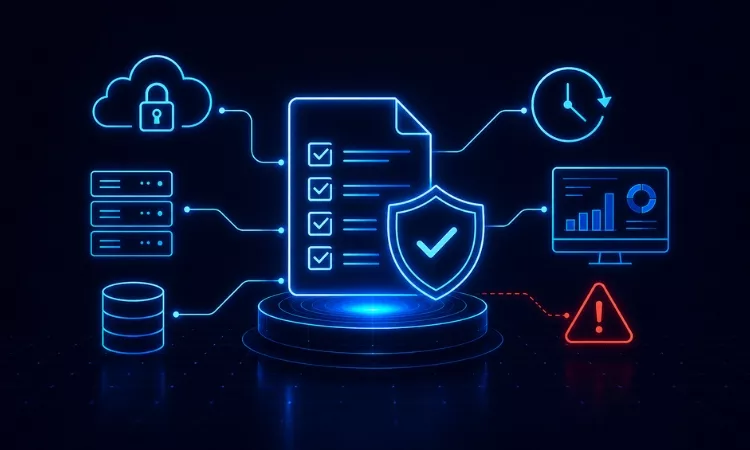
Automated evidence collection is the practice of using software integrations to gather, timestamp, and organize compliance evidence directly from your technology environment, and it replaces the manual, point-in-time effort of collecting artifacts by hand. Evidence in this context refers to any artifact that demonstrates a control is designed and operating effectively, and it can include access-review records, configuration settings, encryption status, log samples, vulnerability-scan results, change-management tickets, and policy acknowledgements. Rather than a person logging into each system to capture a screenshot on the day an auditor asks, an automated platform connects to those systems through APIs and collects the same evidence on a defined schedule, so the record stays continuous, consistent, and fully traceable back to its source.
Why Manual Evidence Collection No Longer Works
Manual evidence collection was already inefficient when environments were static, and it becomes genuinely unmanageable in modern infrastructure where cloud workloads scale dynamically, identities change daily, and code ships multiple times a week. A screenshot captured on a single day proves only that a control worked in that one moment, and it says nothing about whether the control held for the ninety or three hundred sixty-five days that the auditor cares about. The stakes are not trivial either, because IBM’s Cost of a Data Breach Report placed the global average breach cost at USD 4.88 million, and weak or inconsistently evidenced controls are frequently what turns a containable incident into a reportable one. Manual processes also scale badly across frameworks, so a team maintaining PCI DSS, ISO 27001, and SOC 2 at the same time ends up collecting overlapping evidence three separate times, and that duplicated effort could instead be spent on strengthening security. You can read more about the discipline of staying prepared in our guide to audit readiness in cybersecurity.
How Does Automated Evidence Collection Work?
Automated evidence collection follows a repeatable pipeline, and although platforms differ in the finer details, the underlying mechanics are broadly consistent across mature tools.
- It begins with integration, because the platform connects to your cloud providers, identity systems, endpoint tools, ticketing systems, and code repositories through APIs or read-only service accounts, and these connectors are what allow evidence to flow without any manual export.
- Controls are then mapped to frameworks, so a single artifact such as a multi-factor-authentication configuration is linked to every requirement it satisfies across PCI DSS, ISO 27001, SOC 2, and NIST, and this mapping is what lets evidence be collected once and reused many times.
- Collection then runs on a schedule, and the platform pulls the relevant artifacts continuously or at set intervals, timestamps each one, and records where it came from so that its provenance stays defensible under scrutiny.
- Validation follows collection, because the platform compares the collected state against the expected control configuration, and it flags drift or a failing control the moment it appears rather than months later during an audit.
- Everything is then stored in a centralized, tamper-evident repository with a full audit trail, so when an assessor requests proof the evidence is already gathered, organized, and mapped to the exact requirement in question.
The Benefits of Automating Evidence Collection
The most immediate benefit is time, because teams that automate evidence collection stop losing weeks to audit preparation and instead maintain a persistent state of readiness that lets them respond to an assessor within hours. Accuracy improves in parallel, since machine-collected evidence carries consistent timestamps and verifiable sources, and this removes the transcription errors and coverage gaps that manual collection inevitably introduces. Automation also unlocks cross-framework efficiency, because a control validated once can satisfy several certifications at the same time, and that is a meaningful saving for any organization juggling PCI DSS, HITRUST, and ISO 27001 in parallel. Most importantly, continuous collection shifts compliance from a periodic snapshot to real-time visibility, so leadership can see the true state of controls at any moment instead of trusting a report that was already stale on the day it was produced.
From Automated Evidence to Continuous Compliance
Automated evidence collection is the foundation of a broader shift toward continuous compliance, which the National Institute of Standards and Technology framed years ago in its guidance on information security continuous monitoring. In a continuous-compliance model, evidence collection, control validation, and governance workflows run as part of everyday operations rather than as a project that spins up before each audit, and the compliance record therefore evolves alongside the infrastructure it governs.
This is precisely the model that platforms such as GRACE are built to deliver. It automates evidence collection and cross-framework mapping, validates controls continuously, and translates the results into cyber risk quantification that leadership can act on.
Bringing Automated Evidence Collection to Your Program
Automating evidence collection is not simply a tooling upgrade, because it changes how an organization proves trust to its customers, its partners, and its regulators, and getting it right depends on both the right platform and a well-designed set of controls underneath it. Ampcus Cyber helps organizations achieve exactly that through its compliance compass services. If your team is still assembling evidence by hand and feeling the strain each audit cycle, that manual effort is a signal worth acting on, and the move toward automated, continuous evidence collection is how leading security programs are removing it for good.
| Ready to eliminate audit fatigue? Automate evidence collection, simplify compliance across multiple frameworks, and maintain continuous audit readiness with Ampcus Cyber’s experts. |
Enjoyed reading this blog? Stay updated with our latest exclusive content by following us on Twitter and LinkedIn.