









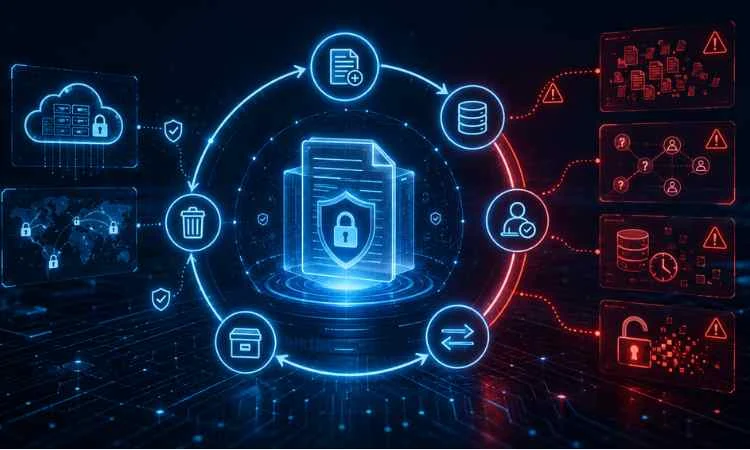
More data doesn’t mean more value. While modern enterprises pull vast amounts of information from APIs, endpoints, and cloud apps, a huge chunk of it is just digital clutter, meaning redundant, obsolete, or trivial. Keeping this dead weight past its expiration date does only two things: it grows your compliance headache and hands hackers a larger target.
Data is not static. It has a lifecycle, moving from the moment it is created or collected to the moment it is securely destroyed. Managing that journey deliberately is what separates a controlled data environment from an unmanaged one where sensitive information accumulates unchecked. A Data Lifecycle Management (DLM) policy is the formal instrument that governs this journey, defining how data should be handled, protected, retained, and disposed of at every stage.
This guide explains everything you need to know about a data lifecycle management policy, including its definition, the stages of the data lifecycle, why it matters for security and compliance, its core components, common challenges, and the best practices for implementing one. It also examines how a strong policy reinforces broader data governance across the organization.
What Is a Data Lifecycle Management Policy?
A data lifecycle management policy is a formal, documented set of rules and standards that define how an organization’s data is handled at every stage of its existence, from creation and classification through storage, use, sharing, archival, retention, and secure disposal. It establishes ownership, sets retention periods, and specifies the security and privacy controls that apply to each type of data at each phase of its life.
It is important to distinguish a data lifecycle management policy from data governance more broadly. Data governance is the overarching framework of accountability, roles, and oversight for how data is managed. A data lifecycle management policy is the operational blueprint within that framework that governs the data’s actual journey. In practice, a well-defined policy typically specifies:
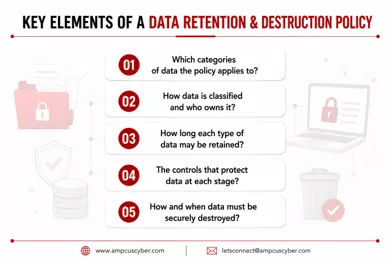
By making these rules explicit, organizations replace ad-hoc, inconsistent data handling with a repeatable and defensible process.
What Are the Stages of the Data Lifecycle?
A data lifecycle management policy is built around the distinct phases that data passes through. While models vary, most organizations recognize the following stages:
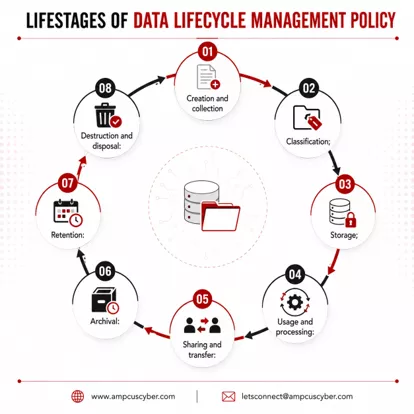
- Creation and collection: Data enters the environment through user input, transactions, sensors, integrations, or acquisition from third parties.
- Classification: Data is labeled by sensitivity and value, such as public, internal, confidential, or regulated, which determines the controls that follow.
- Storage: Data is placed in databases, file stores, or cloud repositories with appropriate encryption, access controls, and backup protection.
- Usage and processing: Data is accessed and used for business operations, analytics, or decision-making under defined access rules.
- Sharing and transfer: Data moves between systems, teams, partners, or jurisdictions, requiring secure transmission and clear handling agreements.
- Archival: Data no longer in active use but still required is moved to long-term, lower-cost storage while remaining protected and retrievable.
- Retention: Data is kept only for as long as business needs or regulations require, governed by defined retention schedules.
- Destruction and disposal: Data that has reached the end of its useful or lawful life is securely and verifiably destroyed.
A mature policy attaches specific responsibilities and controls to each of these stages, so that protection is consistent from the first byte collected to the final act of deletion.
What Are the Core Components of a Data Lifecycle Management Policy?
An effective policy is more than a retention schedule. It brings together the roles, rules, and controls needed to govern data end to end. Core components typically include:
- Scope and applicability: The data types, systems, and business units the policy covers.
- Data classification tiers: A defined scheme for categorizing data by sensitivity and regulatory status.
- Roles and ownership: Named data owners, stewards, and custodians accountable for data at each stage.
- Retention schedules: Defined retention periods for each data type, mapped to business and legal requirements.
- Storage and encryption standards: Requirements for how and where data is stored, including encryption at rest and in transit.
- Access control requirements: Least-privilege rules governing who may access data and under what conditions.
- Transfer and sharing rules: Controls for moving data securely between systems, partners, and jurisdictions.
- Secure disposal methods: Approved techniques for verifiable destruction, including media sanitization and cryptographic erasure.
- Audit, review, and exceptions: A cadence for reviewing the policy and a process for handling legal holds and exceptions.
How Does a Data Lifecycle Management Policy Support Regulatory Compliance?
Data protection regulations increasingly treat over-retention as a liability in itself. Holding personal data longer than necessary is not just a security risk, it is frequently a violation. A data lifecycle management policy operationalizes the retention and deletion requirements that regulators now expect organizations to enforce.
How a DLM Policy Aligns With Key Regulations
- GDPR: The storage-limitation principle requires that personal data be kept no longer than necessary, and the right to erasure requires deletion on valid request.
- India’s DPDP Act: Data fiduciaries are expected to erase personal data once the purpose for processing is served or consent is withdrawn, making defined retention and deletion essential.
- HIPAA: Requires defined retention of specified records and the secure disposal of protected health information to prevent unauthorized recovery.
- PCI DSS: Requires organizations to minimize cardholder data storage, define retention and deletion policies, and securely remove data that is no longer needed.
- ISO 27001 and ISO 27701: Provide controls for information handling, retention, and disposal as part of a certified management system.
- NIST SP 800-88: Offers recognized guidelines for media sanitization, supporting verifiable and defensible data destruction.
By mapping retention schedules and disposal methods to these frameworks, a data lifecycle management policy turns abstract compliance obligations into enforceable, auditable practice.
What Are the Biggest Challenges in Implementing a Data Lifecycle Management Policy?
Designing a policy is straightforward. Enforcing it consistently across a sprawling, hybrid environment is where most organizations struggle. Common challenges include:
- Limited data visibility: You cannot govern what you cannot see, and many organizations lack a complete inventory of where sensitive data resides.
- Unstructured and shadow data: Data scattered across emails, file shares, and unsanctioned tools is difficult to classify and control.
- Conflicting retention requirements: Different regulations and jurisdictions may impose competing retention and deletion obligations.
- Legacy systems and silos: Older platforms often lack the capabilities needed to enforce retention and secure disposal.
- Manual enforcement: Policies applied by hand do not scale and are prone to inconsistency and human error.
- Ownership ambiguity: When no one clearly owns a dataset, retention and disposal decisions are deferred indefinitely.
What Are the Best Practices for Implementing a Data Lifecycle Management Policy?
A successful policy combines clear rules with the automation and oversight needed to enforce them. Recommended best practices include:
- Start with discovery and classification: Locate and label sensitive data before defining how it should be handled.
- Map retention to data type and regulation: Set retention periods based on business need and legal obligation rather than convenience.
- Automate enforcement: Use tooling to apply retention, archival, and deletion rules consistently and at scale.
- Encrypt data throughout its lifecycle: Protect data at rest and in transit so exposure is limited even if controls fail.
- Apply least-privilege access: Restrict access at every stage to the minimum required for legitimate use.
- Use verifiable secure destruction: Adopt recognized sanitization methods, including cryptographic erasure for cloud data.
- Audit and review regularly: Reassess the policy as regulations, systems, and data flows evolve.
- Align with the broader governance program: Ensure the policy reinforces, rather than competes with, enterprise data governance.
Final Thoughts
A data lifecycle management policy is not merely a records-retention document. It is a security and risk control that determines how much sensitive data an organization holds, how well that data is protected, and how defensibly it is disposed of. By governing data from creation to destruction, organizations reduce their attack surface, limit the impact of breaches, and meet the storage-limitation and erasure obligations that regulators now enforce.
Implemented well, a data lifecycle management policy transforms retention from an unmanaged liability into a controlled, auditable strength. Achieving that outcome requires more than a written policy; it depends on accurate data discovery, structured implementation, and continuous oversight.
Ampcus Cyber helps organizations design and operationalize data lifecycle management policies within a robust data governance program, aligning security, privacy, and compliance across the entire data lifecycle. Through expert advisory, data discovery, and governance program development, organizations can protect sensitive information while maintaining regulatory readiness.
| Connect with our experts to assess your data lifecycle management maturity and build a policy that protects your data ecosystem for the future. |
Enjoyed reading this blog? Stay updated with our latest exclusive content by following us on Twitter and LinkedIn.