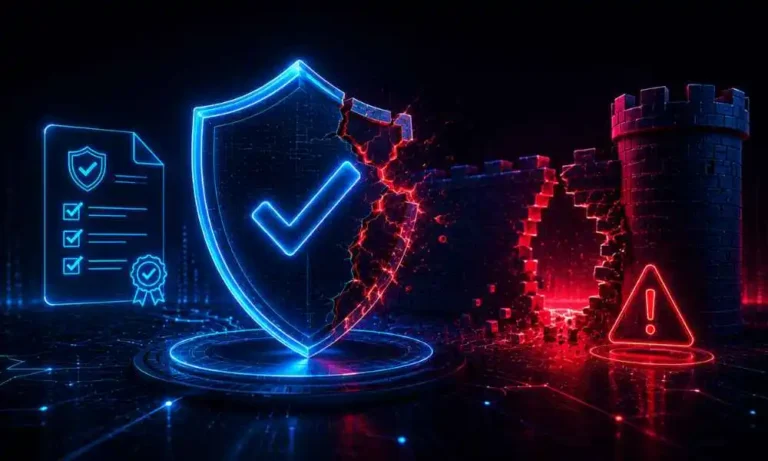










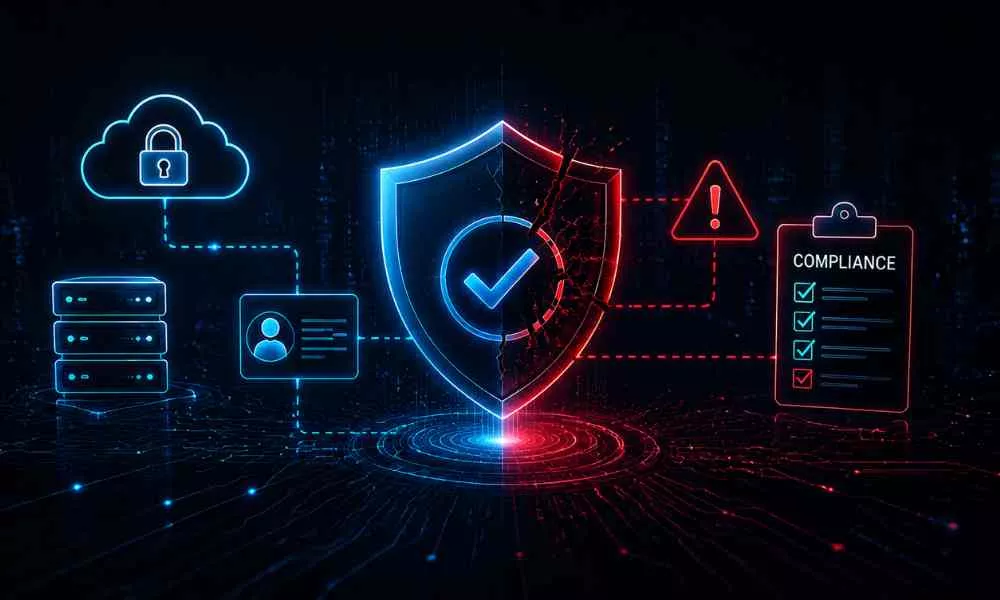
Your organization passed its SOC 2 audit in Q1. Your ISO 27001 certificate is current. Your compliance dashboard is green. And yet, somewhere between the auditor’s last day and today, your security posture has quietly changed.
A developer adjusted a cloud storage permission. An employee changed roles but kept their old access. A new SaaS tool was onboarded without a security review. A firewall exception added months ago was never removed.
None of these changes triggered an alert. None appeared on a compliance report. But each one represents compliance drift, the gradual, invisible divergence between what your last audit certified and what your environment looks like today.
What Is Compliance Drift in Cybersecurity?
Compliance drift is the progressive degradation of an organization’s security and regulatory posture between formal assessments. It occurs when the controls, configurations, policies, and processes validated during an audit slowly diverge from operational reality, without any single change being dramatic enough to trigger a review.
Traditional audit-driven compliance models answer one question: were controls in place on the day we checked? They were not designed to answer the question that matters to regulators, boards, and incident investigators: are controls working continuously, right now?
Compliance drift is not the result of negligence. It is the natural outcome of dynamic environments, cloud infrastructure, rotating personnel, evolving vendor relationships, and daily software deployments, operating under governance models built for far more static worlds. The gap between certified and secure is where real risk lives.
Why Is Compliance Drift Inevitable in Audit-Only Programs?
Point-in-time audits were designed for an era when infrastructure changed slowly, and systems were largely static between assessments. That era is no longer alive. Modern organizations deploy code multiple times a day, spin up and tear down cloud resources automatically, and expand their SaaS ecosystems continuously.
In this environment, every day between audits is a day compliance can degrade. The auditor validates a snapshot, the environment continues changing, the certificate remains valid, and the protection does not.
Five structural vectors drive compliance drift across most organizations:
| Drift Vector | How It Happens | Why Audits Miss It |
| Configuration drift | A developer modifies a cloud storage permission or firewall rule to solve an immediate problem; the change is never reverted | Audits validate configurations at a point in time; cloud environments change continuously between assessments |
| Access accumulation | Employees change roles or leave; permissions are not reviewed or revoked, leaving standing access beyond legitimate need | Entitlement reviews are periodic; access sprawl builds silently between cycles |
| Shadow IT and apps | Business teams adopt unsanctioned SaaS tools that process regulated data without approved controls, logging, or contractual safeguards | Audits assess known systems; shadow IT exists in what auditors never see |
| Policy aging | Documented controls diverge from production reality: MFA exceptions accumulate, logging thresholds are lowered, rules are not removed | Controls may still pass documentation checks while enforcement has materially weakened |
| Third-party posture shift | A vendor is breached, acquired, or changes infrastructure after their last assessment; their risk profile shifts without triggering a review | Annual questionnaires do not capture real-time vendor posture changes |
What Does a Compliance Drift Incident Look Like?
The pattern repeats with striking consistency across industries. An organization completes a rigorous SOC 2 or ISO 27001 assessment. Controls are documented, evidence is collected, and certification is achieved. Then, in the weeks and months that follow:
- A DevOps engineer exposes a cloud storage bucket during a deployment to solve a configuration conflict. The fix is forgotten.
- Three employees change departments. Access review cycles scheduled quarterly. Their old permissions accumulate for 90 days.
- A business team adopts a project management SaaS tool that integrates with the CRM. Sensitive client records are now flowing through an unsanctioned system.
- MFA exceptions granted during a system migration six months ago were never revoked. Twelve accounts still authenticate without a second factor.
Each change appears manageable in isolation. Cumulatively, they represent material exposure. The organization is certified but not secure, and will not discover the gap until an incident, a regulatory investigation, or the next audit cycle forces the issue.
How Do You Recognize Compliance Drift in Your Organization?
Compliance drift rarely announces itself, but it leaves consistent signals:
- Growing exception lists: MFA exceptions, firewall rule exemptions, and access control overrides that were granted temporarily but have persisted beyond their justified lifespan.
- Widening gap between policy and configuration: Security policies state one requirement; a cloud configuration audit reveals a different operational reality.
- Accumulating standing permissions: IAM reviews reveal access rights that no longer correspond to current roles or employment status.
- Shadow IT sprawl: Business units onboard SaaS tools faster than data governance processes can assess and approve them.
- Vendor posture changes without reassessment: Key vendors have been acquired, disclosed incidents, or changed infrastructure since their last vendor risk assessment was completed.
- Compliance evidence collected only at audit time: Evidence is manually assembled in the weeks before an assessment rather than generated continuously through operational processes.
How Do You Fix Compliance Drift? From Point-in-Time to Continuous
Fixing compliance drift requires replacing the audit-only model with continuous compliance architecture, not improving how organizations prepare for audits, but changing what happens between them.
What is Continuous Control Monitoring (CCM) and how does it stop drift?
Continuous Control Monitoring (CCM) integrates governance validation directly with operational telemetry: cloud infrastructure configurations, identity and access management systems, SIEM event feeds, and DevOps pipelines. Rather than validating controls periodically, CCM evaluates control effectiveness continuously and surfaces drift the moment it occurs, not months later during an audit cycle.
Should compliance evidence be automated?
Yes. Manual evidence collection, the dominant model in most compliance programs, is inherently point-in-time and resource-intensive. Automated evidence feeds tied to live infrastructure state create a compliance record that reflects operational reality continuously, rather than a snapshot prepared for an audience of auditors.
How should organizations apply risk-tiered review cycles?
Not all controls drift at the same rate. Cloud configurations change daily; physical access policies change rarely. A risk-tiered approach applies continuous monitoring to high-change, high-risk controls, and periodic review to stable low-risk controls, directing governance resources precisely where drift risk is highest.
How does continuous vendor monitor address third-party compliance drift?
Third-party compliance drift is as consequential as internal drift. Continuous vendor risk monitoring through live threat intelligence feeds, security rating services, and breach notification monitoring ensures vendor posture changes are detected and assessed continuously, not only at scheduled review intervals.
Is Compliance Drift Building Silently in Your Organization?
The gap between your last audit and today is where compliance drift lives. Ampcus Cyber helps organizations move from point-in-time certification to continuous, evidence-backed compliance posture.
| Call our compliance experts to get a free consultation session today! |
Enjoyed reading this blog? Stay updated with our latest exclusive content by following us on Twitter and LinkedIn.