









Long before a stolen credential shows up in a login attempt or a leaked customer database triggers a breach notification, that data is usually already for sale. Underground forums, closed marketplaces, and encrypted channels function as a distribution layer for cybercrime, where stolen credentials, source code, and access to corporate networks change hands well before the victim organization ever learns something is wrong. Dark web monitoring exists to close that gap.
For enterprise security teams, the dark web is no longer a niche concern reserved for law enforcement or brand protection vendors. It has become a working intelligence source that reveals whether an organization’s credentials, source code, or customer data are already circulating among attackers, often days or weeks before that exposure turns into an active incident.
This guide explains what dark web monitoring is, what it tracks, and how it strengthens a broader threat intelligence program.
What Is Dark Web Monitoring?
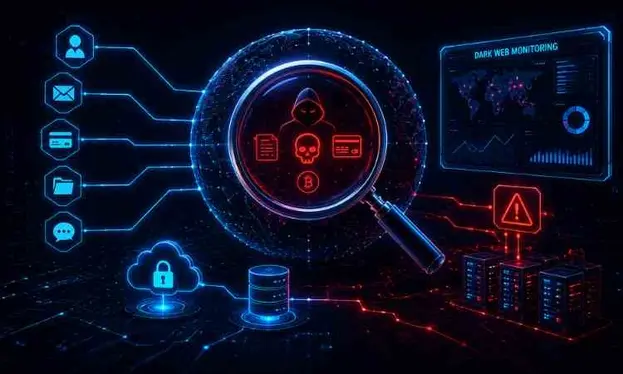
Dark web monitoring is the continuous scanning of hidden and restricted-access parts of the internet, including Tor-based marketplaces, closed criminal forums, paste sites, and encrypted messaging channels, for information tied to a specific organization. It typically covers leaked employee credentials, stolen customer records, exposed source code, counterfeit domains, and chatter that names the organization as a target.
Unlike conventional security controls that defend the network perimeter, dark web monitoring looks outward, into the criminal ecosystem where stolen data is bought, sold, and discussed, and correlates that exposure with cyber threat intelligence to give security teams an early warning before exposure becomes exploitation.
Why Does Dark Web Monitoring Matter for Enterprise Security?
Credentials remain the easiest way into an enterprise environment. Verizon’s 2025 Data Breach Investigations Report found that credential abuse was among the leading initial attack vectors, present in 22 percent of breaches analyzed. Attackers rarely need to break in when valid, working logins are already available for purchase on underground marketplaces.
The cost of missing this exposure is significant. Breaches that begin with compromised credentials carry some of the longest detection timelines and highest costs of any attack vector, according to IBM’s 2025 Cost of a Data Breach Report. Dark web monitoring shortens that window by surfacing the exposure while it is still sitting in a criminal marketplace, giving security teams time to reset credentials and tighten access before an attacker acts on it.
What Does Dark Web Monitoring Actually Track?
A mature dark web monitoring program typically covers several categories of exposure.
| Category | What It Covers | Why It Matters |
| Credential Exposure | Employee and customer usernames, passwords, and session cookies found in breach dumps or stealer logs | Enables early password resets before credential stuffing attempts |
| Data Leaks | Customer records, financial data, intellectual property, or source code posted on leak sites | Confirms scope of a breach and supports regulatory disclosure decisions |
| Initial Access Listings | Advertisements from initial access brokers selling network access to a specific organization | Provides advance warning of an imminent, targeted attack |
| Brand and Domain Abuse | Look-alike domains, counterfeit sites, and impersonation used for phishing or fraud | Protects customers and reduces fraud-related losses |
| Chatter and Targeting | Forum discussions naming the organization, its executives, or its vendors as targets | Supports proactive defense before an attack is launched |
How Does Dark Web Monitoring Strengthen Threat Intelligence?
On its own, a leaked credential or a forum post is just a data point. Its value comes from correlation. When dark web findings are fed into the same pipeline as indicators of compromise, SIEM alerts, and identity telemetry, security teams can confirm whether exposed credentials have been used, whether a targeted attack is already underway, and which systems need immediate attention.
This correlation also strengthens strategic intelligence. Recurring mentions of an organization, its vendors, or its executives across underground forums can reveal patterns, such as a specific threat actor group building toward a coordinated campaign, that isolated technical alerts would never surface on their own. Combined with strong identity and access management practices, dark web intelligence becomes a genuine early-warning layer rather than a reactive checklist item.
What Is the Difference Between the Deep Web and the Dark Web?
| Layer | Definition | Example |
| Surface Web | Publicly indexed content accessible through standard search engines | Company websites, news articles |
| Deep Web | Content not indexed by search engines but reachable through normal browsers | Banking portals, private databases, paywalled content |
| Dark Web | Deliberately hidden networks requiring specialized software such as Tor | Criminal marketplaces, closed forums, ransomware leak sites |
Dark web monitoring focuses specifically on the last category, the deliberately hidden networks where criminal activity is concentrated and where stolen enterprise data most often surfaces first.
How Does Dark Web Monitoring Work in Practice?
Most enterprise programs rely on a combination of automated crawlers, human analysts, and access to closed communities that are not reachable through standard search tools. The typical workflow follows a consistent pattern:
- Continuous scanning of marketplaces, forums, paste sites, and ransomware leak pages for organization-specific keywords, domains, and identifiers
- Automated matching of discovered data against known employee, customer, and vendor identifiers
- Analyst validation to filter noise and confirm whether a finding represents a genuine exposure
- Alerting and prioritization based on severity, such as active credential sales versus historical breach data
- Integration with SIEM, SOAR, and identity platforms to trigger password resets, access reviews, or incident response
This workflow mirrors the same detect-validate-contain discipline used for security monitoring more broadly, applied specifically to exposure that originates outside the organization’s own network.
What Are the Limitations of Dark Web Monitoring?
Dark web monitoring is a valuable early-warning capability, but it is not a complete security program. Coverage varies significantly between providers, since no single tool can access every closed forum or private channel, and threat actors regularly move to new platforms to evade detection. Alert volume can also be high, and without skilled analysts to validate findings, security teams risk chasing false positives instead of genuine exposure.
This is why dark web monitoring works best as one input into a broader detection strategy that includes threat hunting and internal telemetry, rather than a standalone safeguard against credential theft or data exposure.
How Can Enterprises Build an Effective Dark Web Monitoring Program?
An effective program starts with clear scope: which domains, executive names, product names, and third-party vendors should be tracked. From there, findings need a defined escalation path so that a confirmed credential leak automatically triggers a password reset or access review rather than sitting in an analyst queue. Enterprises operating in regulated sectors should also ensure dark web findings are documented consistently enough to support breach notification and audit requirements.
For most organizations, the fastest path to maturity is pairing dark web monitoring with a managed detection and response partner that can operationalize the intelligence around the clock, rather than treating it as a periodic report that arrives too late to act on.
Turning Dark Web Exposure into an Early-Warning Advantage
The dark web will keep functioning as the marketplace, where stolen enterprise data surfaces first. Organizations that monitor it consistently and connect what they find to their broader threat intelligence and identity programs, gain a genuine head start on attackers who are counting on that exposure going unnoticed.
Ampcus Cyber helps enterprises turn dark web intelligence into faster, defensible response through 24×7 managed threat detection.
| Talk to our team about strengthening your threat intelligence program. |
Enjoyed reading this blog? Stay updated with our latest exclusive content by following us on Twitter and LinkedIn.