








Every vendor you onboard expand your attack surface. Every API connection, shared credential, and data processing agreement introduces risk that lives outside your network perimeter but sits squarely within your legal and operational liability.
This guide explains what a vendor risk assessment evaluates, how it fits into the broader TPRM lifecycle, and what distinguishes a proactive modern assessment from the legacy checkbox questionnaires that still create dangerous gaps in most programs.
What Is a Vendor Risk Assessment (VRA)?
A vendor risk assessment is a formal evaluation of a Third-Party Risk Management (TPRM) program, data handling practices, operational resilience, and compliance status. Its purpose is to quantify the risk profile a vendor introduces to your organization and inform decisions about onboarding, contract terms, oversight intensity, and continued use.
A robust VRA answers four fundamental questions:
- System access: What level of access does this vendor have to our systems, production data, or critical infrastructure?
- Security posture: What specific security controls are actively maintained to protect that access and shared assets?
- Impact exposure: What is our financial, operational, and regulatory exposure if this vendor is breached, goes offline, or violates a legal obligation?
- Residual risk: Is the remaining risk within our acceptable threshold, or does it require targeted mitigation before onboarding?
Vendor risk assessments are not one-time exercises. In modern TPRM programs, they form a continuous oversight cycle spanning onboarding, periodic review, triggered reassessment following a breach or material change, and secure offboarding.
Why Vendor Risk Assessments Are Non-Negotiable
1. Vendor breaches cascade inward
When a third party is compromised, the regulatory and reputational fallout lands on your organization. The MOVEit file transfer breach, exploited at scale by the Cl0p ransomware group, cascaded across hundreds of downstream organizations that had no direct interaction with the vulnerability. Organizations without dependency intelligence could not quickly determine exposure or quantify the operational impact.
2. Regulators require documented oversight
Across every major international framework, vendor oversight has shifted from advisory guidance to enforceable obligation:
- DORA (EU): Mandates rigorous oversight of critical ICT third-party providers and systemic dependency analysis for financial institutions
- NIST SP 800-161: Integrates supply chain risk management into enterprise-wide governance and resilience planning
- PCI DSS 4.0.1 Enforces third-party security reviews for all service providers handling cardholder data
- HIPAA: Requires fully executed Business Associate Agreements (BAAs) with documented security requirements
3. Annual questionnaires no longer reflect reality
A vendor’s security posture can change overnight: a new breach disclosure, an unmapped acquisition, an expired certificate, a misconfigured cloud environment. A point-in-time assessment completed in January is often dangerously stale by March. Modern risk programs replace fixed annual cycles with risk-tiered, continuous monitoring that surfaces posture changes in real time.
The 6 Dimensions of a Vendor Risk Assessment
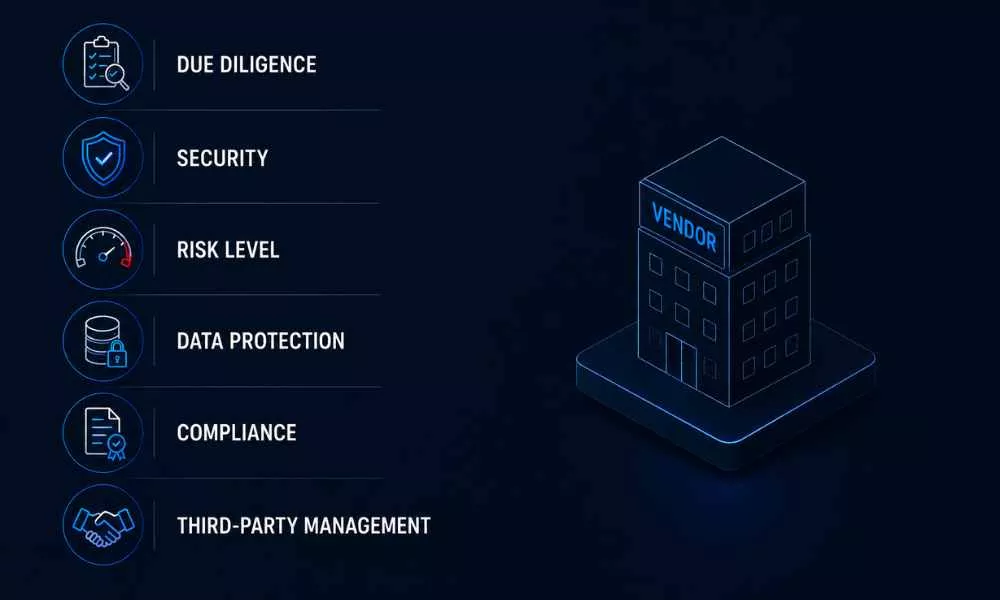
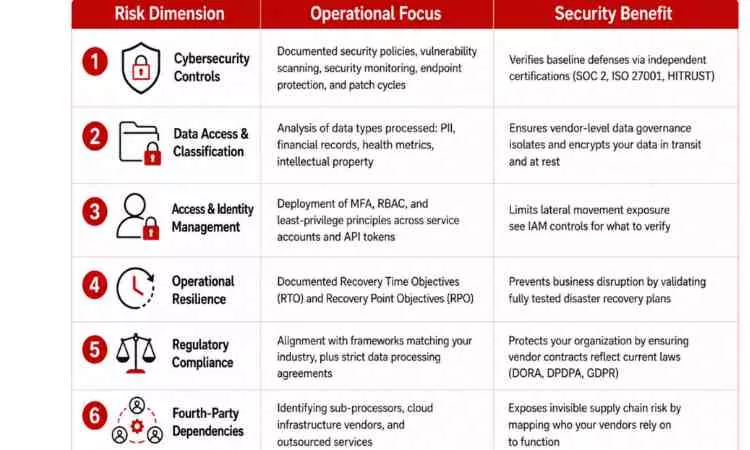
An enterprise-grade vendor risk assessment evaluates third-party exposure across six operational layers:
Traditional vs. Modern Vendor Risk Assessment
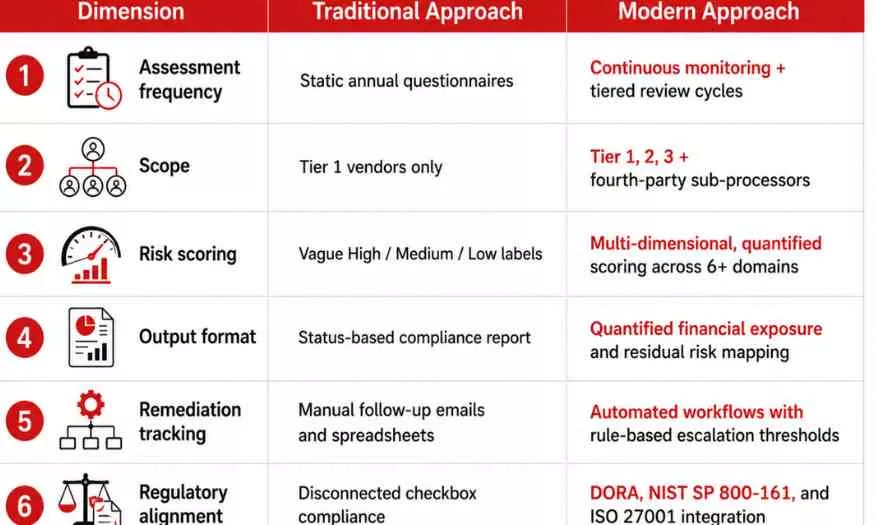
Most programs still operate on architectures that create dangerous blind spots between assessment cycles:
How to Conduct a Vendor Risk Assessment: 5 Steps
- Classify and inventory. Build a centralized vendor registry. Classify each third party by data access depth, business criticality, system integration level, and regulatory relevance. Tiering ensures assessment resources are applied where risk concentrates.
- Scope the assessment depth. Match assessment intensity to risk tier. High-risk vendors require enhanced due diligence, comprehensive questionnaires, technical architecture reviews, and certification verification. Lower-tier vendors receive proportionate, lighter-touch validation.
- Evaluate across all 6 dimensions. Run the vendor through a structured scoring framework covering security controls, IAM practices, continuity plans, compliance status, and fourth-party dependencies. Assign quantified risk scores rather than vague qualitative labels.
- Remediate and contractually bind. Identify critical gaps and require remediation before onboarding completion. Embed security obligations, breach notification SLAs, audit rights, and sub-processor disclosure requirements into the final contract.
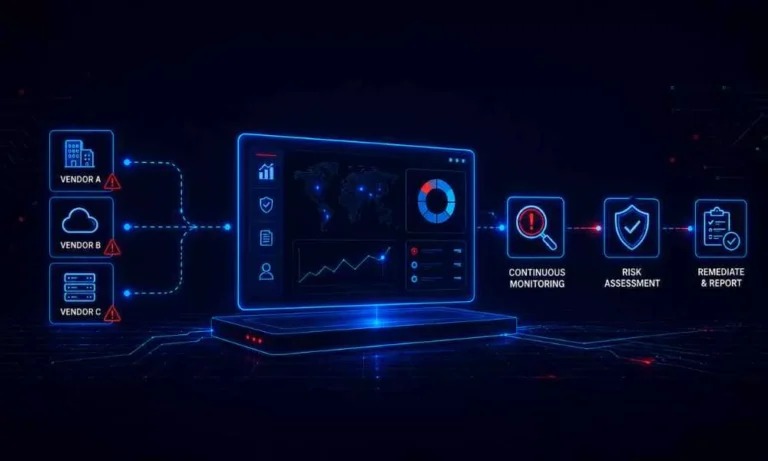
- Establish continuous monitoring. Deploy external security ratings, breach intelligence feeds, and certificate expiry tracking. Set automatic reassessment triggers whenever a vendor discloses an incident, changes infrastructure, or undergoes a corporate acquisition.
Vendor Risk Assessments and Regulatory Compliance
VRAs are an explicit regulatory expectation. Organizations that cannot present a documented, defensible audit trail of vendor assessment, remediation tracking, and continuous oversight face regulatory penalty risk whenever a vendor-originating incident occurs.
- DORA: Financial entities must track critical ICT third parties and perform formal dependency analysis.
- NIST SP 800-161: Demands documented risk profiles for all key technology providers.
- PCI DSS 4.0.1: Mandates formal security verification of third parties touching cardholder data environments.
- India’s DPDPA: With full enforcement tracking toward 2027 following the notification of the DPDP Rules, places legal responsibility directly on Data Fiduciaries to oversee and continuously supervise all vendor data processing practices. See DPDPA compliance guidance.
Risk quantification is what moves a vendor risk program from a compliance cost center to a strategic shield. It gives leadership the financial visibility needed to make defensible decisions about ecosystem exposure.
Is Your Vendor Ecosystem Creating Silent Liabilities?
Most organizations underestimate their vendor exposure until a breach forces the question. Ampcus Cyber helps you assess, quantify, and continuously govern third-party risk before exposure becomes an incident.
| Take Control of Third-Party Risk – Speak with a Vendor Risk Expert . |
Enjoyed reading this blog? Stay updated with our latest exclusive content by following us on Twitter and LinkedIn.