








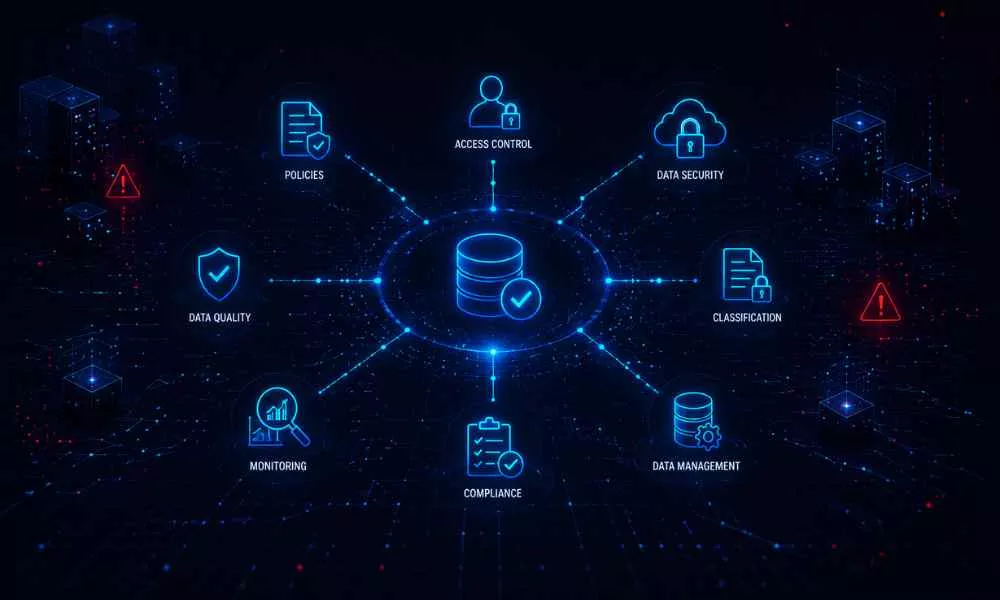
Data is the most targeted asset in modern cyberattacks. Attackers do not go after infrastructure for its own sake, they go after what lives on it: customer records, financial transactions, intellectual property, and authentication credentials.
Yet many organizations still protect data uniformly, applying the same controls to a marketing spreadsheet as to a database containing millions of payment records. Data governance changes that by introducing structure, accountability, and prioritization into how data is managed, accessed, and protected across its entire lifecycle.
This brief guide covers what data governance means in a cybersecurity context, why it matters, its core components, compliance implications, and how to get started.
What Is Data Governance in Cybersecurity?
Data governance in cybersecurity refers to the policies, processes, roles, and technologies that ensure organizational data is secure, accurate, accessible, and controlled throughout its lifecycle.
It defines how data is collected, classified, accessed, shared, retained, and deleted and who is accountable at each stage. From a security perspective, governance is the framework that ensures sensitive information receives the right level of protection based on its actual risk, not a one-size-fits-all policy.
Without governance, organizations face data sprawl across cloud environments, shadow IT storage, inconsistent access controls, and invisible compliance exposure. With governance, they gain clarity over what data they hold, where it lives, and who can touch it.
Why Data Governance Matters for Security
Three interconnected pressures make data governance a non-negotiable security discipline in 2026:
1. Attackers target data, not perimeters
Modern threats, from ransomware groups using double extortion to insider threats exfiltrating records over months, are fundamentally data theft operations. Organizations without clear data classification cannot prioritize what to protect most.
2. Regulatory enforcement is accelerating
India’s Digital Personal Data Protection Act (DPDPA), with full enforcement tracking toward 2027 following the notification of the DPDP Rules, alongside GDPR, HIPAA, and PCI DSS, all require organizations to demonstrate control and accountability over personal and sensitive data. Governance provides the documented evidence regulators expect, audit trails, access logs, classification records, and retention policies.
3. Cloud and third-party exposure have expanded the data surface
Data no longer lives in a single data center. It flows across cloud platforms, SaaS applications, vendor APIs, and third-party processors. Without governance, organizations lose visibility into where sensitive data resides and who can reach it.
The 5 Core Components of Data Governance
A functioning data governance program is built on five interconnected pillars:
| Pillar | What It Covers | Cybersecurity Benefit |
| Data Classification | Labeling data by sensitivity: public, internal, confidential, restricted | Prioritizes protection resources on highest-risk data |
| Data Ownership | Assigning accountable owners and stewards per dataset | Ensures someone is responsible when controls fail |
| Access Control | RBAC, MFA, least-privilege, privileged access management | Limits blast radius of credential compromise |
| Lifecycle Management | Rules for creation, storage, retention, archival, and deletion | Reduces dormant data that attackers can exfiltrate |
| Monitoring & Auditing | Continuous log review, anomaly detection, periodic audits | Detects unauthorized access and policy violations early |
How Data Governance Supports Regulatory Compliance
Governance is the operational backbone of compliance. Without it, organizations cannot consistently demonstrate that sensitive data is protected, that access is controlled, or that breaches are detectable and reportable.
Key Framework Alignments
- ISO 27001 / ISO 27701: Governance structures map directly to information security and privacy management requirements
- NIST CSF v2.0: The newly introduced Govern (GV) Core Function, NIST CSF v2.0’s dedicated sixth function, establishes governance as an operational prerequisite, alongside identity management and continuous monitoring pillars
- PCI DSS 4.0.1: Cardholder data protection requires classification, access restriction, encryption, and audit trails
- DPDPA / GDPR: Accountability, retention limits, and data subject rights cannot be operationalized without lifecycle governance
- HIPAA: ePHI protection, minimum necessary access, and breach detection all depend on governance controls
Organizations aligned with these frameworks do not treat governance as a separate project, they build it into the same program that drives security architecture reviews, risk assessments, and incident response planning.
Common Data Governance Challenges
Understanding where programs fail helps organizations avoid the same gaps:
- Data sprawl: Sensitive data distributed across dozens of cloud services, legacy systems, and SaaS tools with no central inventory
- No clear ownership: When no team owns a dataset, governance policies are rarely enforced, accountability gaps are the most common root cause of compliance failures
- Shadow IT: Data processed in unauthorized applications or personal cloud accounts outside governance scope entirely
- Inconsistent classification: Classification schemes that exist on paper but are never applied systematically across data stores
- Third-Party Risk Management (TPRM) blind spots: Vendor ecosystems processing sensitive data under contracts that predate governance requirements, organizations must map third-party data flows, enforce contractual data processing obligations, and extend breach notification workflows to cover vendor-originating incidents. See Third-Party Risk Management
Each of these challenges has a structural solution, but the starting point is always data discovery: understanding what you have before designing controls around it.
How to Build a Data Governance Program: Where to Start
Organizations beginning their data governance journey should follow a phased approach rather than attempting a comprehensive overhaul:
- Discover and classify. Identify where sensitive data lives across all environments. Apply a classification scheme (at minimum: public, internal, confidential, restricted).
- Assign ownership. Designate a data owner for each critical dataset and a data steward responsible for day-to-day policy compliance.
- Define access policies. Implement IAM controls aligned to classification level: least privilege for internal data, strict RBAC and MFA for confidential and restricted data.
- Implement lifecycle rules. Set defined retention periods, automated deletion workflows, and secure archival processes. Dormant data is a liability.
- Monitor continuously. Deploy SIEM and DLP tools to detect anomalous access patterns, exfiltration attempts, and policy violations in real time.
- Extend governance to vendors. Map third-party data access, ensure contractual data processing obligations, and include vendors in breach notification workflows.
Is Your Data Governance Program Audit-Ready?
Ampcus Cyber helps organizations design, implement, and continuously improve data governance frameworks that align security, compliance, and operational resilience.
Get a free Consulting.
Enjoyed reading this blog? Stay updated with our latest exclusive content by following us on Twitter and LinkedIn.