








Artificial intelligence has moved from pilot projects to production systems that touch credit decisions, hiring, fraud detection, and customer service. With that shift comes a new category of risk that traditional cybersecurity and compliance programs were not built to catch. Model drift, biased outputs, opaque decision logic, and unmonitored autonomous agents can all cause financial, legal, and reputational damage long before a security team notices. An AI assurance program gives enterprises a structured way to manage that risk across the entire lifecycle of an AI system, from design through retirement.
This guide breaks down what an AI assurance program involves, why it matters for security and governance leaders, who should be accountable for it, and how to build one that scales with your organization.
What Is an AI Assurance Program?
An AI assurance program is a formal set of policies, controls, and testing processes that verify an AI system behaves as intended, stays within acceptable risk limits, and complies with relevant laws and internal standards. It combines elements of risk management, quality assurance, and compliance auditing, applied specifically to machine learning models, generative AI tools, and autonomous agents.
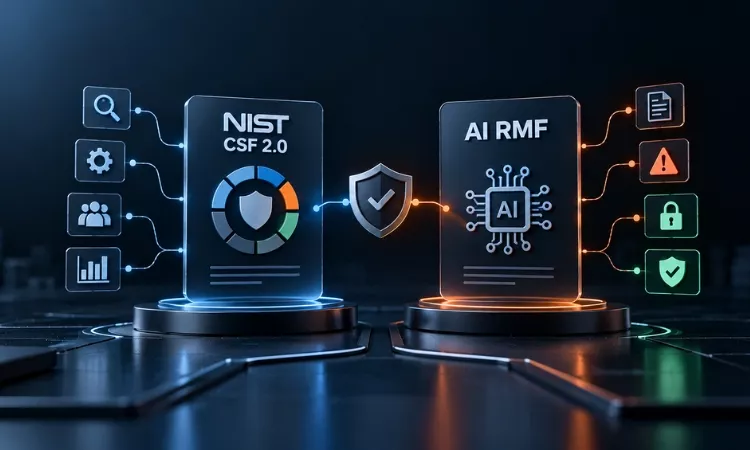
Where traditional software testing checks whether code performs a function correctly, AI assurance checks whether a model produces fair, explainable, and reliable outcomes across changing data and real-world conditions. It covers model validation, bias testing, data governance, security testing for adversarial inputs, and ongoing monitoring once a system is live. Many organizations align their programs to established references such as the NIST AI Risk Management Framework and the ISO/IEC 42001 AI management system standard, which both provide structured approaches for identifying, measuring, and managing AI-related risk.
What is the importance of AI Assurance Program for Enterprises?
AI systems fail differently than conventional software. A model can produce inaccurate or biased results while appearing to function normally, and those errors often surface only after they have already influenced a business decision. Enterprises that skip formal assurance processes tend to discover problems through customer complaints, regulatory inquiries, or public incidents rather than internal testing.
Regulatory pressure is another driver. Laws such as the EU AI Act classify many enterprise use cases as high-risk and require documented risk management, human oversight, and post-market monitoring. Sector-specific rules in finance, healthcare, and insurance add further obligations around explainability and non-discrimination. Boards and regulators increasingly expect the same level of rigor for AI that they already expect for financial controls and cybersecurity, and an assurance program is how that expectation gets translated into repeatable practice.
There is also an operational case. Enterprises that formalize AI assurance inside their existing governance, risk, and compliance program avoid building a parallel, disconnected process for every new AI initiative. Instead, AI risk becomes one more category tracked alongside cyber risk, operational risk, and third-party risk, which keeps reporting consistent for the board and for auditors.
Who Should Own AI Assurance in an Organization?
AI assurance sits at the intersection of security, data science, legal, and business operations, so ownership works best as a shared model rather than a single department’s responsibility. The CISO or a designated AI governance lead typically owns the overall framework and reporting cadence. Data science and engineering teams’ own model-level testing and documentation. Legal and compliance teams interpret regulatory requirements and translate them into control objectives. Business unit leaders remain accountable for how AI outputs are used in their processes.
This shared structure matters even more as organizations deploy autonomous AI agents that can take actions across systems without waiting for a human prompt. When an agent can modify configurations or approve transactions on its own, accountability cannot be delegated to the algorithm itself. Human oversight, clear escalation paths, and auditable decision trails have to be built into the governance model from the start, a point explored further in Ampcus Cyber’s analysis of accountability in agentic AI.
When Should an Enterprise Build an AI Assurance Program?
The best time to build an AI assurance program is before AI systems reach production, not after an incident force the issue. In practice, most enterprises start once they have more than one or two AI use cases in active development, since that is the point where informal, ad hoc reviews stop scaling. Warning signs that a program is overdue include inconsistent model documentation across teams, no clear process for approving new AI use cases, and an inability to answer basic questions about which models are currently in production and what data they rely on.
Organizations preparing for a specific regulatory deadline, a customer security questionnaire, or a certification such as ISO/IEC 42001 should treat that date as a forcing function and begin building the program with enough lead time for testing, documentation, and staff training.
What Are the Core Components of an AI Assurance Program?
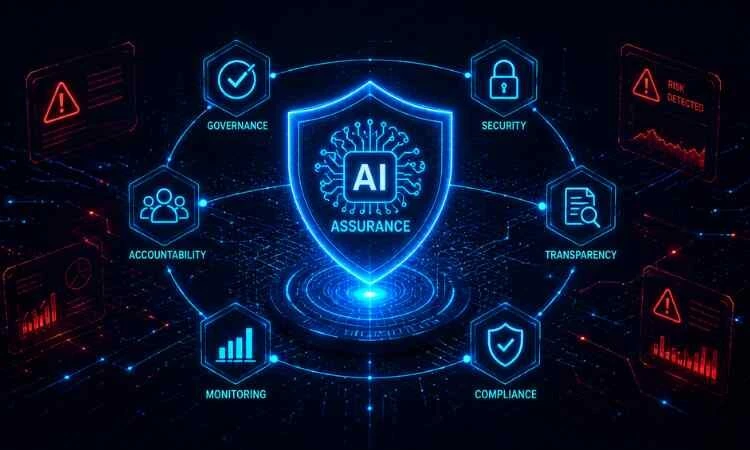
A mature AI assurance program generally includes the following elements:
- AI inventory and risk classification: a living record of every AI system in use, tagged by business function and risk level
- Model validation and testing: accuracy, bias, robustness, and adversarial testing performed before and after deployment
- Data governance: controls over training data quality, provenance, and privacy
- Explainability and documentation: model cards, decision logic summaries, and audit trails that support both regulators and internal reviewers
- Continuous monitoring: tracking for model drift, performance degradation, and anomalous outputs once a system is live
- Incident response: a defined process for investigating and remediating AI-related failures or harms
- Third-party AI oversight: assessment of vendor models and embedded AI features in purchased software
Deciding how much of this to build in-house versus support with a platform is a common early question. Organizations weighing that trade off often benefit from reviewing the differences covered in GRC platform versus compliance automation tool comparisons before committing to a specific approach.
What are AI Assurance Program Operations?
AI assurance runs as a continuous cycle rather than a one-time approval gate. A new AI use case is registered in the inventory and assigned a risk tier based on factors like data sensitivity and decision impact. Higher-risk systems go through deeper testing and require sign-off from legal and business stakeholders before launch. Once live, the system is monitored on an ongoing basis, with defined thresholds that trigger a re-review if performance or fairness metrics move outside acceptable ranges.
Quantifying that risk in a way leadership can act on is often the hardest part of the process. Platforms built for continuous, data-driven risk measurement, such as GRACE, give security and compliance teams real-time visibility into control status and evidence across frameworks instead of relying on periodic manual reviews, an approach detailed in this quantitative risk measurement overview. Bringing AI assurance into that same continuous monitoring model, rather than treating it as a separate annual exercise, keeps pace with how quickly AI systems change in production.
Building AI Assurance Into Your Governance Strategy
An AI assurance program is no longer optional for enterprises deploying AI at scale. It protects against biased or unreliable outputs, satisfies growing regulatory expectations, and gives boards the same confidence in AI systems that they already expect from financial and cybersecurity controls. The organizations that succeed treat it as an extension of existing GRC practice rather than a separate initiative, with clear ownership, defined risk tiers, and continuous monitoring built in from day one.
| Talk to Ampcus Cyber’s governance and risk team to assess your current AI risk posture and build an assurance program suited to your enterprise. |
Enjoyed reading this blog? Stay updated with our latest exclusive content by following us on Twitter and LinkedIn.