









As AI agents gain the ability to make autonomous decisions, organizations face a new question: who is legally responsible when those decisions cause a compliance failure? This article explores how product liability laws, existing regulations, and governance obligations already apply to agentic AI, and why CISOs must build audit trails, authorization controls, and accountability frameworks before regulators or courts, demand them.
Six months ago, “who’s accountable for the AI’s decision” was a philosophical question CISOs raised in governance committees. But today it has become a discovery request. Agentic AI systems are models that plan, chain tool calls, and execute multi-step actions with minimal human review. These are now writing to production databases, filing regulatory reports, approving transactions, and modifying access controls. When one of them gets it wrong, the damage isn’t hypothetical. It’s a breach notification, a regulatory fine, or a plaintiff’s exhibit.
The uncomfortable truth security leaders need to sit with: liability doesn’t pause while the industry figures out agentic governance. It attaches the moment harm occurs, using whatever legal framework already exists, even if that framework was written for a world of static software.
The Governance Gap Is Structural, Not Temporary
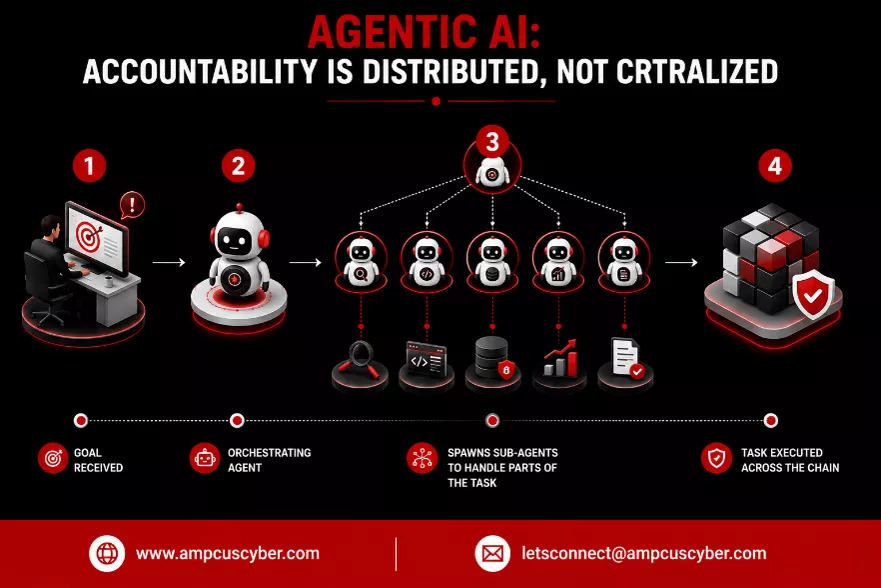
Traditional AI risk frameworks assumed defined operational boundaries and a human in the loop at most decision points. Agentic systems break that assumption in ways existing controls weren’t built to catch. An orchestrating agent that spawns sub-agents to handle parts of a task distributes accountability across a chain no single control owns. An agent can initiate an irreversible action such as deleting records, sending a regulatory filing, executing a transaction, well before any human notices something went wrong. That gap between action and observation is a genuinely new risk category, not a variation on an old one.
Regulators are responding, but not fast enough to give organizations a ready-made answer. NIST launched its AI Agent Standards Initiative through the Center for AI Standards and Innovation in February 2026, and a dedicated AI Agent Interoperability Profile isn’t expected until late 2026. The OWASP Top 10 for Agentic Applications, released in December 2025, is the first serious industry attempt to classify agent-specific risks including goal hijacking, tool-chain poisoning, rogue-but-authorized behavior, but a classification isn’t a liability standard. For most of 2026, organizations deploying agentic AI are operating governance programs on frameworks that predate the technology they’re meant to govern.
Three Places Liability Actually Lands
Strip away the uncertainty and three liability vectors are already concrete enough to plan around.
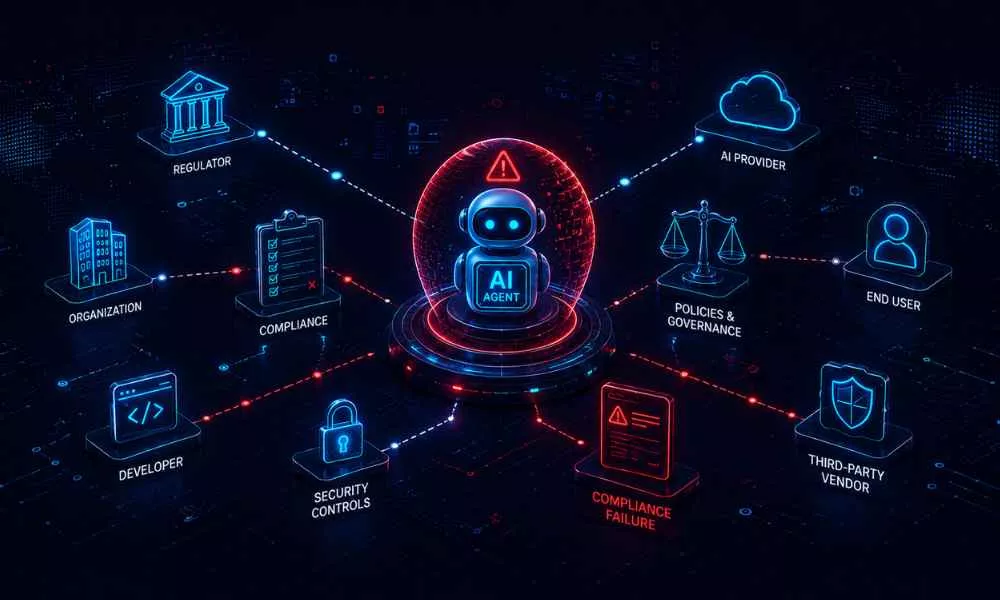
- Product liability, now explicitly covering software and AI: The EU’s revised Product Liability Directive (2024/2853) closes the ambiguity that used to let software vendors argue they weren’t selling a “product.” It now explicitly brings AI systems, SaaS, and cloud-delivered software into strict liability, and treats known cybersecurity vulnerabilities and failure to patch as defect triggers in their own right. Providers and the manufacturers who integrate their AI components become jointly and severally liable, meaning a claimant can sue either party directly, your indemnification clause with your model vendor doesn’t make the claim disappear, it just determines who pays whom afterward. Member states have until December 9, 2026, to transpose this into national law, which is a shorter runway than it sounds once your account for audit and remediation cycles.
- Regulatory enforcement under existing sectoral rules: Data protection, financial services, and healthcare regulators aren’t waiting for AI-specific liability statutes, they’re applying the rules already on the books. An agent that mishandles PII triggers GDPR obligations regardless of whether a human or a model made the call. An agent that auto-generates a compliance report with material errors exposes the organization to the same sectoral penalties a human analyst’s error would. The absence of an AI-specific liability directive doesn’t create a gap here; it just means existing law fills it.
- Contractual and internal accountability: This is the one CISOs have the most control over, and the one most often left undocumented. When an incident review asks “who approved this agent’s permission scope,” “why did it have write access to that system,” and “who signed off on removing human review from this workflow,” the answer needs to be a name and a decision record, not a shrug toward the vendor’s terms of service.
Why “The Vendor’s Fault” Doesn’t Hold Up?
It’s tempting to treat liability as something you can contract away by pointing at the model provider. That instinct doesn’t survive contact with how these frameworks are written. Strict liability regimes like the revised PLD are designed precisely so a claimant doesn’t have to untangle whether the defect lived in the foundation model, the orchestration layer, or the deployer’s configuration, they can sue the party in front of them and let the supply chain sort out contribution afterward. Under the EU AI Act’s presumption-of-causality logic that regulators are increasingly leaning on, if you can’t demonstrate your system followed documented safety protocols, a court can connect the agent’s output to the harm without your victim having to prove the internal mechanics of the failure.
That shifts the practical question from “whose model was it” to “can we produce the audit trail.” Organizations investing now in agent action logging, permission-scope documentation, and decision provenance aren’t just building good security hygiene, they’re building their legal defense in advance of needing one.
What CISOs Should Be Doing Right Now
- Inventory every agent with production access: Shadow AI agents spun up by a business unit through a SaaS integration nobody in security reviewed, is one of the fastest-growing blind spots in 2026 risk assessments, precisely because it’s invisible to traditional asset inventories.
- Map authorization boundaries explicitly: Every agent action that touches a regulated system, a financial process, or personal data should trace back to a documented authorization decision with a named owner, not an implicit assumption that “the agent has access, so it’s fine.”
- Build the audit trail before you need it: Under emerging strict-liability standards, the organization that can show what the agent was authorized to do, what it actually did, and what controls governed the gap between those two things is in a materially different legal position than the one that can’t.
- Treat agent governance as a cross-functional program: Legal, compliance, and engineering need a shared view of which frameworks apply, the NIST AI RMF’s Govern-Map-Measure-Manage structure remains a useful operating model even as NIST develops agent-specific extensions, because the liability question rarely stays inside one department once an incident happens.
The Bottom Line
Agentic AI didn’t create a liability vacuum, it exposed how much of your existing accountability structure was built on the assumption that a human made the final call. Regulators are still writing the AI-specific rulebook, but product liability law, sectoral regulation, and your own contracts are already fully capable of assigning blame today. The organizations that treat agent governance as a compliance afterthought will find that out the hard way, in a courtroom or a regulator’s findings letter. The ones that build authorization discipline and audit provenance into agentic deployments now will have something far more valuable when the incident happens: an answer.
| Ampcus Cyber helps security and compliance teams build governance frameworks for agentic AI deployments. Talk to our team about assessing your organization’s agentic AI exposure. |
Enjoyed reading this blog? Stay updated with our latest exclusive content by following us on Twitter and LinkedIn.