









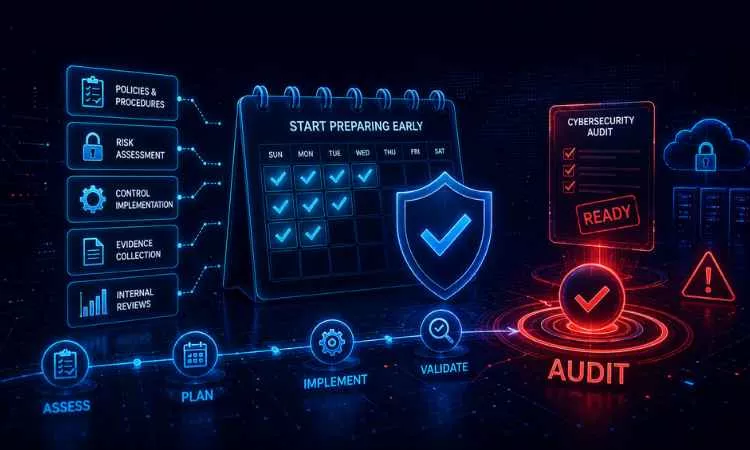
Cybersecurity audit readiness doesn’t begin a few weeks before an assessment, it starts the day your last audit ends. Organizations that continuously monitor controls, maintain evidence, and address compliance gaps throughout the year experience fewer audit findings, smoother certifications, and less operational disruption. Discover when to start preparing, why most organizations fall behind, and how to build a continuous audit readiness program.
The short answer is the day your last audit ends. Cybersecurity audit readiness is not a project with a start and end date it’s an operating condition. Organizations that treat it as continuous rarely dread audit season. Organizations that only think about it a few weeks out are the ones scrambling for screenshots and access logs the night before the auditor arrives.
Recent industry research backs up how widespread that scramble is. According to a 2025 Swimlane survey of 500 IT and cybersecurity decision-makers, 71% of organizations said they could fail a cyber audit, and only 29% reported that their compliance programs consistently meet internal and external standards. That’s not a small-organization problem, it’s the norm across enterprise-scale companies.
This article covers what audit readiness means, how far in advance to start preparing, what the data says about the cost of waiting, and how to build a program that stays audit-ready year-round.
What Is Cybersecurity Audit Readiness?
Cybersecurity audit readiness is the ongoing ability to demonstrate, at any point in time, that your organization’s security controls, policies, and evidence align with the regulatory requirements, contracts, and industry frameworks that apply to you. It’s different from simply “having security.” An organization can have strong controls in place and still fail an audit if it can’t produce timely, consistent proof that those controls are operating. For a fuller breakdown of the concept, see this guide to cybersecurity audit readiness.
This distinction, having security versus proving it, is the single biggest reason audits go badly, and it’s why “start early” isn’t a cliché. It’s a structural requirement.
How Far in Advance Should You Prepare for a Cybersecurity Audit?
There’s no universal countdown, but mature security and compliance teams generally work backward from the audit date using a timeline like this:
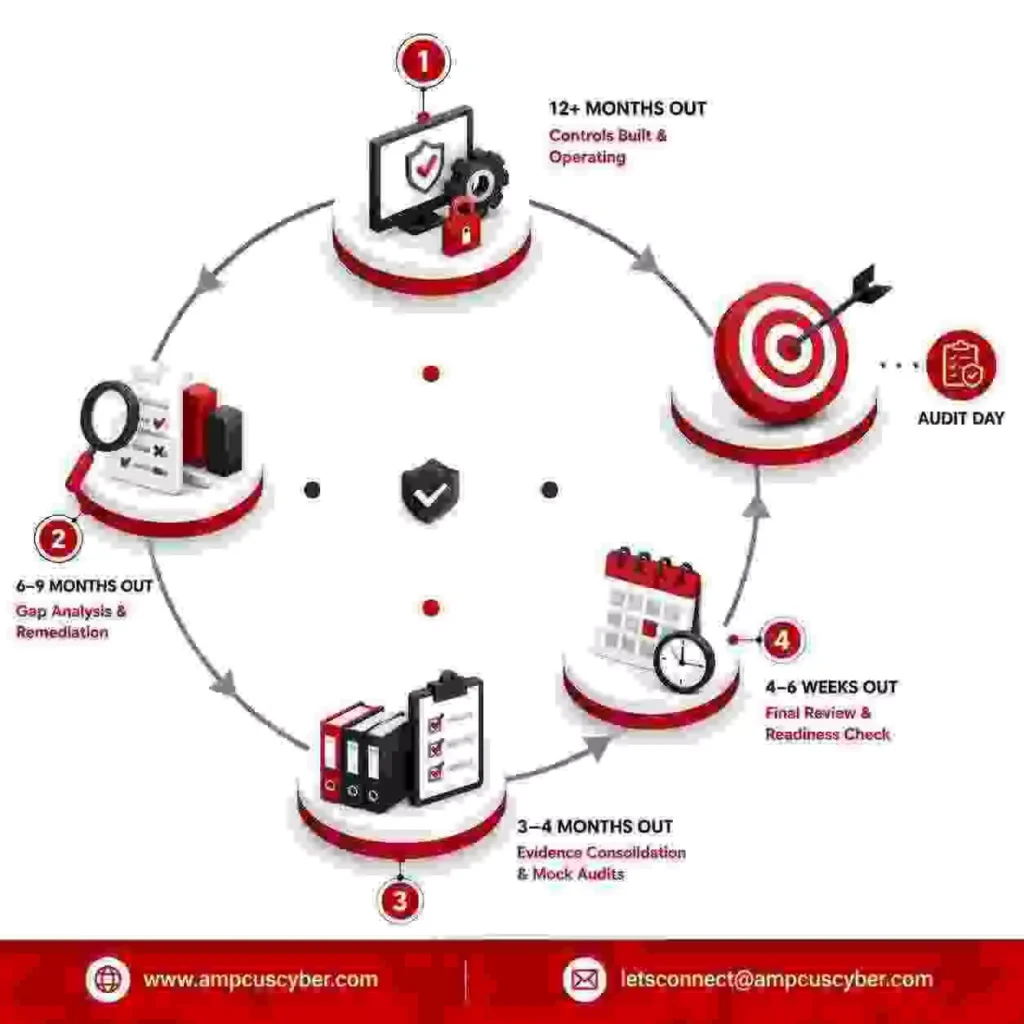
12+ months out, this is where real readiness lives: Controls are implemented, monitored, and documented as part of normal operations rather than a special project. Access rights are recertified on a set cadence, not the week before the auditor’s kick-off call.
6 to 9 months out, gap analysis and remediation window: This is when you formally compare your current control environment against the target framework (SOC 2, ISO 27001, PCI DSS, HIPAA, or a sector-specific mandate) and fix what’s missing. Remediation involving new tooling or process redesign routinely takes longer than expected, so gaps found later than this window often don’t get fully closed before the audit, only explained.
3 to 4 months out, evidence consolidation and mock audits: Documentation is organized into an audit-ready evidence library, and many organizations run an internal or third-party mock audit here to catch weak spots before an external auditor does.
4 to 6 weeks out, final review, not first pass: At this stage, teams should be confirming that evidence is current, not generating it for the first time.
If your process only kicks off at the “4 to 6 weeks out” stage, that doesn’t count as preparation but reaction. Reactive audit prep is exactly what tends to show up in the findings.
Cybersecurity Audit Statistics: Why Most Organizations Aren’t Ready
The numbers behind audit unpreparedness are more specific and more sobering than most teams assume:
- 71% of organizations believe they could fail a cybersecurity audit today, according to Swimlane’s 2025 GRC research.
- 38% of organizations have had an audit report rejected outright by a vendor or prospect, per A-LIGN’s 2024 Compliance Benchmark Report.
- 50% of organizations managing risk on an ad-hoc basis experienced a data breach in 2025, compared to organizations with structured, continuous risk programs, according to Hyperproof’s 2026 IT Risk and Compliance Benchmark Report.
- Fewer than half of organizations maintain full PCI DSS compliance year over year, and Verizon’s forensics team reports it has never found a fully compliant organization now of a breach, per Verizon’s Payment Security Report.
The common thread across these findings is not an absence of controls, it’s an absence of continuous, provable operation of those controls. That gap is precisely what a “start early” posture is designed to close.
What Waiting Too Long Actually Costs You
Starting late doesn’t just create stress, it creates measurable business consequences:
- Delayed certification: Auditors flag gaps and request follow-up evidence, pushing certification out by weeks or months.
- Rejected or downgraded reports: As the A-LIGN data above shows, more than a third of organizations have already had an audit report turned away by a business partner.
- Stalled deals and renewals: For B2B and regulated organizations, a delayed or lapsed certification can freeze procurement conversations that depend on it.
- Burned-out security and IT teams: Staff pulled into weeks of manual evidence collection aren’t doing threat detection, patching, or incident response during that time.
- Higher breach exposure: Organizations without continuous, structured risk management were breached at meaningfully higher rates in 2025 than those with mature programs, per Hyperproof’s benchmark data cited above.
None of this is hypothetical, it’s the recurring pattern behind audits that technically pass but leave leadership uneasy about what almost didn’t.
How to Build Continuous Cybersecurity Audit Readiness
Organizations that rarely stress about an upcoming audit share a few consistent habits.
- They treat evidence collection as a byproduct of operations, not a separate task:
Logging, access reviews, vulnerability scans, and policy attestations happen because they’re built into how the security program runs day to day. This is easier to sustain when a program is structured around a recognized model like the NIST Cybersecurity Framework, which organizes controls around ongoing functions, Identify, Protect, Detect, Respond, Recover, and Govern, rather than a single annual checkpoint.
They run a documented cybersecurity risk assessment on a regular cycle, not only when a framework requires one, keeping their understanding of their own exposure current.
- They monitor controls continuously instead of validating them once a year:
Continuous security monitoring closes the gap between “we implemented this control” and “we can prove this control is still working today,” which is where most audit friction originates. Frameworks like ISO/IEC 27001 increasingly reflect this shift toward demonstrating operational effectiveness rather than a point-in-time snapshot; see the official ISO/IEC 27001 standard for how this is codified.
They assign clear, year-round ownership of the evidence calendar, a compliance lead, a GRC function, or an outsourced partner, so audit prep isn’t reassembled from scratch by whoever’s available when the notice arrives. They pressure-test with a mock audit or internal review before the real one, exposing documentation gaps while there’s still time to close them.
Cybersecurity Audit Readiness Checklist: 3 Questions to Ask Right Now
Ask your team these questions today, not during the next audit call:
- Could we produce evidence for a control we implemented eight months ago, today, without asking someone to go dig for it?
- Do we know exactly which framework requirements apply to us, and which ones currently have open gaps?
- Is there one person or team who owns audit readiness continuously, or does it become “everyone’s job” only when a deadline is close?
If any answer makes you uneasy, that discomfort is useful information and the exact signal that it’s time to start now, not next quarter.
Final Thought
The organizations that dread audits are almost always the ones that only think about audits during audit season. The ones that don’t have simply moved the work earlier, building readiness into daily operations instead of assembling it under deadline pressure. Given that 71% of organizations currently believe they’d fail an audit today, the real question isn’t whether your organization has time to start preparing it’s whether it has time not to.
| Stay Audit-Ready with Ampcus Cyber! Call our experts to build continuous audit readiness strategy for your organization. |
Enjoyed reading this blog? Stay updated with our latest exclusive content by following us on Twitter and LinkedIn.