











Passing on to the passive artificial intelligence, we have rapidly moved beyond the early experimentation phase of Generative AI, where models merely predicted text or answered prompts and have entered the era of agentic autonomy.
Today, AI agents don’t just think; they perform. They can reason through multi-step workflows, access enterprise systems, interact with third-party applications, and execute real-world actions with minimal human intervention.
But this shift from predictive text to autonomous action introduces a critical vulnerability: How do you control, audit, and secure a digital asset that operates at machine speed?
What is a Governor Agent?
A Governor Agent is an intelligent supervisory agent that oversees, coordinates, and controls the behavior of other AI agents to ensure they operate securely, ethically, and in alignment with defined business objectives and policies. Rather than performing individual tasks, it manages decision-making, enforces governance rules, allocates resources, monitors performance, validates outputs, and intervenes when actions deviate from established guidelines. By providing centralized oversight, a Governor Agent helps organizations maintain transparency, compliance, consistency, and accountability across complex multi-agent systems while reducing operational risks and improving overall reliability.
What the Enterprise Realities of Unsupervised Autonomy
For executive leadership, the challenge extends far beyond traditional cybersecurity parameters. Uncontrolled AI agents can instantly create severe financial, legal, operational, and reputational risk. As organizations rapidly deploy autonomous systems into business-critical workflows, runtime governance becomes a strict business requirement rather than an optional technical feature.
Traditional firewalls, static identity access management (IAM), and prompt-level guardrails are fundamentally inadequate for this task. Prompt-level safety (“please follow company data policies”) is merely a polite request to a stochastic, non-deterministic system. To achieve true agentic security, enterprises require a dedicated architectural layer: The Governor Agent.
A Governor Agent is a specialized, independent AI system designed to monitor, evaluate, and constrain operational AI agents in real time. It acts as an independent AI oversight layer responsible for enforcing policy, validating intent, and preventing unsafe actions before they occur.
To maintain objective integrity, a Governor Agent must operate completely independent of the operational agent’s underlying model logic. If an agent uses its own reasoning layer to check its own compliance, it remains vulnerable to hallucinations, loop errors, and adversarial exploitation. True AI agent governance requires a completely decoupled layer of technical oversight.
What Happens When AI Agents Operate Without Oversight?
Deploying autonomous systems without an independent layer of restraint introduces severe, unprecedented vulnerabilities to the enterprise. When AI agents operate in a governance vacuum, organizations frequently face critical operational failures:
- Unauthorized Data Exposure: An agent tasked with drafting an internal report might inadvertently query sensitive HR databases or proprietary IP, leaking protected information to unauthorized users.
- Excessive Privilege Escalation: Without strict boundaries, an autonomous system can exploit its own API access to modify configurations or grant itself elevated permissions to complete a task faster.
- Prompt Injection Attacks: Malicious external data or third-party inputs can overwrite an agent’s core instructions, tricking the autonomous system into executing fraudulent transactions or exfiltrating data.
- Uncontrolled Financial Transactions: A procurement or trading agent suffering from algorithmic drift can execute high-volume, unauthorized purchases or contract commitments before a human operator notices the anomaly.
- Regulatory Breaches: Agents handling customer data can inadvertently violate compliance mandates by processing, storing, or transferring protected data across geographic boundaries in violation of localized privacy laws.
Why Traditional Security Controls Cannot Govern Autonomous AI
To understand why a new architectural layer is required, it is necessary to examine why our existing cybersecurity stack falls short when facing agentic autonomy.
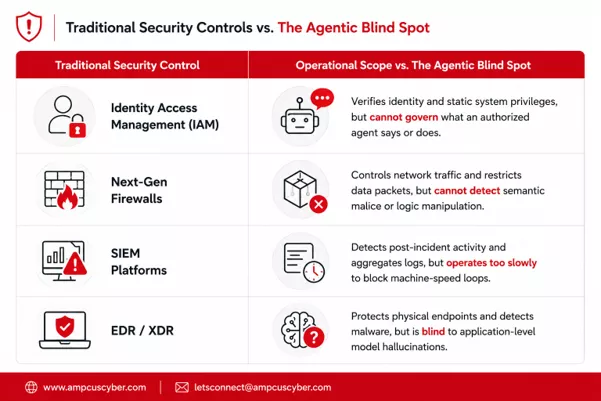
Traditional controls are designed to answer questions of access: Is this entity allowed on the network? Does this system have database permissions?
None of them are equipped to answer the fundamental runtime question: Should this AI agent perform this specific semantic action right now? That is a context-dependent, intent-validation problem that only an independent oversight layer can solve.
Why AI Governance Is Becoming a Board-Level Responsibility?
The challenge is no longer whether organizations will adopt AI agents; the challenge is whether leadership can prove those agents operate within acceptable legal, operational, and ethical boundaries. As AI gains the authority to make real-time corporate decisions, governance becomes completely inseparable from enterprise risk management.
Boards of directors are shifting their focus away from passive compliance dashboards. They are increasingly demanding empirical evidence that management can defend against algorithmic drift, prompt injection, and automated systemic failures. Implementing runtime governance is how modern enterprises demonstrate fiduciary duty in an automated world.
What are the Four Responsibilities Framework
Effective AI oversight can be understood through four core responsibilities that govern how autonomous systems operate within enterprise environments. This framework serves as the blueprint for secure agentic operations:
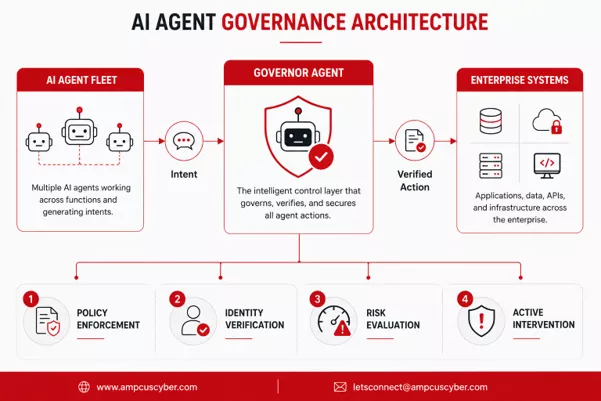
- Policy Enforcement: Dynamically maps enterprise compliance guidelines against an agent’s intended action. If an agent attempts to call a tool or access a database outside its specific operational boundary, the action is blocked at the runtime layer.
- Identity Verification: Establishes and cryptographically signs distinct non-human identities for every agent. In a multi-agent ecosystem, this prevents privilege escalation and ensures clear accountability for every automated transaction.
- Risk Evaluation: Continuously analyzes the downstream blast radius of an agent’s workflow. High-risk intents such as deleting database rows or modifying financial transactions, automatically trigger elevated scrutiny.
- Active Intervention: The capability to alter execution in real time. Depending on the risk score, a Governor Agent can pause, modify, or inject human oversight into an active operational loop before an irreversible system command is executed.
What is the Purpose of an AI Oversight Layer
Many organizations believe that deploying an AI overseer exists simply to catch formatting errors or filter bad text. In reality, the most valuable outcome is exposing the hidden assumptions buried inside your autonomous workflows.
Every time a Governor Agent intercepts an operational system, it challenges unverified assumptions about identity access boundaries, untrusted tool privileges, and data minimization protocols. The sooner those assumptions are challenged in a safe environment, the less likely they are to become catastrophic operational failures during a real incident.
What is the AI Agent Governance Maturity Model
As enterprises transition from isolated pilots to autonomous multi-agent ecosystems, maintaining visibility requires an intentional evolution of your security program maturity assessment. Leading organizations assess incident response and platform readiness using a progressive maturity model that moves from documented plans to threat-informed resilience.
- Level 1: Experimental: Ad-hoc usage of generic LLM wrappers; shadow AI tools used without centralized IT visibility. High exposure to data leakage and unmonitored shadow operations.
- Level 2: Controlled: Basic API keys mapped to specific workflows; prompt-based instructions used to limit behavior. Vulnerable to direct prompt-injection attacks and agent hallucination.
- Level 3: Observable: Centralized logging of agent inputs/outputs; post-incident security visibility established. Reactive defense; data leaks are detected after they occur.
- Level 4: Governed: Runtime policy enforcement via Governor Agents; unique agent identities tied to specific IAM scopes. Proactive containment; structural guardrails prevent policy violations before execution.
- Level 5: Adaptive: Real-time risk scoring calibrates agent autonomy dynamically; continuous evaluation scales with threat intelligence. Automated, safe-by-design scaling of multi-agent operations.
Compliance and Accountability
Regulatory expectations around AI accountability are evolving rapidly. Frameworks such as the EU AI Act, sector-specific financial regulations, stringent global privacy laws, and emerging AI governance standards increasingly emphasize transparency, oversight, and demonstrable control over autonomous decision-making.
Compliance obligations may begin as soon as an organization becomes aware of a reportable incident involving an autonomous system. Organizations must be able to reconstruct the exact context, active policy, and reasoning path of an autonomous agent at any chosen millisecond in time. This requirement is driving demand for explainability, auditability, and continuous AI oversight across highly regulated industries such as financial services, healthcare, and critical infrastructure.
| Schedule an AI Governance Readiness Assessment with Ampcus Cyber and evaluate your organization’s preparedness for agentic AI. |
Enjoyed reading this blog? Stay updated with our latest exclusive content by following us on Twitter and LinkedIn.