










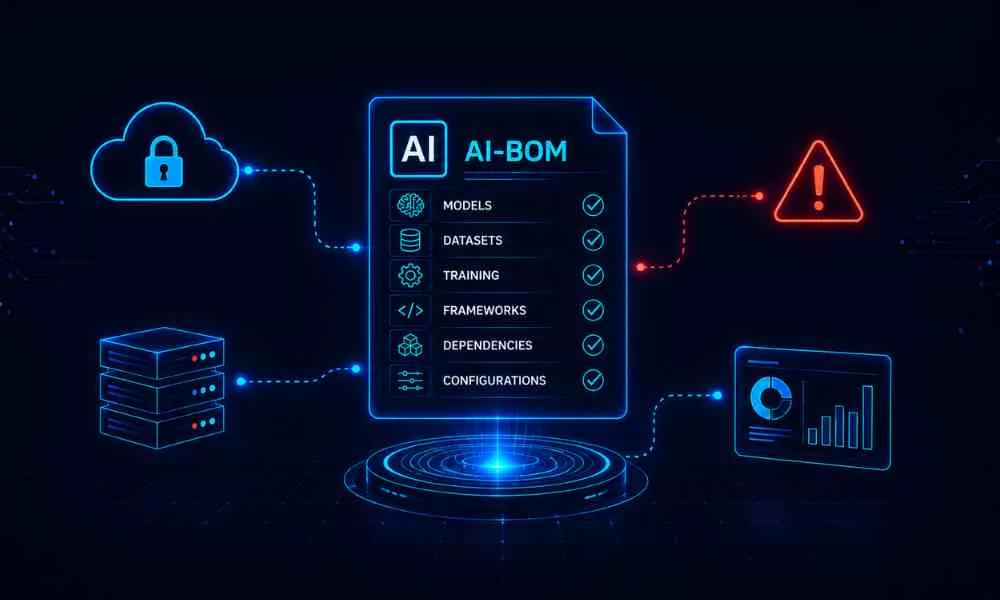
AI systems are only as trustworthy as the data, models, and components behind them. Discover what an AI Bill of Materials (AI-BOM) is, why it’s becoming essential for AI governance, and how it helps organizations improve transparency, strengthen security, manage AI supply chain risks, and prepare for evolving regulations such as the EU AI Act.
We’ve all heard the phrase “you are what you eat.” In the software world, a similar rule applies: your application is only as secure as the code it’s built on. For years, organizations have used a Software Bill of Materials (SBOM) to inventory every ingredient in their software applications.
But then, Artificial Intelligence and Generative AI entered the room.
Certainly, software isn’t just made of static lines of code; it’s driven by probabilistic models, massive training datasets, and shifting neural networks. This is where enters the AI Bill of Materials (AI-BOM). It is the tech industry’s answer to understanding, securing, and governing the “black box” of modern AI systems.
This blog walks you through everything you want to learn about an AI-BOM.
What Is an AI-BOM?
An AI Bill of Materials (AI-BOM) is a comprehensive, machine-readable inventory that lists every single component used to build, train, and operate an AI system.
Think of it as a transparent ingredient label for an AI model. It doesn’t just stop at the application code; it details the data used to train the model, the specific version of the model weights, the underlying frameworks, and even the hardware infrastructure running it.
The National Institute of Standards and Technology (NIST) views AI-BOMs as critical enablers for transparency, trust, and security in software supply chains.
What Is Inside an AI-BOM?
An AI-BOM (Artificial Intelligence Bill of Materials) is a machine-readable inventory that documents the datasets, models, software components, and dependencies that make up an AI system. It is created by capturing this information throughout the AI development lifecycle and organizing it in a standardized format, including details such as versions, sources, and relationships.
By maintaining an AI-BOM, organizations gain end-to-end visibility into model lineage, validate data provenance, strengthen transparency, and support regulatory compliance and governance requirements.
A complete AI-BOM goes far deeper than a traditional software manifest. A robust, enterprise-grade AI-BOM typically categorizes components into several layers:
1. The Data Layer
Because AI is inherently data-driven, this layer acts as the foundation of the AI-BOM. It details:
- Training and Fine-Tuning Datasets: Their origins, versions, and data collection methodologies.
- Data Lineage and Provenance: Where the data came from and whether it was legally and ethically sourced.
- Data Characteristics: Information on licensing, data types, and potential presence of PII (Personally Identifiable Information).
2. The Model Layer
This tracks the brain of the operation, including:
- Model Identification: Model name, provider (e.g., OpenAI, Anthropic, or open-source), and specific architectural version or checkpoint.
- Hyperparameters & Configuration: The specific settings used during training or fine-tuning.
- Model Cards: The intended use cases, performance metrics, and known limitations of the model.
3. The Dependency & Framework Layer
AI applications rely heavily on specialized tech stacks. This layer lists:
- ML Frameworks: Libraries like PyTorch, TensorFlow, or JAX.
- AI SDKs & Orchestrators: Tools like LangChain or the OpenAI SDK.
- Third-Party Packages: Standard software libraries supporting the AI workflows.
4. The Infrastructure Layer
The physical and cloud-based resources matter, too. This covers:
- Compute Resources: Specific GPUs, TPUs, or NPUs used for training and inference.
- Deployment Context: Cloud environments, regions, and network configurations.
5. Governance & Security Metadata
- Ownership: Clear accountability indicating who owns which component.
- Guardrails & Controls: System prompts, safety templates, and alignment constraints.
What Makes an AI-BOM Different From a Traditional SBOM?
While an SBOM and an AI-BOM share a common lineage, they track fundamentally different things:
| Feature | Traditional SBOM | AI-BOM |
| Primary Focus | Static software code, libraries, and open-source dependencies. | Data pipelines, model architectures, parameters, and training sets. |
| System Behavior | Deterministic: Code behaves the same way every time unless modified. | Non-deterministic: Behavior emerges from training data; outputs can shift. |
| Lifecycle State | Typically, static at the point of release. | Dynamic: Requires continuous updates for every retraining or fine-tuning cycle. |
| Core Risks Tracked | Standard software vulnerabilities (CVEs) and license compliance. | Data poisoning, model drift, prompt injection, and ethical bias. |
The Takeaway: An SBOM alone is blind to the “cognitive layer” of an application. If an engineer drops an open-source model into a project, an SBOM tracks the wrapper code, but the AI-BOM tracks what the model is and knows.
What Risks Does an AI-BOM Solve?
Deploying AI without an AI-BOM is like flying a plane blind. Implementing a structured manifest solves several pressing enterprise pain points:
- Combating “Shadow AI”: Generative AI has made it incredibly easy for developers to plug third-party models into applications. An automated AI-BOM discovers these hidden elements, so security teams know exactly what models are running in production.
- Securing the Supply Chain Against Data Poisoning: If a training dataset is maliciously altered, the model’s logic is compromised. An AI-BOM helps verify data lineage to ensure integrity.
- Detecting Model Drift: Models degrade over time or change when providers silently update underlying weights. Tracking explicit version markers helps engineers spot when a model starts behaving differently.
- Regulatory Compliance: Major frameworks, most notably the EU AI Act, mandate rigorous documentation regarding training data characteristics and risk mitigation for high-risk AI systems. An AI-BOM turns a compliance nightmare into a smooth, auditable process.
What is the Catch? Static Manifests vs. Runtime Reality
As the technology matures, security experts point out a critical nuance: static AI-BOMs are not enough. A static manifest is just a snapshot of what you intended to deploy. However, modern AI threats like prompt injection, model evasion, or agentic tool misuse exploit how components behave at runtime, rather than how they look at build time.
For maximum security, organizations are moving toward runtime-connected AI-BOMs. These systems pair the initial inventory with continuous telemetry to monitor what data resources a model is touching and what APIs an agent is calling in real-time.
Moving Forward with AI-BOMs
If your organization is building or integrating AI, an AI-BOM is quickly becoming non-negotiable. To get started, MLOps and security teams are leveraging emerging open standards like SPDX 3.0 (with AI and Dataset profiles) to automate metadata extraction directly inside their CI/CD and training pipelines.
Ultimately, transparency is the cornerstone of responsible AI adoption and the AI-BOM is the ultimate blueprint for achieving it.
Looking to secure your AI applications and establish AI governance from day one?
| Talk to the Ampcus Cyber AI Security experts to build secure, compliant, and trustworthy AI systems. |
Enjoyed reading this blog? Stay updated with our latest exclusive content by following us on Twitter and LinkedIn.