









AI agents are rapidly becoming digital employees, capable of accessing systems, orchestrating workflows, and making decisions autonomously. But traditional IAM was built for humans and static machines, not adaptive, non-deterministic agents operating at machine speed. Discover why Agentic IAM is emerging as the critical identity layer for governing autonomous AI, enforcing dynamic authorization, and ensuring accountability in the age of agentic AI.
Enterprise technology is undergoing a massive paradigm shift: moving from generative AI that simply answers prompts to agentic AI that acts on goals. Autonomous AI agents are no longer just chatbots reading your documents; they are digital employees. They log into applications, execute code, orchestrate multi-system workflows, call APIs, and make operational decisions independently.
Recent industry data underscores the velocity of this shift. Research from BeyondTrust indicates that enterprise AI agent deployments have grown 466.7% year-over-year, and machine workloads now vastly outnumber human users in enterprise environments. Despite this explosion, standard Identity and Access Management (IAM) systems remain completely unequipped to handle autonomous, non-deterministic software agents that adapt their behavior at runtime.
Enter Agentic IAM, the newly emerging security architecture designed specifically to manage, govern, and audit the identities and access rights of autonomous AI agents.
What is the Identity Paradigm Shift?
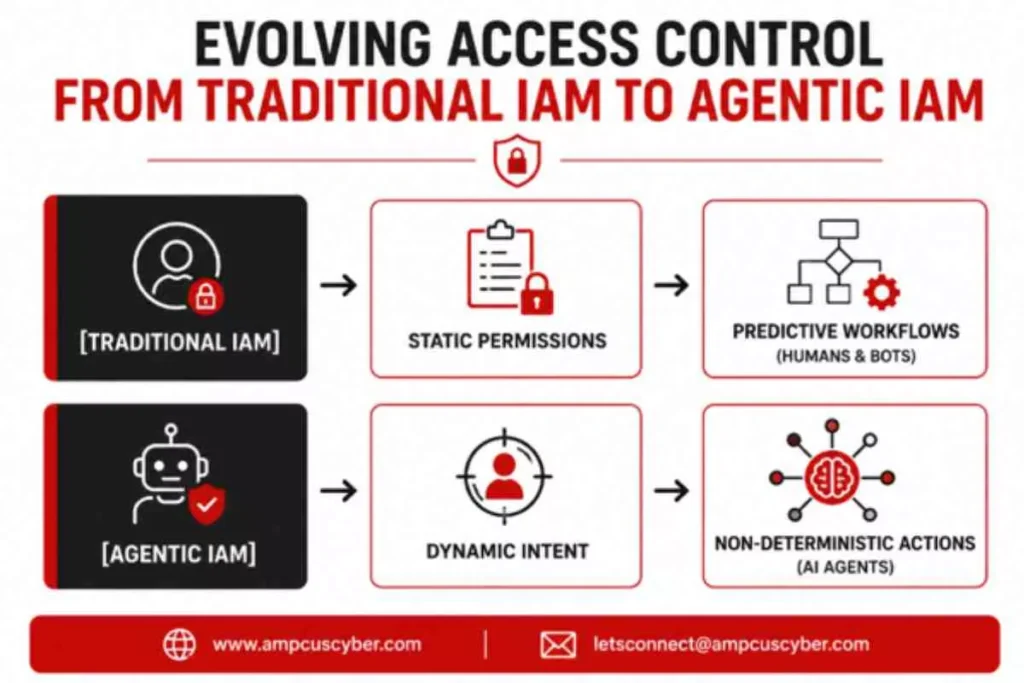
To understand Agentic IAM, it helps to understand how it differs from the identity classes security teams have managed for years:
- Human Identities: Governed by single sign-on (SSO), passwords, and multi-factor authentication (MFA). They operate at human speed and make conscious, policy-bound choices.
- Machine Identities (Service Accounts/Bots): Governed by static secrets, API keys, and certificates. They follow rigid, predefined scripts. If Step A happens, execute Step B.
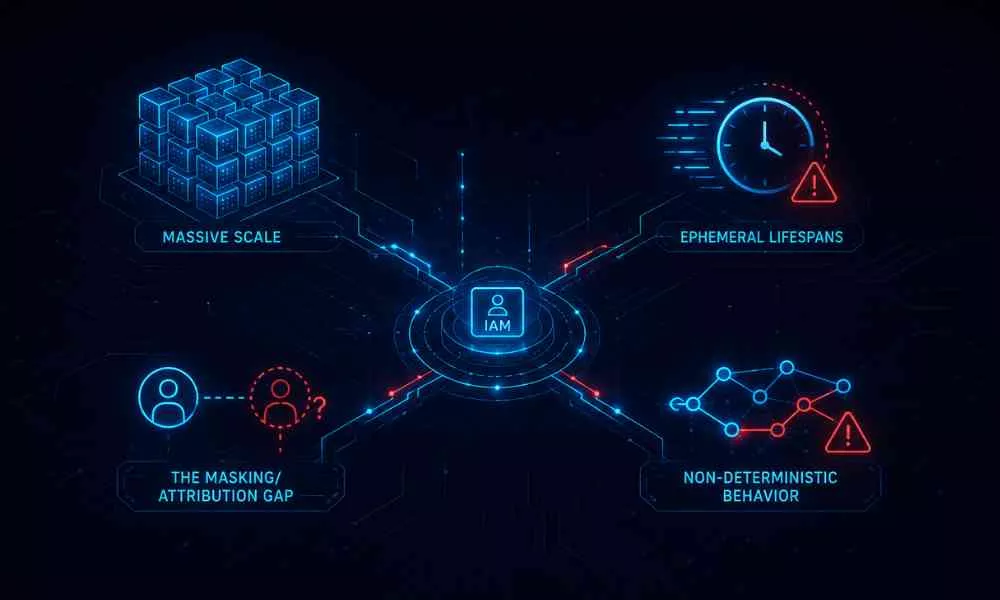
- Agentic Identities: A completely new class of Non-Human Identities (NHIs). They do not follow hardcoded paths. They receive an open-ended objective (e.g., “Optimize our supply chain logistics”), evaluate the context, choose which third-party APIs or internal databases to call, and execute actions dynamically at machine speed.
What Stops IAM and PAM to Govern AI Agents?
Many organizations assume that existing Privileged Access Management (PAM) or legacy IAM tools can be stretched to secure these new autonomous workers. However, these traditional tools have fundamental architectural limitations that leave them blind to agent behavior.
| Identity Control | Traditional Capability | The Agentic Limitation |
| Traditional IAM | Verifies who the entity is at initial login. | Verifies identity but cannot assess changing intent or runtime decisions. |
| PAM (Privileged Access) | Grants elevated administrative access to a session. | Gives high privilege based on credentials but lacks real-time oversight of individual API calls. |
| RBAC (Role-Based Access) | Assigns static permissions based on structural roles. | Grants overly broad, static permissions to agents executing fluid, dynamic tasks. |
| MFA (Multi-Factor Auth) | Adds a step-up security layer for access verification. | Designed strictly for humans interacting with a UI, not autonomous systems running in the background. |
The Core Distinction: Traditional security models govern authentication and baseline permissions. Agentic IAM governs intent, context, and dynamic delegation at the exact moment an action is executed.
Why Classic IAM Fails the Agentic Frontier?
If an organization attempts to secure autonomous agents using legacy identity frameworks without dedicated agentic controls, they open themselves up to severe security gaps:
1. The “Authenticate Once, Trust Forever” Fallacy
Traditional web security relies on session-based trust. A user or application authenticates at login, receives a token, and can execute actions for hours. If an autonomous agent inherits a long-lived session token and its core model suffers an intent drift or an adversarial prompt injection attack, the agent can abuse that persistent access to systematically exfiltrate data before the session expires.
2. Impersonation vs. Authenticated Delegation
When an agent acts on behalf of a human executive, developers frequently take the easiest shortcut: they share the human’s personal credentials or service account tokens with the agent. This completely breaks the audit trail. In the log files, an automated database drop executed by a rogue agent looks exactly like a manual action taken by the executive, destroying non-repudiation.
3. Static RBAC Is Too Coarse
Standard enterprise security assigns users to fixed roles (e.g., Financial Analyst). If an agent is assigned that broad role, it has blanket permission to view all financial data. But an agent only needs access to the specific spreadsheets required to complete its immediate task. Standard RBAC inevitably leads to massively over-privileged agents operating at machine scale.
What is the Agentic Identity Fabric Framework?
To securely onboard and manage autonomous agents, enterprise security must evaluate and govern agentic behavior across four core layers. This framework ensures that machine autonomy never outpaces enterprise control.
1. Cryptographic Identity Binding
Every AI agent must be registered as a first-class citizen with a unique, verifiable non-human identity, aligning with emerging industry standards like the IETF draft AIMS (Agent Identity Management System). Rather than sharing an API key across an entire deployment, an agent’s identity is cryptographically bound to the signature of its specific underlying code, model version, and deployment container. If the code is maliciously altered, the identity is automatically invalidated.
2. Intent-Aware Continuous Authorization
Authentication must occur not just at initial login, but at runtime action-time. Every time an agent attempts to invoke an API, pull a database record, or trigger a transaction, the Agentic IAM layer evaluates the request dynamically based on real-time context.
3. Cryptographic Delegation Chains
Agents must never impersonate users. Agentic IAM implements standards-based delegation patterns such as OAuth 2.0 Token Exchange. When a human user gives an agent a goal, the agent exchanges the human’s assertion token for a strictly scoped, short-lived, ephemeral credential. This creates a verifiable cryptographic chain that links the agent’s action back to the explicit human intent.
4. Human-in-the-Loop (HITL) Step-Up Enforcement
For routine tasks (like summarizing an email), the agent runs autonomously. However, for high-risk boundaries such as moving funds, altering infrastructure configurations, or deleting customer data the Agentic IAM fabric halts execution and triggers a Human-in-the-Loop step-up verification, requiring explicit human authorization via a push notification or secondary token before the agent can proceed.
What is the Importance of Agentic IAM For the Board?
For executive leadership, Agentic IAM is not a niche technical detail, it is a core business resilience strategy.
As enterprises rapidly deploy agent platforms and custom Model Context Protocol (MCP) architectures, they are effectively introducing hundreds of automated entities into their infrastructure. The question facing executives is no longer whether AI agents will receive access to enterprise systems. The question is whether those agents will operate under the same accountability, auditability, and governance expectations applied to human employees.
Organizations that establish strong agentic governance and identity controls today will be positioned to scale autonomous operations securely. Those that rely on yesterday’s identity models will find themselves attempting to police a rogue digital ecosystem under crisis conditions.
As autonomous AI agents gain access to enterprise systems, legacy IAM and PAM frameworks are no longer enough. Organizations need identity architectures designed for dynamic delegation, runtime authorization, and continuous oversight.
Ampcus Cyber helps enterprises build secure foundations for agentic AI through modern identity governance and AI security frameworks.
| Secure AI Agents Before They Become Your Biggest Identity Risk. Call Our AI Security Experts Now! |
Enjoyed reading this blog? Stay updated with our latest exclusive content by following us on Twitter and LinkedIn.